Lunch

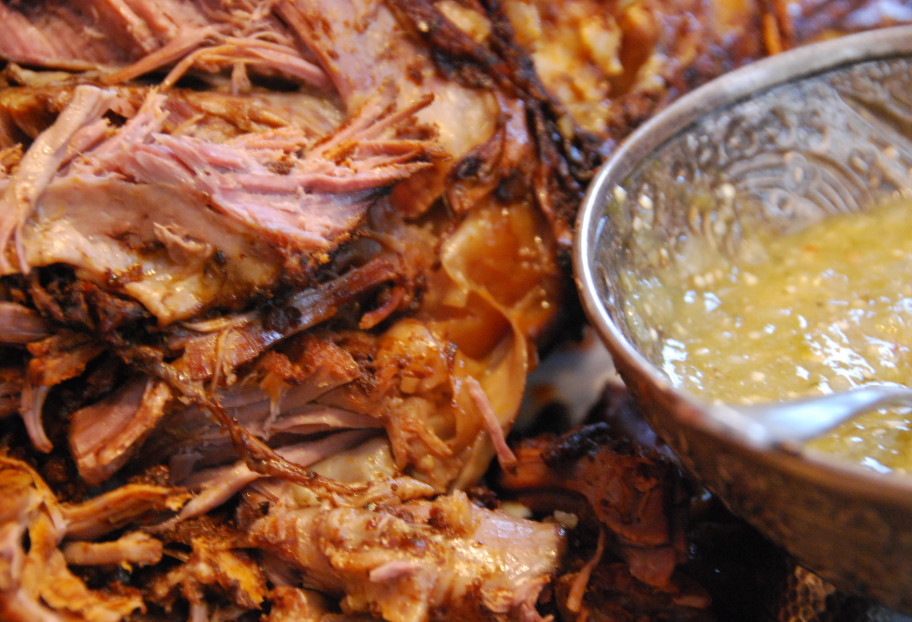
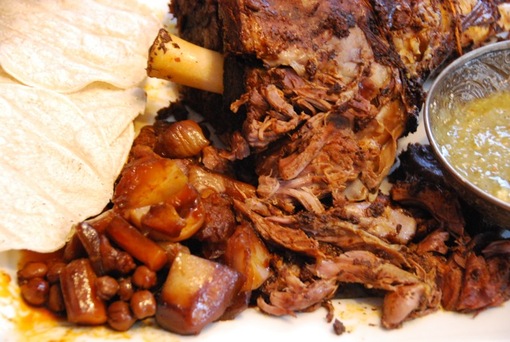
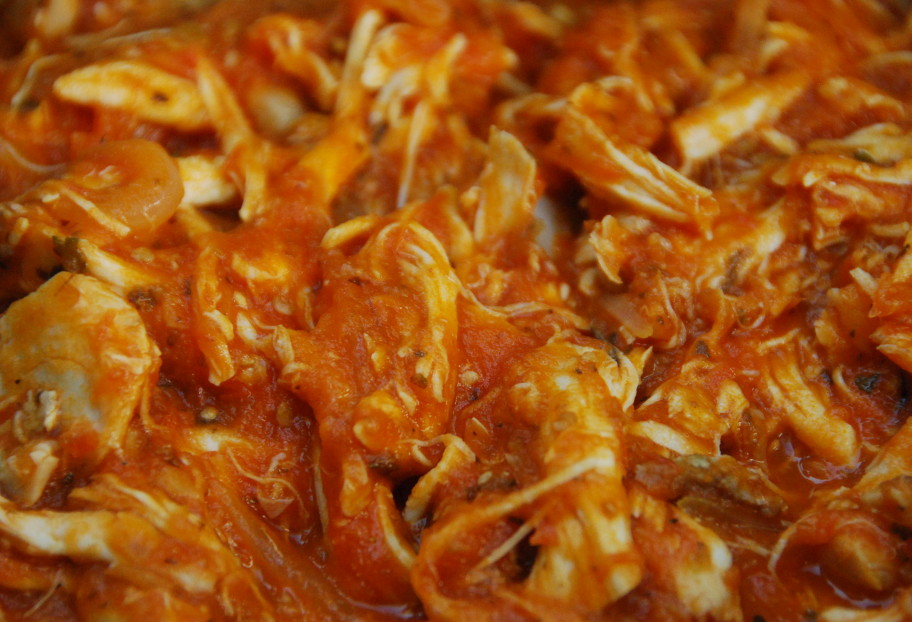
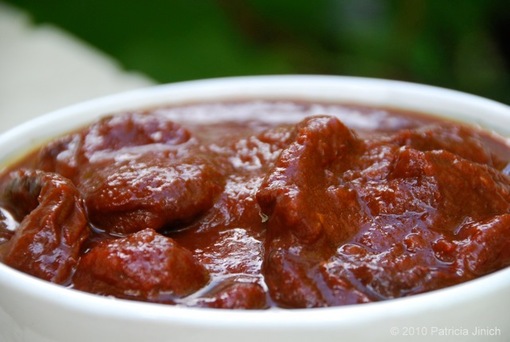
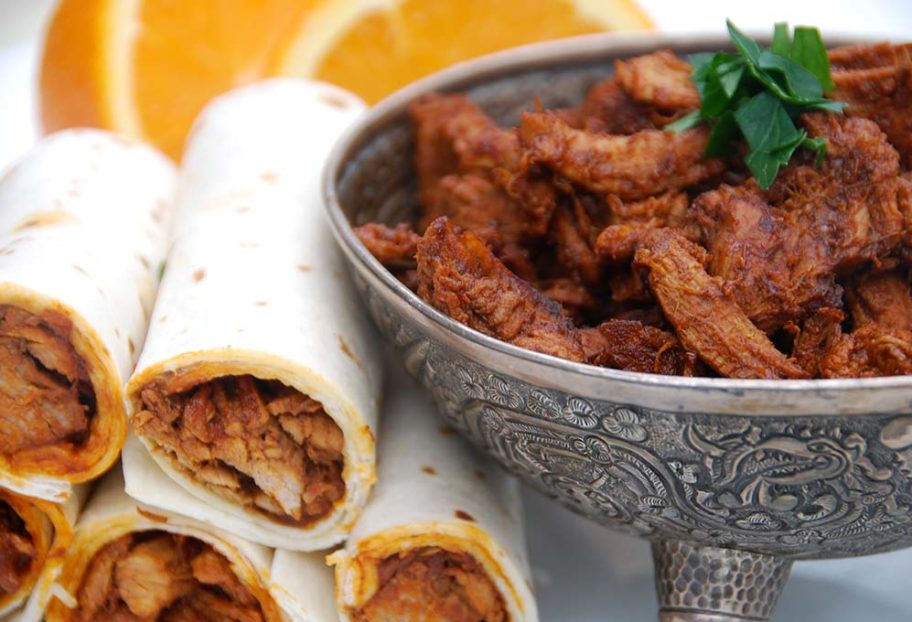
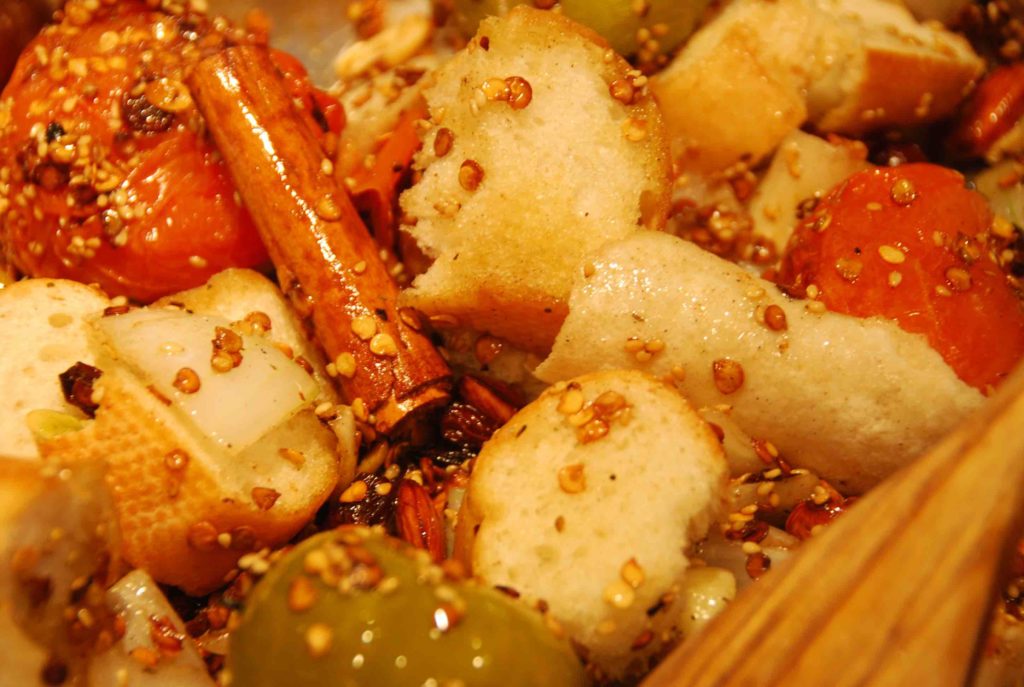
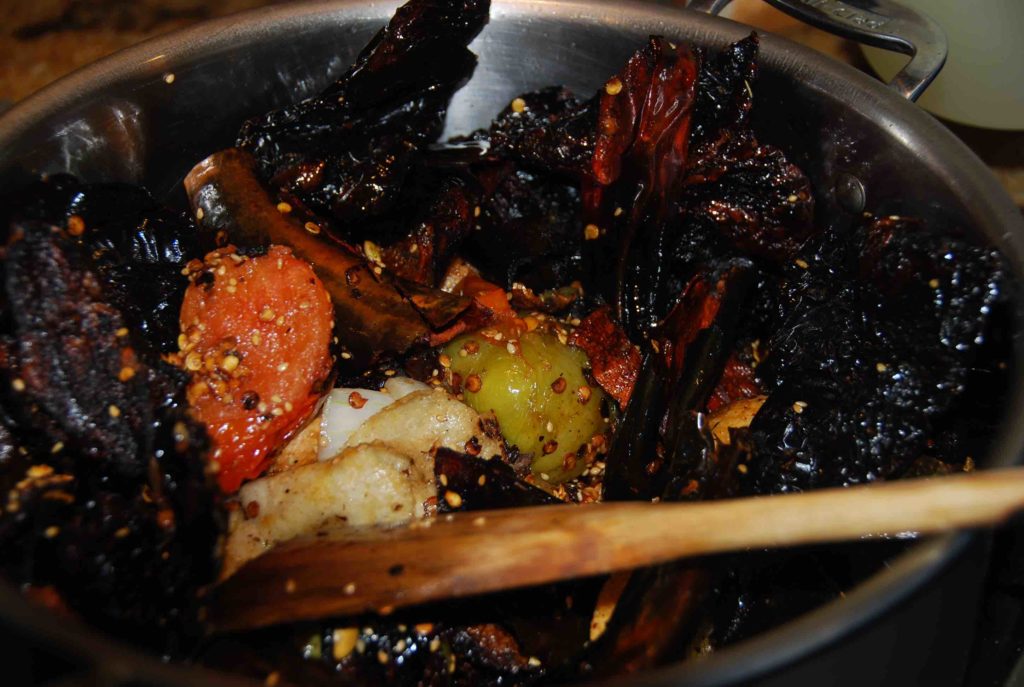
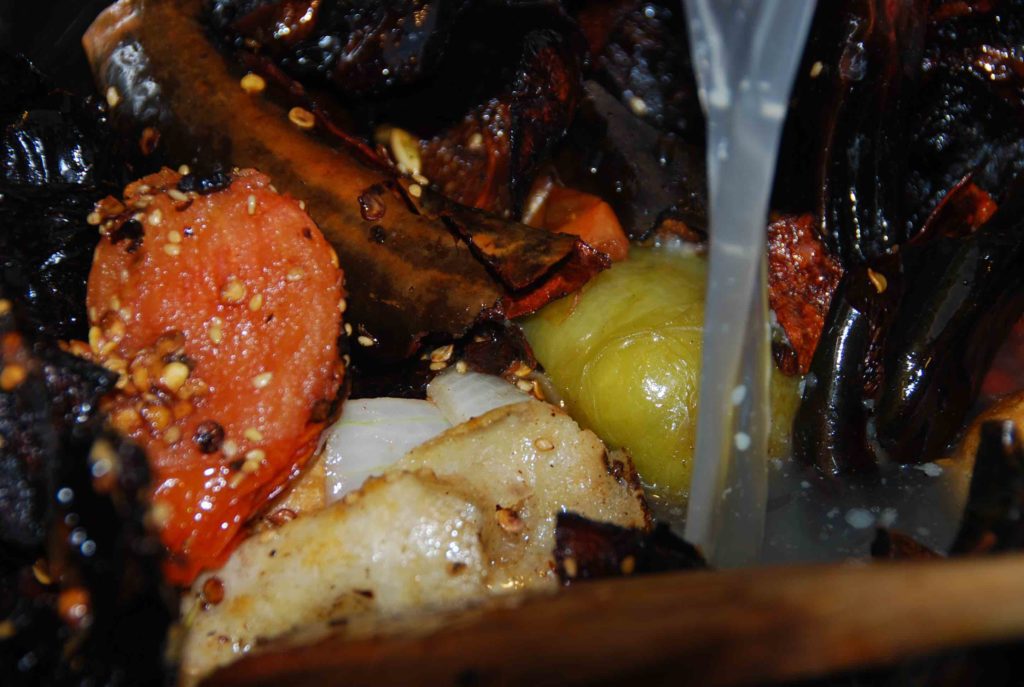
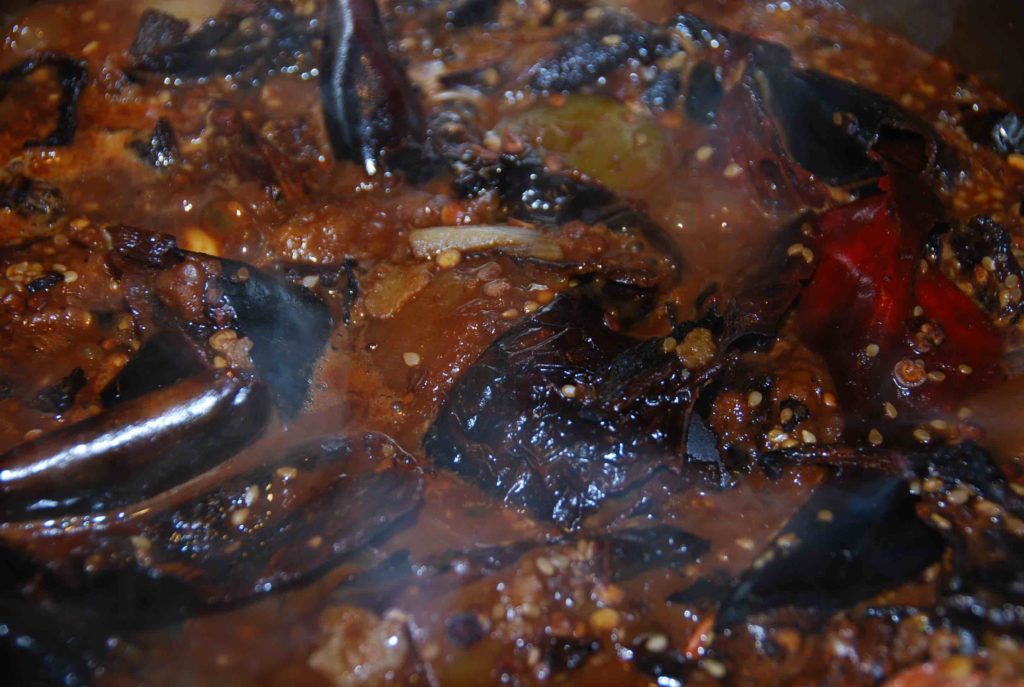
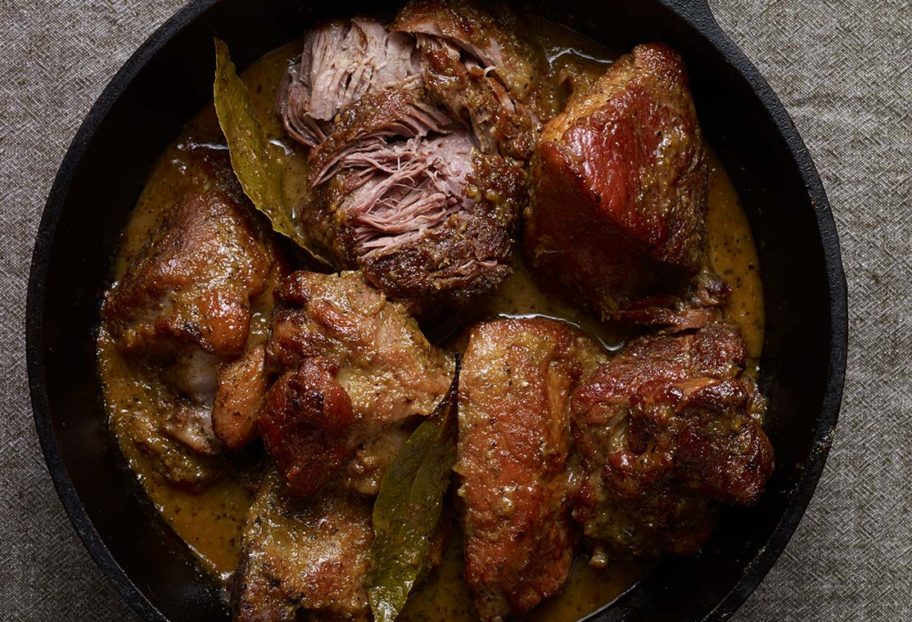
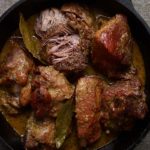
Carnitas

Print Recipe
4.89 from 18 votes

Carnitas

Carnitas recipe from Pati's Mexican Table Season 3, Episode 5 “Family Fiesta”
Prep Time10 minutes
Cook Time1 hour 50 minutes
Total Time2 hours
Course: Main Course
Cuisine: Mexican
Keyword: marjoram, onion, orange juice, pati's mexican table, pork, Sweetened Condensed Milk
Servings: 8 servings
Author: Pati Jinich

Ingredients

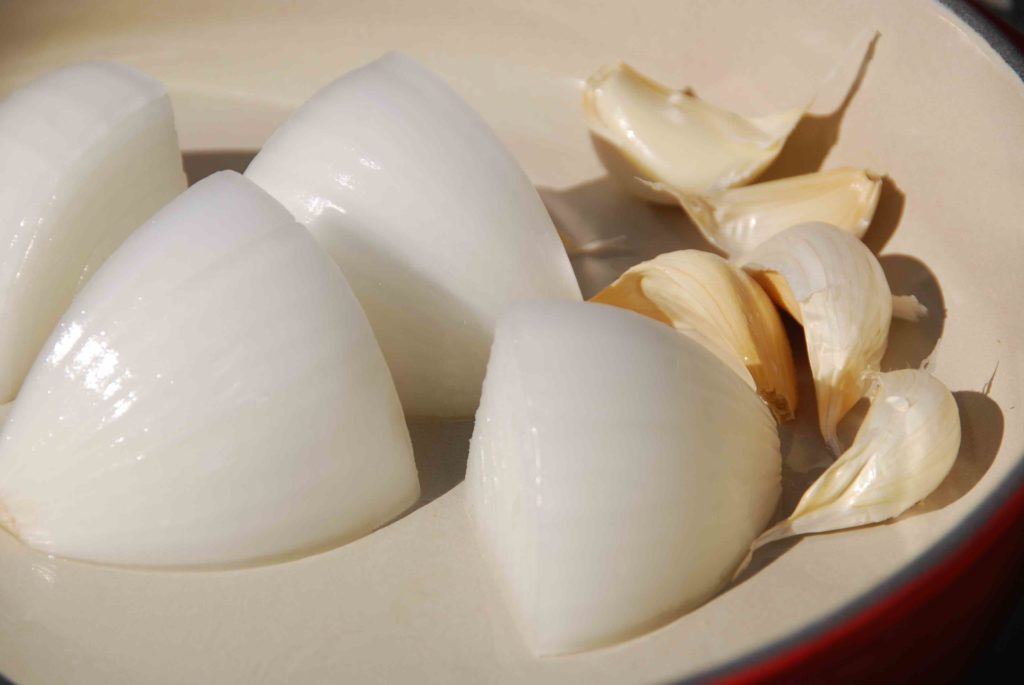
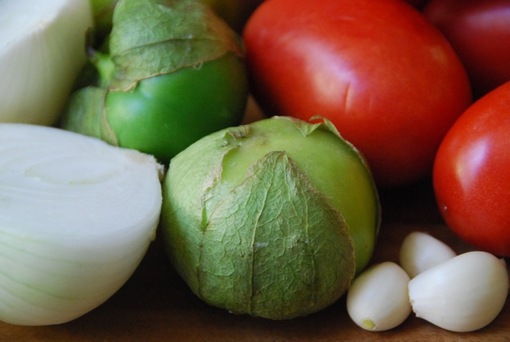
  • 1/2 a white onion peeled and coarsely chopped
  • 1 1/2 cups water
  • 6 cloves garlic
  • 1 teaspoon dried marjoram
  • 1 teaspoon dried thyme
  • 1 teaspoon freshly ground black pepper
  • Pinch cumin
  • 4 whole cloves stems removed
  • 1 tablespoon kosher or coarse sea salt or to taste
  • 1 tablespoon lard vegetable shortening or oil
  • 4 to 5 pounds boneless pork shoulder or butt cut into 4-inch chunks, fat on!
  • 1/2 teaspoon kosher or coarse sea salt
  • 2 bay leaves
  • 1 cup freshly squeezed orange juice
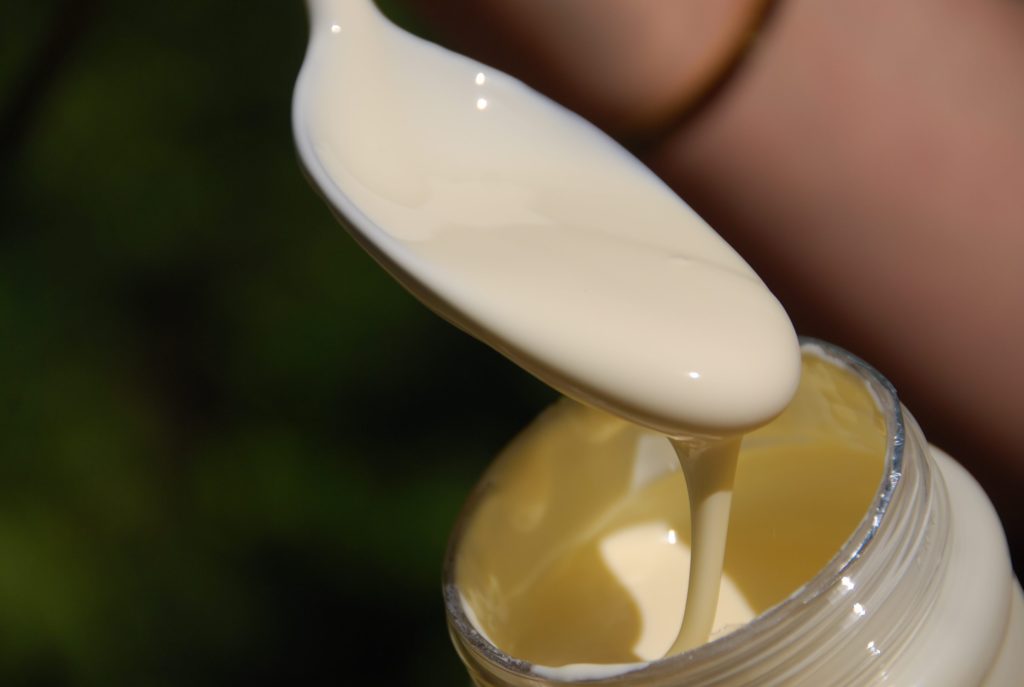
  • 2 tablespoons sweetened condensed milk

Instructions

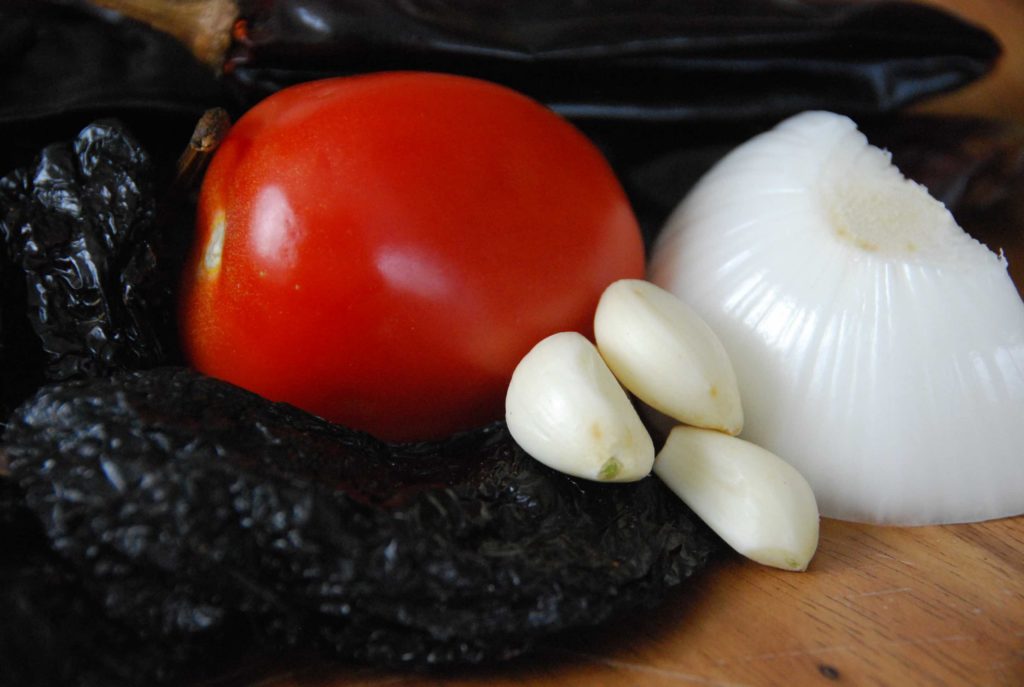
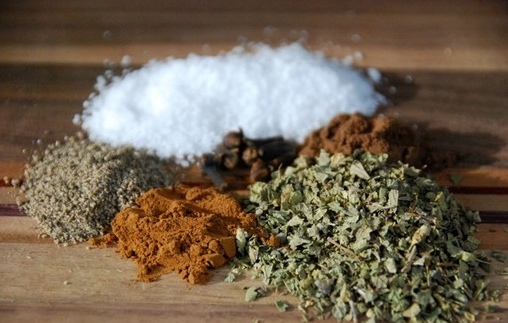
  • In the jar of a blender, place the water, onion, garlic cloves, marjoram, thyme, black pepper, cumin, stemmed whole cloves and 1 tablespoon salt. Puree until smooth.
  • Set a large Dutch oven or heavy casserole over medium-high heat. Add the lard (or vegetable shortening or oil), and once it has heated up, add the pork chunks and sprinkle in 1/2 teaspoon of salt. Brown the meat on all sides, stirring and flipping as each side browns, about 10 minutes.
  • Pour the onion mixture over the meat, let it come to a simmer and cook for 5 to 6 minutes. Pour in the orange juice and sweetened condensed milk, add the 2 bay leaves, and give it a good stir. Let it come to a simmer, then reduce heat to medium-low to low and cover.
  • Cook covered, stirring and scraping the bottom of the casserole 2 to 3 times along the way, until the meat is completely cooked and coming easily apart if you pull one piece, about one hour and a half. Remove the lid, cook for another 4 to 5 minutes. Scoop out the carnitas with a slotted spoon, leaving any fat behind, and serve in a bowl or platter. Shred with a fork, if desired, before tucking into tacos. Or do like we do, serve straight from the pot.
  • Serve with warm corn tortillas and pickled jalapeños or salsa verde cruda on the side.
Tuna Minilla Casserole

tuna minilla casserole pati jinich
Print Recipe
4.43 from 7 votes

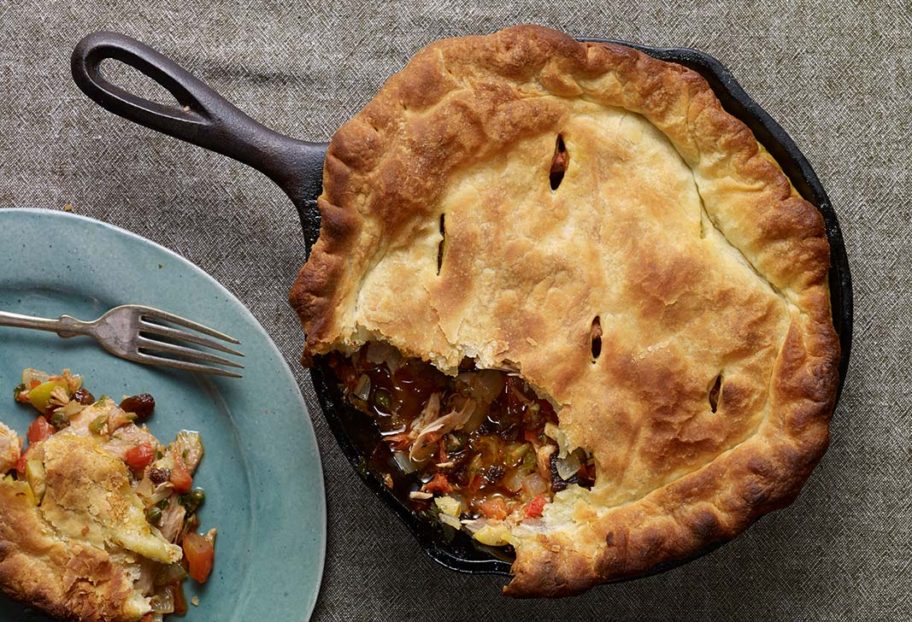
Tuna Minilla Casserole

Tuna Minilla Casserole recipe from Pati's Mexican Table Season 3, Episode 4 “Meals in a Minute”
Prep Time10 minutes
Cook Time55 minutes
Total Time1 hour 5 minutes
Course: Main Course
Cuisine: Mexican
Keyword: capers, Casserole, olives, onion, pati's mexican table, Pickled Jalapeños, puff pastry, raisins, Tomatoes, tuna
Servings: 8 to 10 servings
Author: Pati Jinich

Ingredients

  • 1/4 cup vegetable oil
  • 3/4 cup chopped white onion
  • 1 garlic clove finely chopped
  • 1 1/2 pounds (about 6) ripe Roma tomatoes chopped
  • 2 7-ounce cans tuna drained and shredded
  • 2 bay leaves
  • 1 teaspoon brown sugar
  • 1/2 teaspoon dried oregano
  • 1/2 teaspoon dried thyme
  • 1/2 teaspoon kosher or coarse sea salt or to taste
  • 1/4 cup roughly chopped raisins
  • 1/4 cup manzanilla olives stuffed with pimientos roughly chopped
  • 1/4 cup pickled jalapeño chiles store-bought or homemade, seeded and roughly chopped
  • 1 tablespoon capers
  • 3 tablespoons Italian or flat-leaf parsley chopped
  • 1 1.2-pound package frozen puff pastry thawed, or homemade puff pastry
  • all-purpose flour for rolling out the puff pastry
  • 1 egg optional
  • 2 tablespoons water optional

Instructions

  • In a large skillet, heat the oil over medium heat. Once hot, but not smoking, stir in the onion and cook until it is soft and translucent, about 5 minutes. Add the garlic, stir, and cook until fragrant, about 1 minute. Stir in the chopped tomatoes and cook, stirring often, until completely cooked, softened and mashed-up and pasty looking, about 15 minutes.
  • Toss in the tuna, and with a spatula or wooden spoon, mix it well with the tomato mixture, making sure there are no big chunks. Add the bay leaves, brown sugar, oregano, thyme, salt and mix well. Add the raisins, olives, pickled jalapenos, capers, fresh parsley and mix well. Cover the skillet and reduce the heat to medium low. Cook for about 10 minutes, the mixture should be very moist but not watery. Taste for salt and add more if needed. Remove the bay leaves and set aside.
  • Preheat oven to 425°F.
  • Lightly flour a rolling pin and roll out 1 thawed sheet of pastry about 1/8-inch thick to line the bottom and sides of a round baking dish (you may wish to add a pastry sheet in the bottom and top of the casserole, or only on the top!). Add the tuna filling to the puff pastry lined baking dish, using a rubber spatula to evenly spread the filling. Roll out another thawed sheet of pastry and use to cover the tuna filling – pinching the edges of the 2 sheets of pastry together to seal.
  • Optional: In a small mixing bowl, beat the egg along with the water. Brush the top of the casserole with the egg wash.
  • Cut 4 to 5 vents on the top. Place the casserole in the oven and bake for about 20 minutes, until crisp, puffed up and golden brown.

Notes

Cazuela de Minilla de Atún

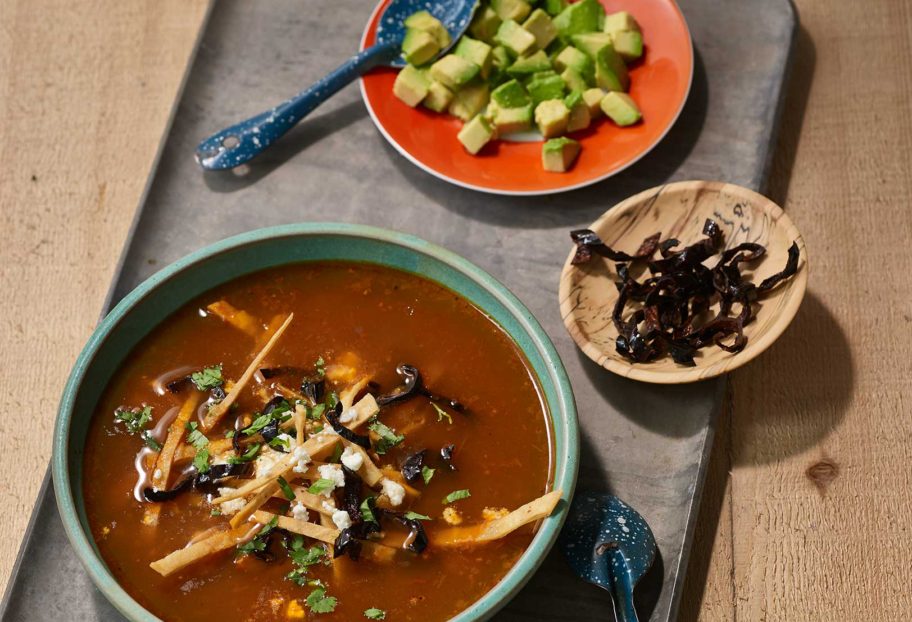
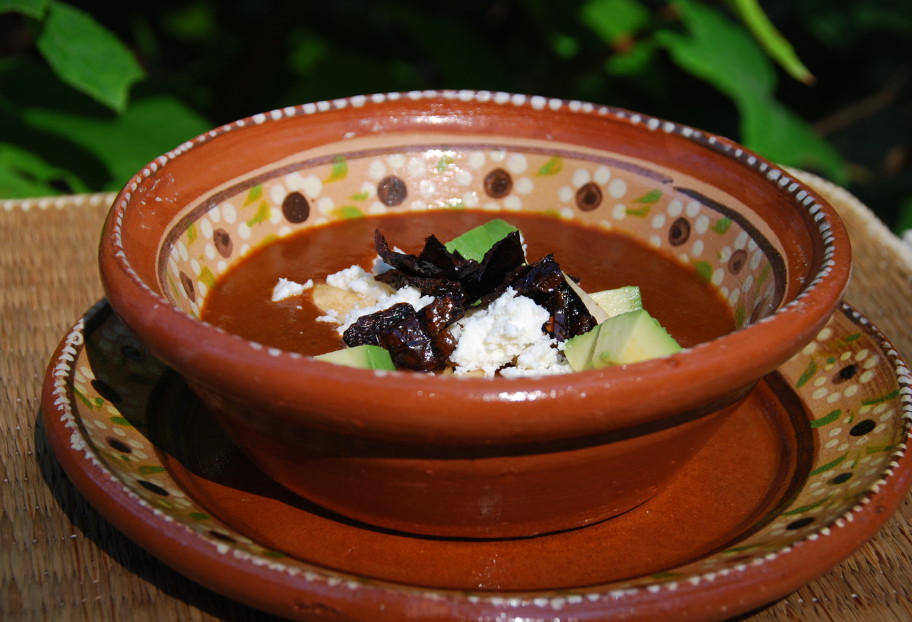
Tortilla Soup

Print Recipe
4.37 from 11 votes

Tortilla Soup

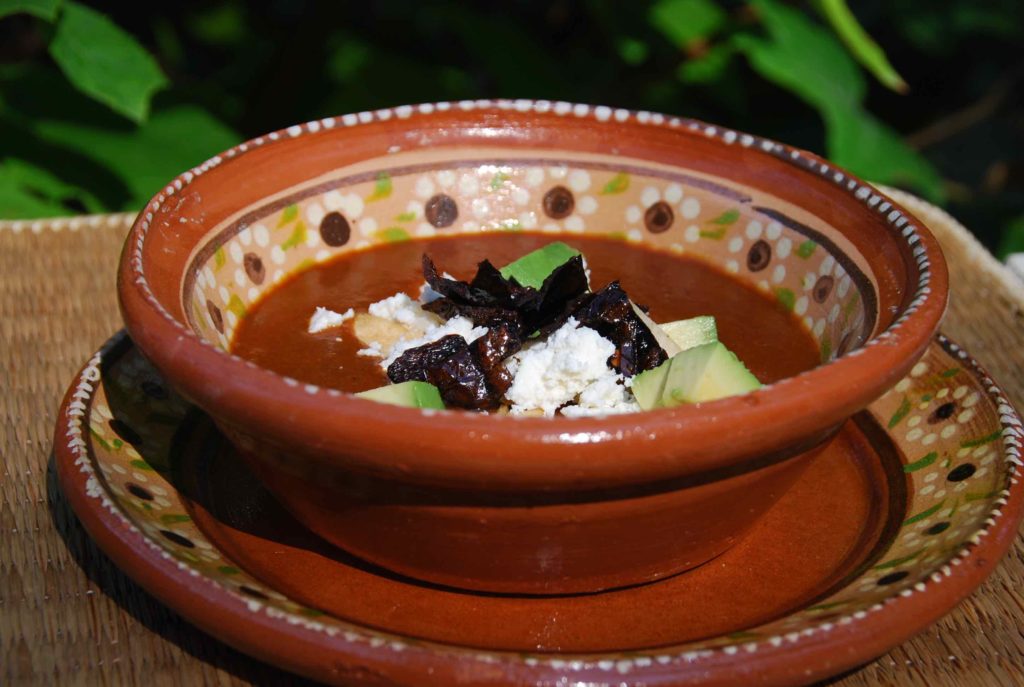
Tortilla Soup recipe from Pati's Mexican Table Season 3, Episode 4 “Meals in a Minute”
Prep Time20 minutes
Cook Time25 minutes
Total Time45 minutes
Course: Soup
Cuisine: Mexican
Keyword: ancho chiles, Avocado, chicken broth, guajillo chiles, mexican crema, onion, pasilla, pati's mexican table, queso fresco, Tomatoes, tortilla chips
Servings: 6 servings
Author: Pati Jinich

Ingredients

  • 3 guajillo chiles stemmed and seeded
  • 1 pound ripe tomatoes
  • 1 clove garlic
  • 1/2 cup roughly chopped white onion
  • 1/2 teaspoon kosher or coarse sea salt or to taste
  • 2 tablespoons vegetable oil
  • 6 cups chicken broth
  • 1 sprig fresh parsley
  • 12 corn tortillas cut into 1- to 2-inch strips
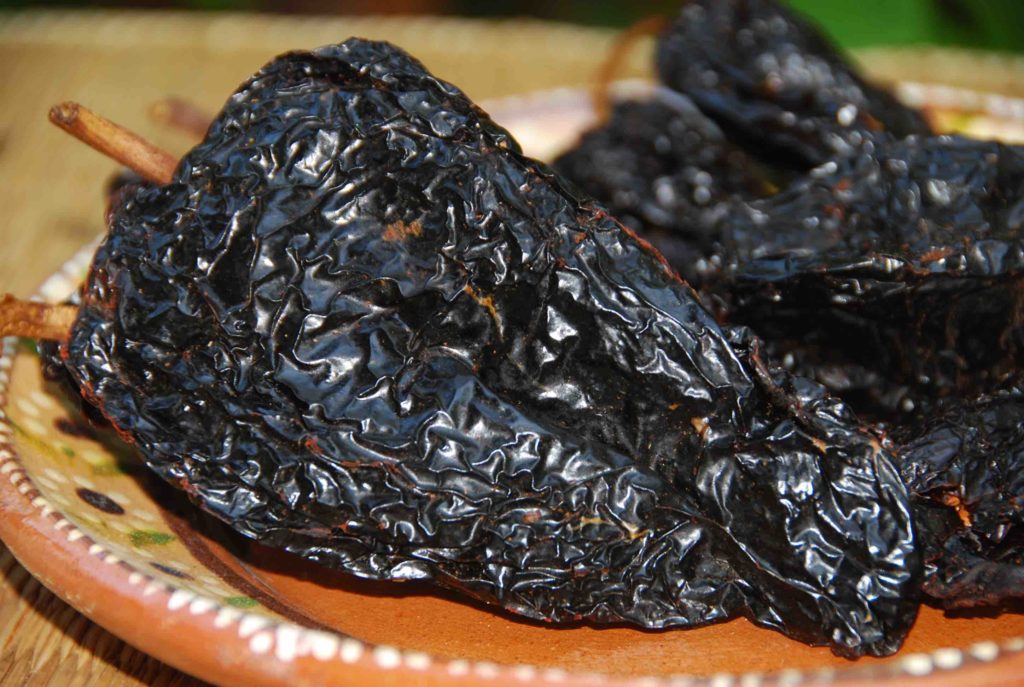
  • 1 ancho or pasilla chile stemmed, seeded, cut into 1-inch strips and quickly fried (optional, for garnish)
  • vegetable oil for frying
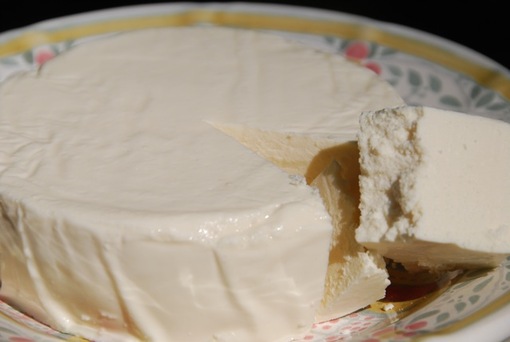
  • 8 ounces queso fresco diced
  • 1/2 cup Mexican style cream crème fraiche or sour cream
  • 1 ripe Mexican avocado halved, pitted, meat scooped out and diced

Instructions

  • Set a comal or skillet over medium heat. Once it is hot, toast the guajillo chiles for about a minute per side.
  • In a medium saucepan, place the toasted guajillos, tomatoes, and garlic clove and cover with water. Place over medium-high heat and bring to a boil. Reduce heat to medium and simmer anywhere from 12 to 15 minutes, until tomatoes are fully cooked and mushy, and the guajillos have rehydrated and plumped up.
  • Place the guajillos, tomatoes, garlic and onion in a blender, along with 1 cup of the simmering liquid and salt. Puree until completely smooth.
  • In a large soup pot, heat the 2 tablespoons oil over medium-high heat. Once hot, but not smoking, pour in the tomato puree. It will sizzle, make noise and smoke. Partially cover with a lid, if you need to. Let the puree cook, season and thicken, changing from a bright red to a darker red and thicker consistency, for about 12 minutes, stirring occasionally. Pour in the chicken broth, add the parsley sprig and once it comes to a simmer, continue simmering for another 10 minutes. Before serving, remove the parsley sprig.
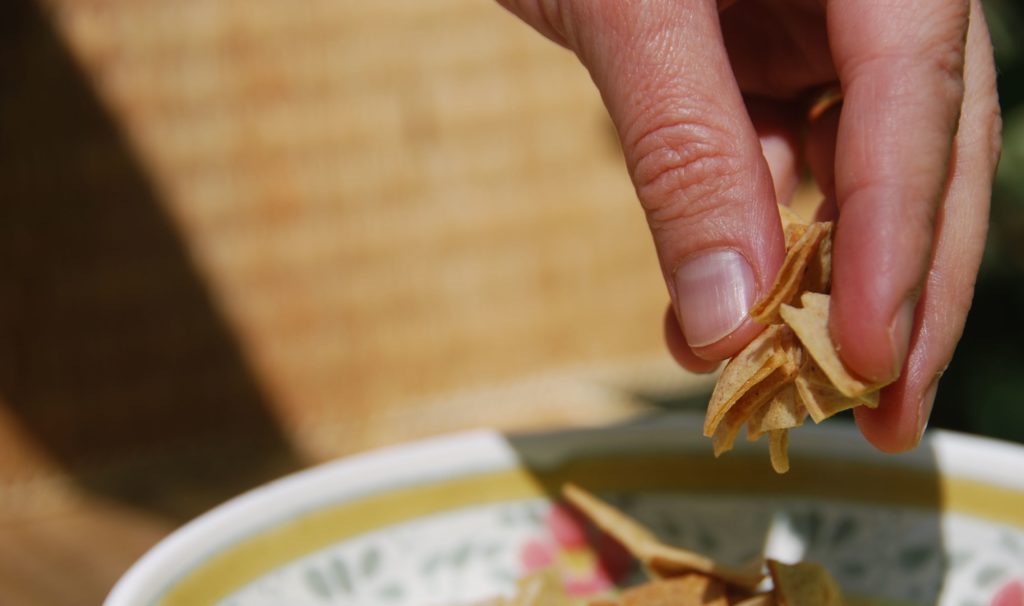
  • To prepare the garnishes: Fry or bake the tortilla strips. Flash fry the ancho or pasilla chile strips, literally 5 seconds in already hot oil in a skillet set over medium heat, drain in a paper towel.
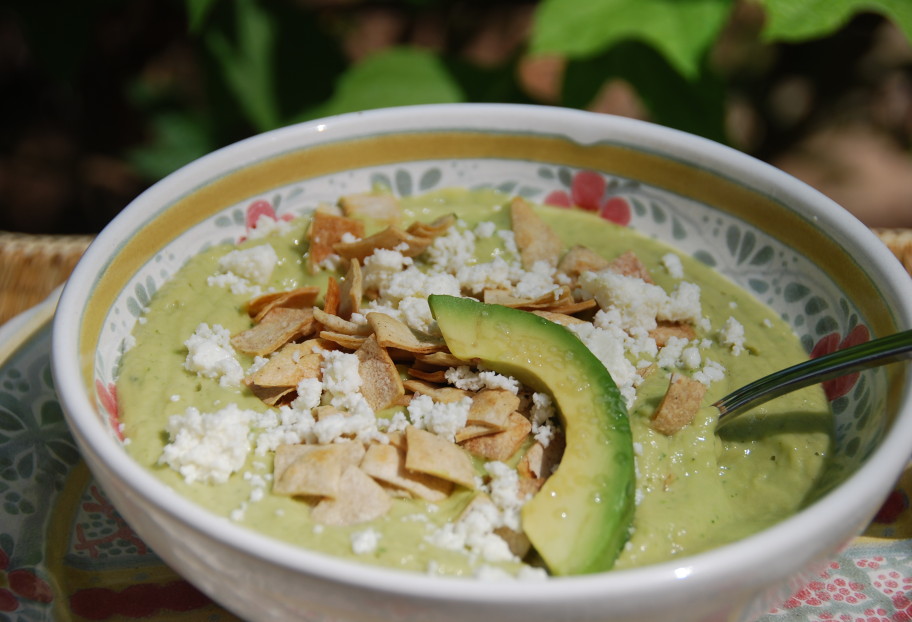
  • Serve in soup bowls. Add a handful of tortilla crisps, and let people decide how much cream, queso fresco, chile crisps and avocado to add to their bowls. Or, if you don’t want to give anyone a choice, place all the garnishes in the soup plates, and pour the hot soup into the bowls at the table.

Notes

Sopa de Tortilla

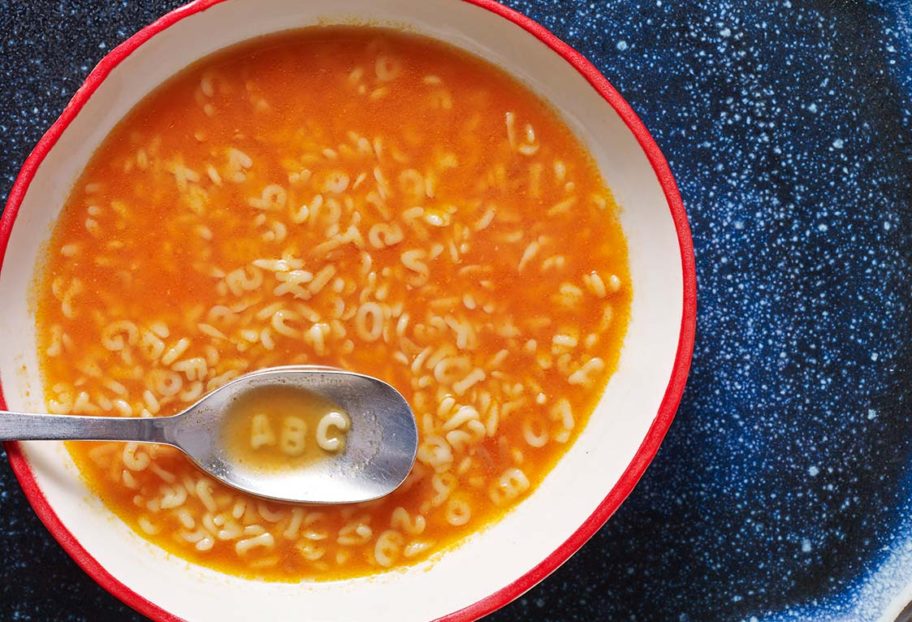
Alphabet Soup

Print Recipe
4.08 from 13 votes

Alphabet Soup

Alphabet Soup recipe from Pati's Mexican Table Season 3, Episode 3 “My Three Favorite Boys”
Prep Time5 minutes
Cook Time18 minutes
Total Time23 minutes
Course: Soup
Cuisine: Mexican
Keyword: chicken broth, fideo, onion, pasta, pati's mexican table, Tomatoes
Servings: 6 servings
Author: Pati Jinich

Ingredients

  • 1 1/2 pounds fresh ripe tomatoes quartered, or whole canned tomatoes, drained
  • 1 garlic clove peeled
  • 1/4 cup coarsely chopped white onion
  • 1 cup water
  • 3 tablespoons vegetable oil
  • 2 cups alphabet-shaped pasta or any other small-shaped pasta, 12 ounces
  • 1 teaspoon kosher or coarse sea salt or to taste
  • 8 cups chicken or vegetable broth

Instructions

  • Place the tomatoes, garlic, onion and water in a blender or food processor. Puree until smooth.
  • Heat the oil in a large soup pot over medium-high heat. When the oil is hot, but not smoking, add the pasta, stirring continuously. As you fry the pasta, it will change in color from a deep white to a deep brown. Take care not to burn it! You want to cook it until it smells toasty, but not bitter like burned toast, about 2 to 3 minutes.
  • Pour the tomato puree over the pasta, sprinkle in the salt, and stir. Be careful, as the puree will want to jump all over your burners, it’s a good idea to cover it partially with a lid. Let the tomato base cook and thicken for about 6 minutes, stirring often, until it becomes a deeper red and has thickened to the consistency of a thick puree. Keep on stirring, so the pasta doesn’t stick to the bottom of the pot. You will see the base of the pot as you stir, but the sauce will not be dried out. Cooking the tomato puree to this point will give the soup a really nice depth of flavor.
  • Pour in the broth, stir, and when it comes to a boil, reduce the heat to medium and simmer for another 10 minutes. Taste for seasoning and serve.

Notes

Sopa de Letras

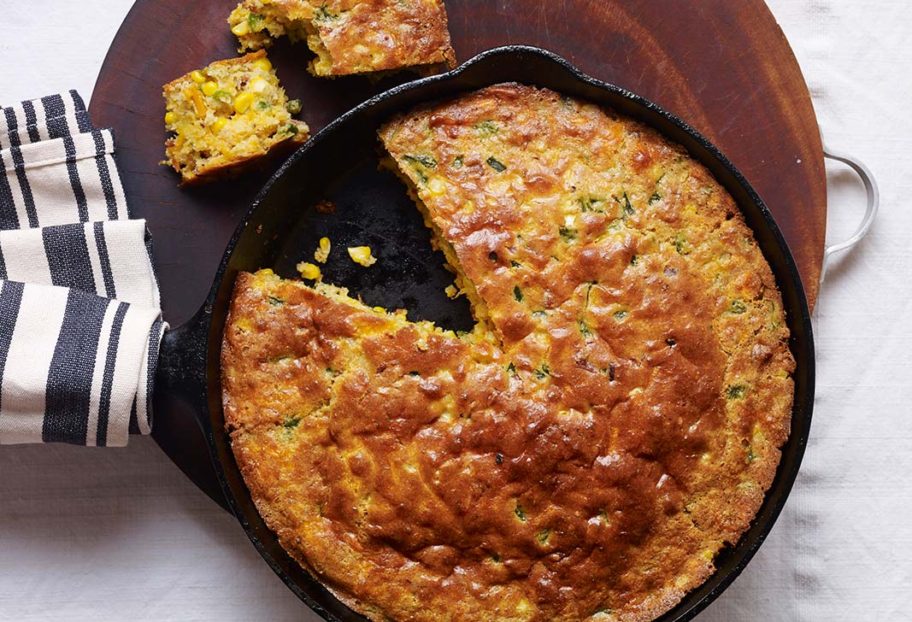
Poblano, Bacon and Cheddar Skillet Cornbread

Print Recipe
4.34 from 9 votes

Poblano, Bacon and Cheddar Skillet Cornbread

Poblano, Bacon and Cheddar Skillet Cornbread recipe from Pati's Mexican Table Season 3, Episode 2 “Pati’s Texican”
Prep Time15 minutes
Cook Time30 minutes
Total Time45 minutes
Course: Side Dish
Cuisine: American, Mexican
Keyword: bacon, cheddar, Corn, corn bread, pati's mexican table, Poblano
Servings: 10 servings
Author: Pati Jinich

Ingredients

  • 3 poblano chiles charred, sweated, peeled, seeded and diced
  • 6 to 8 slices center cut bacon
  • 1/2 cup yellow cornmeal
  • 1 1/4 cup all-purpose flour
  • 1/3 cup brown sugar
  • 1 teaspoon baking powder
  • 1 teaspoon baking soda
  • 1/2 teaspoon kosher or coarse sea salt
  • 1/2 teaspoon freshly ground black pepper
  • 1 cup whole milk
  • 1/2 cup heavy cream
  • 4 eggs well beaten
  • 2 cups grated cheddar cheese
  • 2 cups corn kernels preferably fresh, or thawed from frozen

Instructions

  • Preheat the oven to 375°F.
  • In a large cast-iron pan, over medium-high heat, add the bacon. Cook until crispy, about 3 minutes per side. Remove the bacon from the pan and turn off the heat.
  • In a large bowl, combine the cornmeal, flour, brown sugar, baking powder, baking soda, salt and pepper. In a small bowl, combine the milk, cream and eggs. Whisk the wet ingredients into the dry. Add the cheddar cheese, corn and poblano chiles. Crumble the bacon and toss it in. Pour in most of the bacon fat from the cast-iron pan into the batter, leaving about 1 tablespoon in the pan. Mix well.
  • Place the cast-iron pan with the remaining bacon drippings again over medium heat, pour the batter into the pan. Transfer to the oven and bake for 30 minutes or until golden brown. Cut into wedges and serve.

Notes

Pan de Elote de Cazuela con Poblanos, Tocino y Queso Cheddar

Tex-Mex Chili

tex mex chili pati jinich
Print Recipe
4.67 from 15 votes

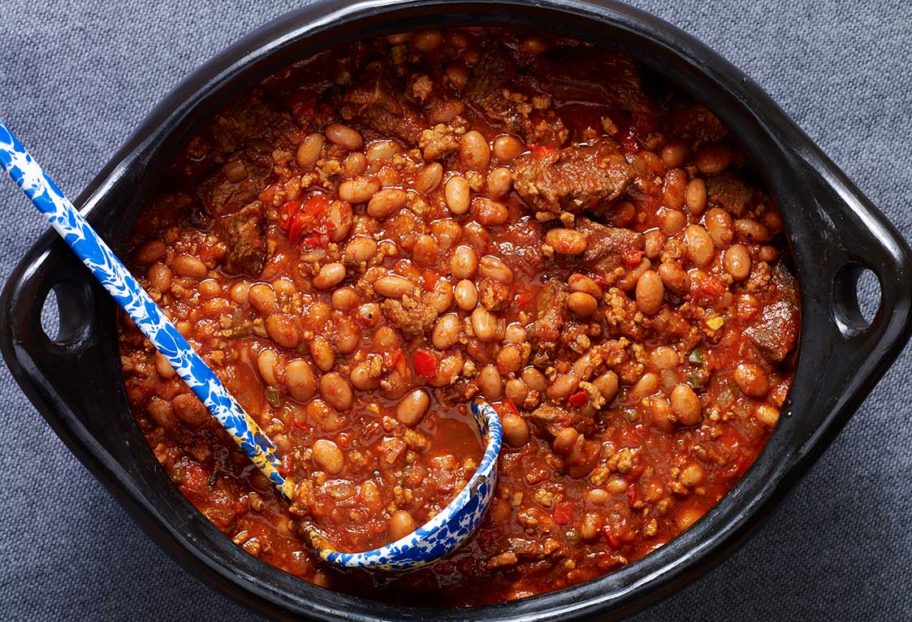
Tex-Mex Chili

Tex-Mex Chili recipe from Pati's Mexican Table Season 3, Episode 2 “Pati’s Texican”
Prep Time10 minutes
Cook Time1 hour 15 minutes
Total Time1 hour 25 minutes
Course: Main Course
Cuisine: American, Mexican
Keyword: beans, beef, bell peppers, cayenne pepper, chili, chipotles in adobo, ground beef, jalapeno, onion, pati's mexican table, pinto beans, pork
Servings: 8 servings
Author: Pati Jinich

Ingredients

  • 3 tablespoons vegetable oil plus one tablespoon set aside
  • 1 pound beef stew meat cubed into 1-inch chunks
  • 1 pound ground pork or beef
  • 1 teaspoon kosher or coarse sea salt or more to taste
  • 1/4 teaspoon freshly ground black pepper or more to taste
  • 1 white onion chopped
  • 1 red bell pepper chopped
  • 1 tablespoon chopped jalapeño seeding optional
  • 4 cloves garlic finely chopped
  • 1/2 teaspoon crushed red pepper flakes
  • 1/2 teaspoon cayenne pepper
  • 1/2 teaspoon paprika
  • 1 teaspoon Chili powder such as ancho or chipotle chile powder
  • 1 tablespoon chipotle chiles in adobo sauce or more to taste
  • 1/2 teaspoon cumin
  • 1 teaspoon dried oregano
  • 1 tablespoon tomato paste
  • 1 28- ounce can crushed tomatoes
  • 1 tablespoon dark brown sugar
  • 1 tablespoon distilled white vinegar
  • 4 cups beef stock
  • 2 15-ounce cans pinto beans drained and rinsed (or about 4 cups homemade)

To garnish:

  • sour cream
  • Chopped fresh cilantro
  • Shredded cheddar cheese
  • Tortilla chips
  • Green onions sliced thin

Instructions

  • In a Dutch oven or heavy bottom casserole, heat 3 tablespoons oil over medium-high heat. Add the beef, and begin to brown on all sides. After 2 to 3 minutes, add the ground meat, sprinkle with salt and pepper, and let it brown along with the cubed meat for another 5 to 6 minutes. The juices of the ground meat should have come out and then dry out. Stir as the meat browns.
  • Make room in the center of the pan, add the extra tablespoon of oil and add the onions and peppers, cook for 5 more minutes or until they begin to soften. Make some room in the casserole again, add the garlic, red pepper flakes, cayenne, paprika, chili powder, chipotle sauce, cumin, oregano, stir well.
  • Add the crushed tomatoes, tomato paste, sugar and vinegar, mix well and cook for 3 to 4 minutes stirring a couple times. The tomato paste should have dissolved and the sauce thickened a bit. Pour in the beef stock and once it comes to a strong simmer, reduce heat to medium. Add the beans and stir. Lower the heat to medium-low, it should have a low steady simmer, and cook uncovered for an hour, stir every once in awhile.
  • Serve the chili in bowls and let your guests garnish with sour cream, cilantro, shredded cheddar cheese, tortilla chips and green onions.

Notes

Chili Tex-Mex

Mexican Rice with Prawns

Print Recipe
4.80 from 5 votes

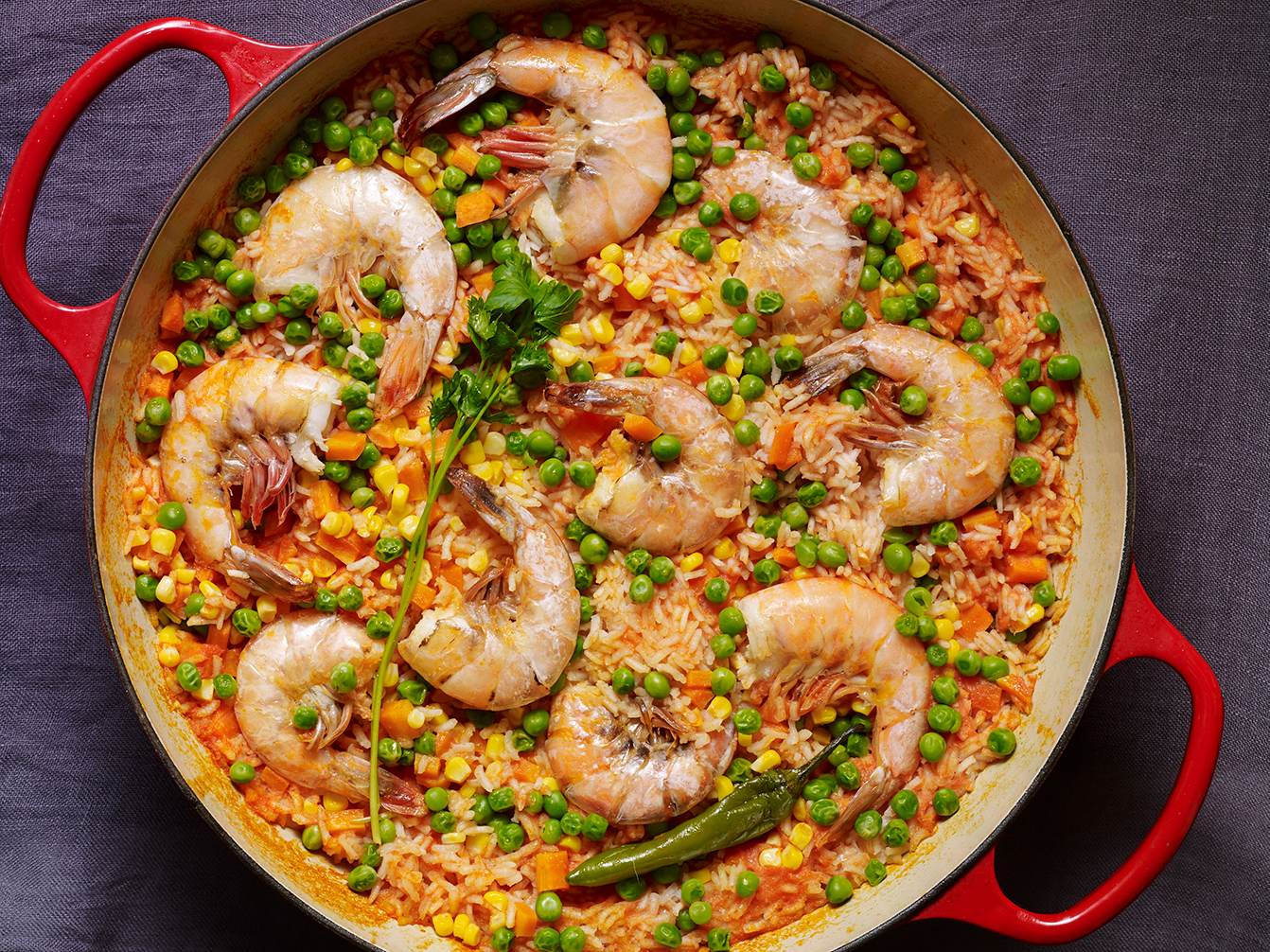
Mexican Rice with Prawns

Mexican Rice with Prawns recipe from Pati's Mexican Table Season 3, Episode 1 “Born in The Kitchen”
Prep Time15 minutes
Cook Time20 minutes
Total Time35 minutes
Course: Main Course
Cuisine: Mexican
Keyword: carrots, Corn, jalapeno, Mexican rice, onion, pati's mexican table, peas, rice, serrano chiles, Shrimp, Tomatoes
Servings: 6 to 8 servings
Author: Pati Jinich

Ingredients

  • 2 cups white rice or jasmine rice
  • 1 pound ripe tomatoes quartered
  • 1/3 cup roughly chopped white onion
  • 2 cloves garlic
  • 1 teaspoon kosher or coarse sea salt or to taste
  • 3 tablespoons vegetable oil
  • 3 cups chicken or vegetable broth or enough to make 4total liquid including the strained tomato puree, see step 2 below
  • 2 sprigs fresh parsley
  • 3/4 cup peeled and diced carrots optional
  • 1/2 cup shelled green peas fresh or frozen (optional)
  • 1/2 cup corn kernels fresh or frozen (optional)
  • 1 whole jalapeño or serrano chile optional
  • 6 to 8 head-on prawns
  • Half a lime optional

Instructions

  • Place rice in a bowl, cover with hot water, and soak for about 5 minutes. Strain and rinse under cold running water until the water runs clear; drain well. If you don’t have time to soak and drain the rice, you can skip this step…
  • In a blender or food processor, puree the tomatoes along with the onion, garlic and salt until thoroughly smooth. Pass through a strainer into a measuring cup and reserve. In another measuring cup, add enough chicken broth to make altogether 4 cups of liquid, but keep the 2 measuring cups separate.
  • Heat the oil in a medium saucepan or casserole, over medium-high heat until hot but not smoking. Add the drained rice and cook, stirring often, until the rice becomes milky white and feels heavy in the pan as you stir, about 3 to 4 minutes.
  • Pour in the strained tomato puree, mix gently and cook until the color of the puree darkens, thickens, and is mostly absorbed, about 3 to 4 more minutes. Stir in the pre-measured chicken broth and add the parsley, carrots, peas, corn and whole chile, if using.
  • Bring to a rolling boil, reduce heat, add the prawns, squeeze the juice of half a lime all over if using, cover, and reduce heat to the lowest setting. Cook until most of the liquid has been absorbed, yet there is still some moisture in the pan. The rice should be cooked and tender; if not, but the liquid is totally absorbed, add a couple tablespoons of water, cover again, and continue to cook for a couple more minutes.
  • Remove from the heat and let the rice rest, covered, for at least 5 minutes before you fluff with a fork and serve.

Notes

Arroz Rojo con Langostinos

Shredded Flank Steak with Potatoes in Green Salsa

Print Recipe
4.43 from 7 votes

Shredded Flank Steak with Potatoes in Green Salsa

Shredded Flank Steak with Potatoes in Green Salsa recipe from Pati's Mexican Table Season 3, Episode 1 “Born in The Kitchen”
Prep Time10 minutes
Cook Time1 hour 45 minutes
Total Time1 hour 55 minutes
Course: Main Course
Cuisine: Mexican
Keyword: cilantro, corn tortillas, jalapeno, pati's mexican table, potatoes, serrano chiles, steak, stew, tomatillos
Servings: 6 servings
Author: Pati Jinich

Ingredients

  • 2 pounds flank steak cut into 3- to 4-inch chunks
  • 2 bay leaves
  • Half of a white onion
  • 3 garlic cloves peeled
  • 1 teaspoon kosher or coarse sea salt
  • 10 black peppercorns optional
  • 1 pound tomatillos husks removed and rinsed
  • 1 garlic clove peeled
  • 1 jalapeño or serrano chile or to taste
  • 1/3 cup coarsely chopped white onion
  • 1 cup cilantro leaves and top part of stems
  • 1/2 teaspoon kosher or coarse sea salt or more to taste
  • 2 tablespoons vegetable oil
  • 1 pound baby red potatoes if they are not so small, halved or quartered to be bite size

Instructions

  • Place meat in a soup pot or large, heavy pot along with the bay leaves, half an onion, 3 garlic cloves, 1 teaspoon salt and black peppercorns. Cover with water up to 2 inches above top of the meat. Bring to a boil over medium-high heat, reduce the heat to medium and simmer, partially covered, for 50 minutes to an hour, until the meat is thoroughly cooked and soft. Strain, reserving 3 cups of the meat cooking liquid. Once the meat has cooled enough to handle, shred it into pieces.
  • Place the tomatillos, 1 garlic clove and chiles in a saucepan and cover with water. Bring to a simmer over medium heat, and cook until the tomatillos have changed their color from bright green to pale green and are soft and thoroughly cooked but not coming apart, about 10 minutes. Drain and place in a blender or food processor, adding only one chile to begin. Add the onion, cilantro and salt to the blender and puree until smooth. Taste for heat, adding more chile until you have the desired amount of heat.
  • Heat the oil in a large casserole pan over medium heat. When the oil is hot but not smoking, pour the salsa into the pan, along with the potatoes and cook, partially covered, until the sauce thickens slightly, about 5 to 6 minutes. Toss in the shredded meat and pour in 2 cups of the meat cooking liquid. Stir and cook uncovered for about 25 minutes, or until the potatoes are completely cooked through and soft and the stew has thickened considerably. Add more cooking liquid if the sauce is thickening too much.
  • Serve with a side of warm corn tortillas.

Notes

Guisado de Carne en Salsa Verde

Potato, Sweet Potato and Granny Smith Latkes

A Mexican immigrant cooking Thanksgiving and Hanukkah on the same night in the cold Eastern region of the United States may sound a bit odd to some. For me, it turns out to be an unexpected opportunity to bring all my pieces together. Which has my mind reeling about the just as unexpected possibilities for the menu.

See… ever since I can remember, I have felt like I am treading between worlds. The Mexican. The Jewish. The immigrant in the U.S. Not from here, not from there. Yet, as time goes by, the different parts of my identity feel increasingly solid, in all those worlds and their intersections. It turns out that where those intersections make the most sense is in the kitchen.

I admit, though, that I am a hopeless romantic. That’s why every year when my husband asks what I want for my birthday, I say: the most passionate love letter, ever. Haven’t seen it, since he has seen me everyday in one way or another for the past 17 years. So, when my birthday comes close, I offer to pack my bags and leave, just to pretend… so he can write that super duper passionate love letter.

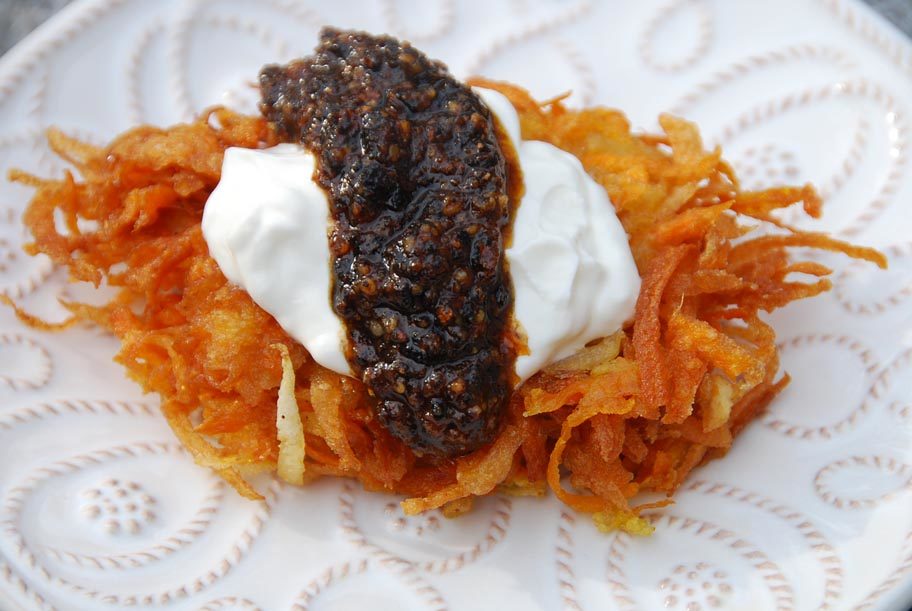
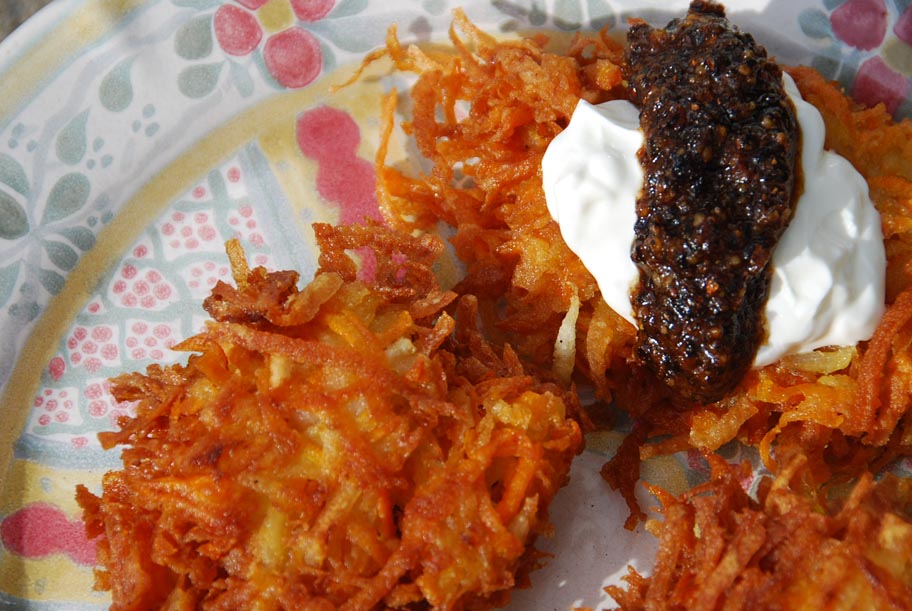
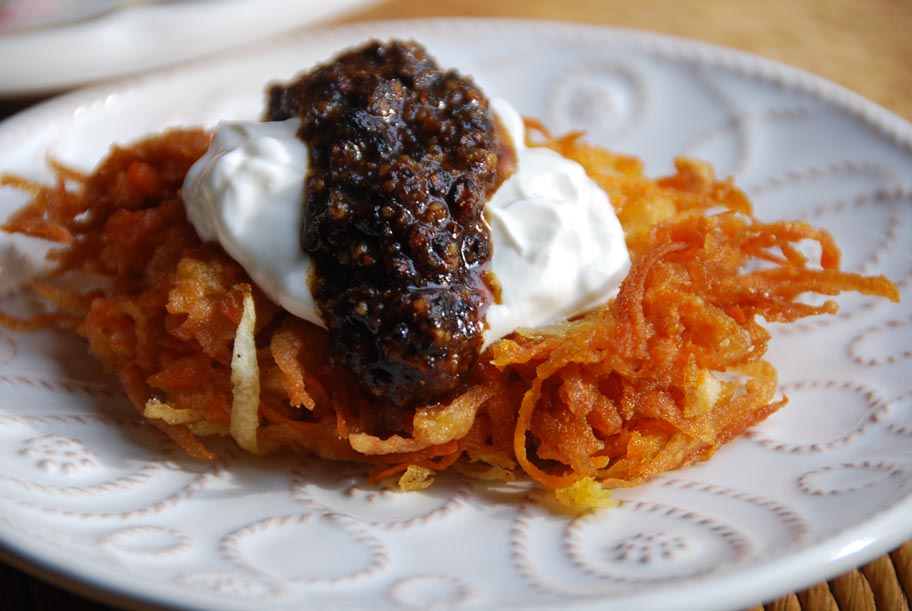
Potato, Sweet Potato and Granny Smith Latkes with Salsa Macha and Fennel Crema
That romantic nature of mine may be why little things mean a lot to me. Remember when 12/12/12 happened? I was wild about the beauty of the 1,2,1,2,1,2 pattern and the chances of that happening again being zero. Of course, realists immediately pointed out the fact that every single day in the calendar will never, ever, be repeated again. Yet, it is the highlighted uniqueness of the 1,2,1,2,1,2 pattern that brings us the opportunity to realize just how precious that day, and any other day, is.

No surprise, then, that I am beyond ecstatic about Hanukkah and Thanksgiving happening at the same time. The chances of that happening again are so few and far in between (the next time, in 2070, it will be pretty likely that neither I nor Daniel will be here, so that is another reason for getting to that love letter) that it allows us to see these holidays under a different perspective: an enhanced sense of light, an expanded feeling of gratitude, a new vision of  what sharing at the table can mean, a new chance to continue to build bridges, and what’s best, we can eat it all along the way.

One dish that I came up with, for this once in a lifetime meal, are these Potato, Sweet Potato and Granny Smith Latkes.

Potato, Sweet Potato and Granny Smith Latkes with Salsa Macha and Fennel Crema

It is a recipe that has no fuss. It lets these three ingredients shine through and, at the same time, complement each other with the help of a bit of ancho chile  powder and true cinnamon. You can choose to eat them just like that, on their own, or you can serve them with a thick, chunky, fresh and citrusy Fennel and Lime Crema or with this rustic and nutty Salsa Macha.

Here’s a thought: you can do what I do. Eat them on their own as I am cooking them, and then eat them with both the Crema and the Salsa Macha once they are at the table.

sweet potato and granny smith apple latkes
Print Recipe
4.20 from 5 votes

Potato, Sweet Potato and Granny Smith Latkes

One dish that I came up with, for this once in a lifetime meal, are these Potato, Sweet Potato and Granny Smith Latkes. It is a recipe that has no fuss. It lets these three ingredients shine through and, at the same time, complement each other with the help of a bit of ancho chile  powder and true cinnamon. You can choose to eat them just like that, on their own, or you can serve them with a thick, chunky, fresh and citrusy Fennel and Lime Crema or with this rustic and nutty Salsa Macha.
Prep Time15 minutes
Cook Time20 minutes
Keyword: Antojo, chile, Jewish Mexican, Potato, Recipe, Salsa, Vegetarian
Servings: 16 to 18 latkes
Author: Pati Jinich

Ingredients

  • 1 1/2 pounds russett potatoes about 2
  • 1 1/2 pounds sweet potatoes about 1
  • 1/2 pound Granny Smith apples about 1
  • 1/2 cup grated white onion about 1
  • 1 1/2 teaspoons kosher or sea salt
  • 2 large eggs well beaten
  • 1/2 teaspoon ancho chile powder preferably, but may substitute with another dried ground chile powder that you may have handy
  • Pinch ground ceylon or true cinnamon
  • 2 teaspoons baking powder
  • 1/4 cup all-purpose flour
  • Fennel & Lime Crema optional
  • Salsa Macha optional

Instructions

  • Wash and peel the potatoes, sweet potatoes, apple and onion and grate them, placing them as you go, into a large bowl filled halfway with ice water. After you are finished, let it all sit for a few minutes and thoroughly drain with a strainer. Wrap all the grated ingredients in cheesecloth or a clean kitchen towel and wring energetically, squeezing out as much liquid as you can.
  • Transfer to a bowl and combine with eggs, ancho chile powder, salt, cinnamon, baking powder and flour. Mix well.
  • Fill a large, heavy casserole or skillet with ½ inch of oil and place over medium-high heat. After 3 to 4 minutes, test the oil by adding a teaspoon of the mix. If it bubbles happily all around the edges, it is ready. Working in small batches, to not crowd the casserole, spoon latkes of about 3 tablespoons each into the hot oil. (I use large serving spoon or my hands and shape them in flattened ovals.)
  • Cook until the first side is crisp and golden brown, about 4 to 5 minutes, and flip to the other side, letting it crisp and brown as well, about 3 to 4 minutes. Transfer to a wire rack set over a baking sheet. Once you are finished, you may keep them warm in a 250-degree oven, or you may cover and reheat later on.

Notes

Tortitas de Papa, Camote y Manzana Verde

Bricklayer Tacos

A taco is a beautiful thing.

One of the most satisfying, versatile, exciting, and downright honest foods I can think of.

Plus, there is no need or mood a taco can’t tackle.

You are hungry and have but one peso in your pocket? Eat a Taco de Nada. You pass a tortillería on your way home? A Taco de Sal will hold you off until you get there. A deep hangover ails you? Go for Tacos de Barbacoa with Salsa Borracha. Did you say you have a broken heart? A pair of fully stocked Tacos al Pastor will be your most effective rebound. You are home with a cold? Soft chicken tacos dipped in fresh crema will make you all better, no doubt about that. Need to feed your teen kid and his buddies before they head out? Crispy Potato and Chorizo Tacos dressed with shredded lettuce, crumbled queso fresco and Salsa Verde will make them happy and fill them up. It’s lunchtime and you are on the road? If you are in Mexico (or somewhere with a large Mexican community), you will find someone with a huge basket selling Tacos Sudados to go. Planning a backyard party? Tacos de Carnitas will kick it off, without you even saying a word.

I could write an endless post on all sorts of tacos and all they can do for you… But, if you want to feed your family a generous, satiating, and super tasty weeknight meal, make them bricklayer tacos. Step by step instructions follow below. But as I cook, let me quickly reflect on The Taco.

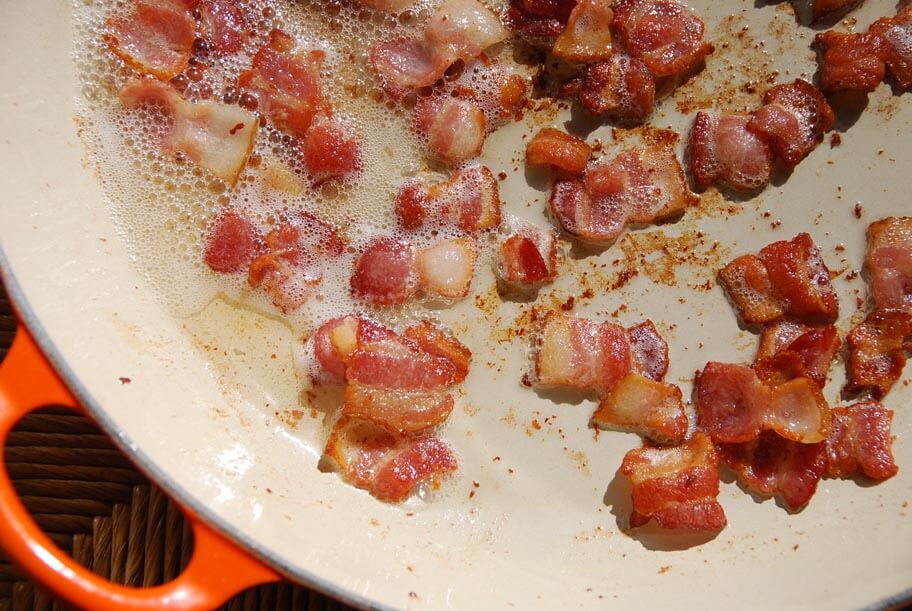
bacon for bricklayer tacos
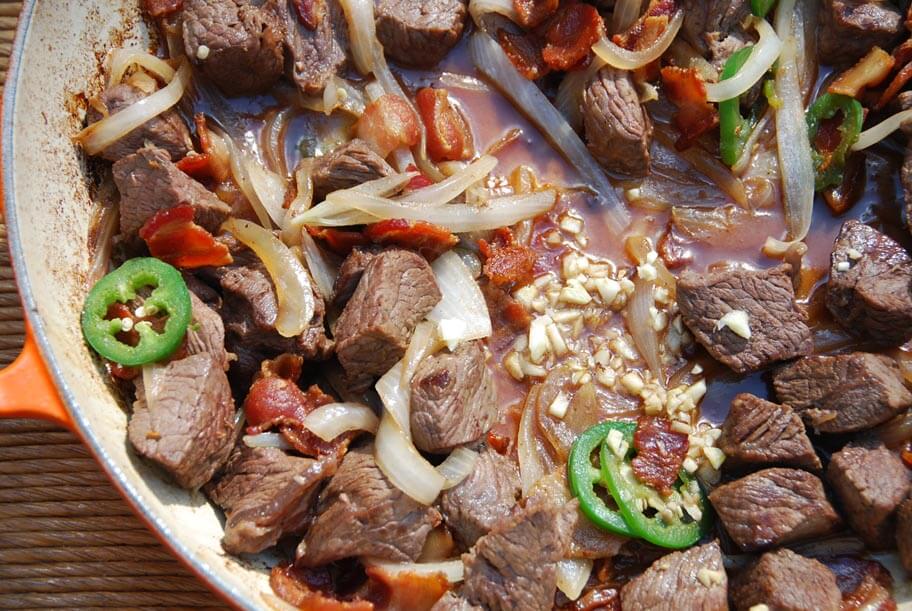
Start with a large casserole or skillet and fry some bacon until crisp.

Whenever I teach Mexican cooking, I never fail to say that the food of a country resembles its people. The taco, the most emblematic of Mexican foods, fully embodies Mexico and its people. Through the gazillion different kinds of tacos that have existed, we can explore the evolution of Mexico and the identity of Mexicans. The stories told by each taco, linked to one another, holds us Mexicans (and Mexican food lovers) together.  I am getting a tad too philosophical about tacos, I know, but just think about the possibilities.

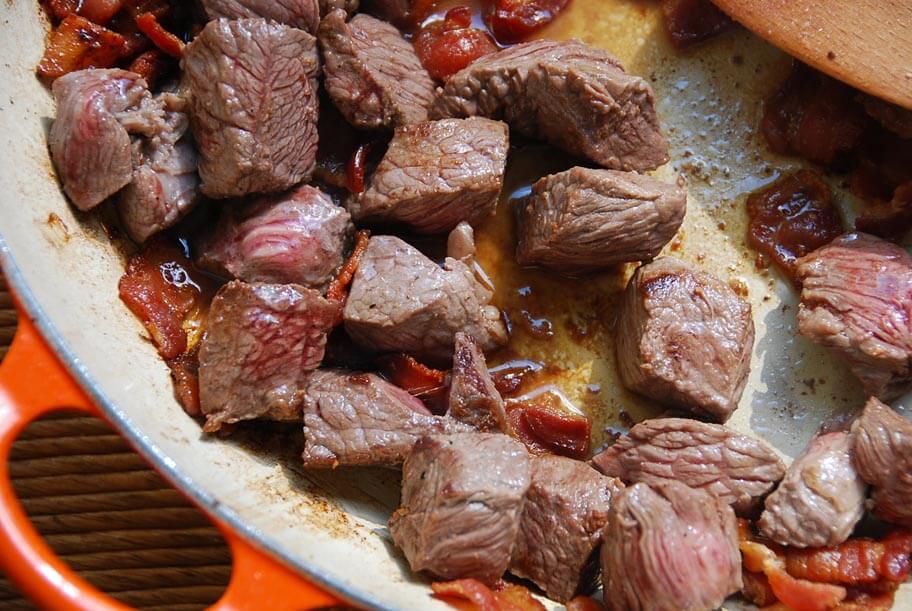
meat cooking in the bacon

You don’t need to add any other fat.  You will add tender pieces of tenderloin or sirloin straight into the bacon fat. Sprinkle with salt nd pepper, and let the meat brown without fully cooking.

There is no exact date on when the taco came to be. It existed before the Spaniards arrived in Mexico, in pre-Hispanic times, for sure. There is anthropological evidence that it was thousands, not hundreds of years, before the Spanish conquest that people in Mexico were eating tacos (even if they weren’t called that). Indigenous people had domesticated corn and found a way to make it fully nutritious by way of the nixtamalization process (where corn is shucked, dried, cooked in slaked lime or ashes, hulled and ground) and turned into a malleable dough to be used in a thousand different ways, including tamales, drinks, all sorts of patties and that flat bread we call tortilla.

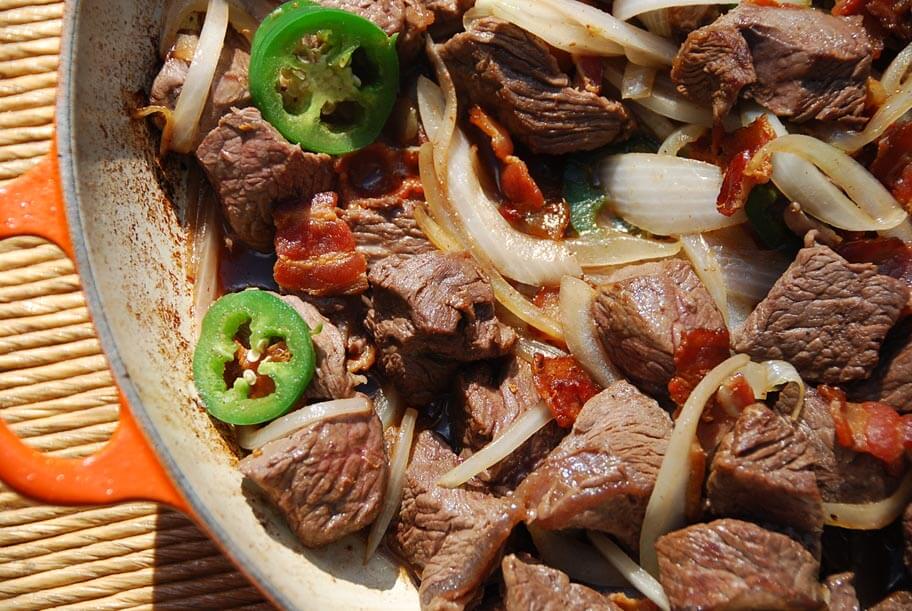
adding onion and jalapenos to the bricklayer taco filling
Add onion and jalapeños.

Now, how long since has the tortilla been used as an edible plate, or torn into pieces to scoop up food as an edible spoon, or held in hand to wrap a filling to munch on? I am guessing more years than you probably are. The filling could have been cactus paddle or iguana, who knows.

adding garlic to the bricklayer taco filling
Add garlic and cook for less than a minute, until garlic is fragrant.

The first documented tacos appeared in the “Truthful History of the Conquest of New Spain” (1520), by Bernal Diaz del Castillo, a conquistador. He reported a taco feast, enjoyed by Hernán Cortes and many of his commanders, where many kinds of fillings were eaten wrapped in tortillas. Friar Bernardino de Sahagún, a Spanish ethnographer, also wrote about many different kinds of tortillas based on corn (different colors including yellow, blue and white; small and large; thin and thick) during the time of the conquest, in his “General History of the Things in new Spain.” It wasn’t until the Spanish arrived that the flour tortilla came to be, as they are the ones who introduced wheat.

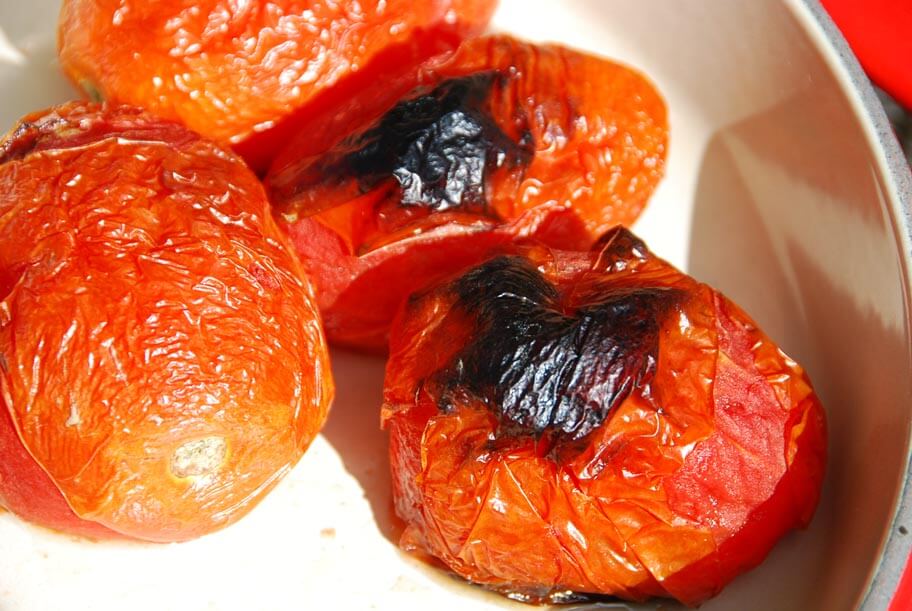
charred tomatoes
Add chopped roasted tomatoes. This is how they need to look, charred, juicy and mushy.

According to Jeffrey M. Pilcher, Mexican silver miners invented the taco, but he is most likely referring to the word. The word taco also refers to any small piece of material that can fit into a hole or gap, such as the pieces of paper wrapped around gun powder that were used to extract precious metals from ore, in that same shape. Workers in Mexican silver mines in the 18th century called their meals Tacos Mineros. Though there may be a link to the shape of the other kind of “tacos,” we know for a fact that edible tacos have existed for thousands of years before those.

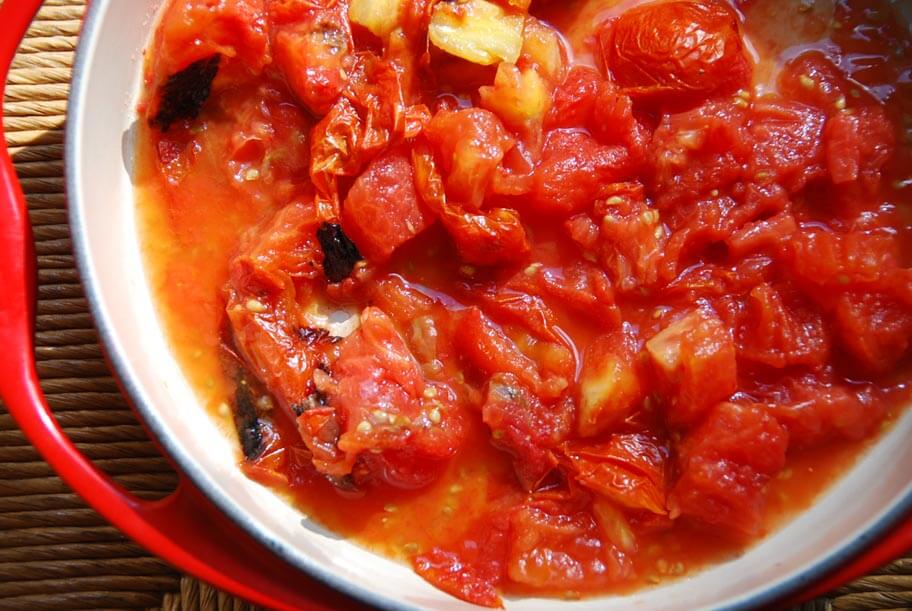
chopped charred tomatoes
Did I say chop up the tomatoes?

So yes, indeed, there are Tacos Mineros, but there are also tacos for and of absolutely EVERYTHING else, including the Tacos de Albañíl, or Bricklayer-style Tacos, that I am here showing you how to make. They’ve been baptized as such, for they are quick to prepare, very filling and need nothing else to be added on the side or on top.

They can also be prepared on site in a comal and  can use any kind of available meat, as long as it is cut in small bite size pieces. Tacos de albañíl sellers can also be  found near construction sites. Just walk around Mexico City, or come over on a weeknight as it is also one of my family’s favorite fast meals. And you get to pick what kind of tortilla you want, flour or corn.

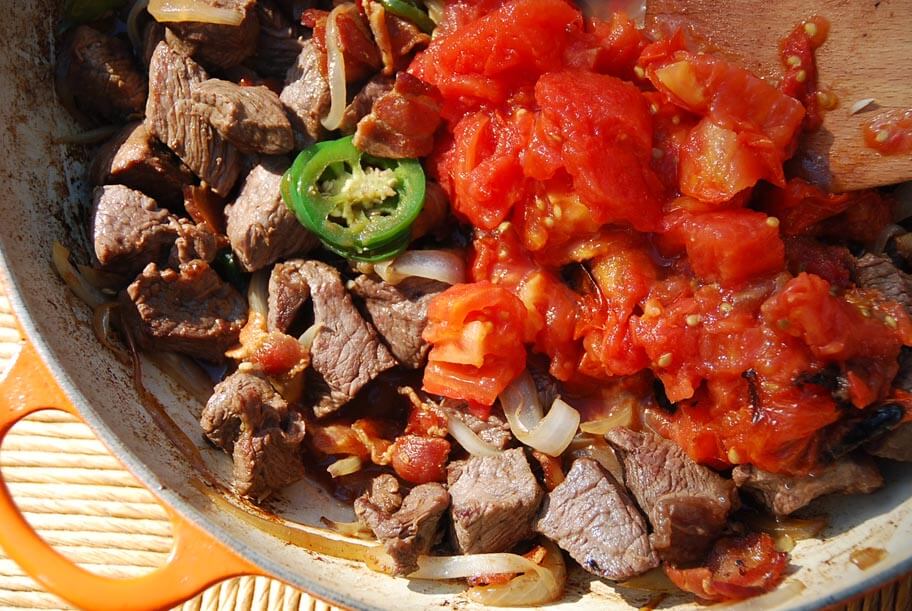
adding charred tomatoes to the bricklayer taco filling
Add to the mix and cook for a few more minutes.

Soft taco, crispy taco, hard shell taco (wish I didn’t have to say Taco Bell taco but we can’t ignore they have in a way helped to spread the word), puffy taco… I hope you add these Bricklayer-style Tacos to your collection of taco recipes.

finished bricklayer taco filling
You are done. Set it on the table.

Wait, you don’t have a taco recipe collection? Make this your first one!

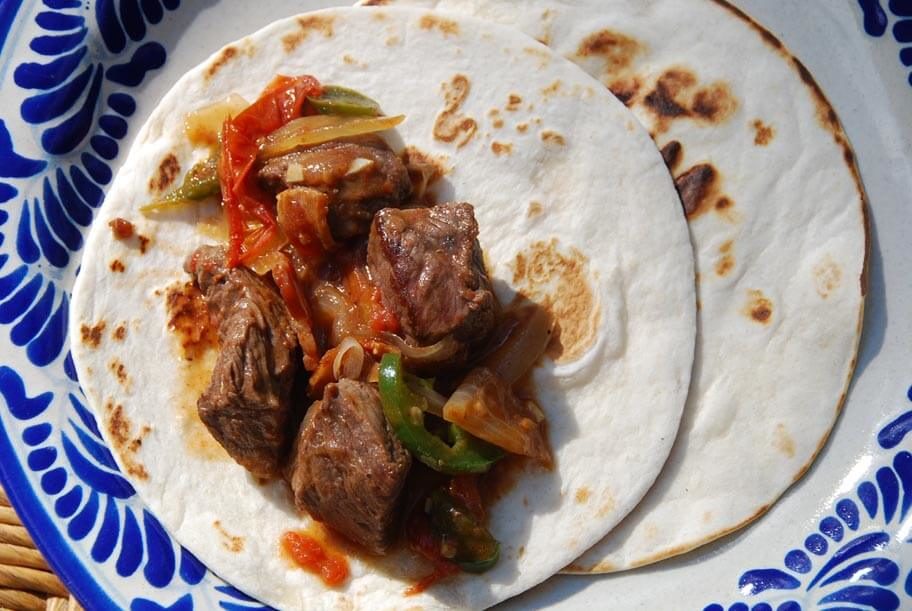
bricklayer tacos
Warm up your choice of tortillas, corn or flour. And let everyone have a go!

bricklayer tacos
Print Recipe
4.67 from 6 votes

Bricklayer Tacos

I could write an endless post on all sorts of tacos and all they can do for you… But, if you want to feed your family a generous, satiating, and super tasty weeknight meal, make them bricklayer tacos. Step by step instructions follow below. But as I cook, let me quickly reflect on The Taco.
Prep Time10 minutes
Cook Time30 minutes
Course: Main Course
Cuisine: Mexican
Keyword: bacon, beef, corn tortillas, flour tortillas, garlic, jalapeno, onion, Recipe, Taco, Tomatoes
Servings: 6 to 8 servings
Author: Pati Jinich

Ingredients

  • 8 ounces bacon sliced
  • 2 pounds beef sirloin or tenderloin cut into 1-inch pieces
  • To taste kosher or sea salt
  • To taste freshly ground black pepper
  • 2 cups white onion slivered or sliced
  • 2 garlic cloves chopped
  • 1 jalapeno chile sliced, seeding optional, or to taste
  • 1 pound ripe Roma tomatoes
  • Flour or corn tortillas

Instructions

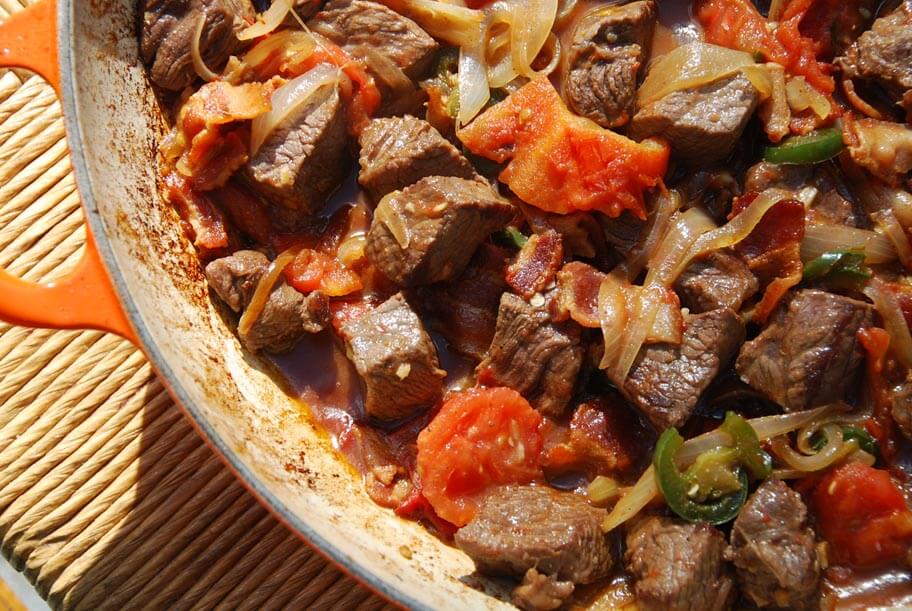
  • Place tomatoes in a baking dish and under the broiler for 6 to 9 minutes, until charred, mushy and juices have begun to run. Once cool, roughly chop, but don’t discard the juices.
  • Heat the skillet, add the bacon and cook until it is crisp and browned, about 5 minutes. Add the meat and season with salt and pepper and sear for about 2 minutes per side.
  • Add in the onion and jalapeño and let them soften for 2 to 3 minutes. Add the garlic and before it browns, in less than a minute, add the chopped tomatoes. Stir here and there and let it all season for about 4 to 5 minutes.
  • In a skillet or comal, set over medium-low heat, heat the tortillas. It will take about 1 minute per side. Place the tortillas in a tortilla warmer or wrap them in a clean kitchen towel or cloth napkin.
  • Serve along with the tenderloin tips; guests can fill the tortillas with the amount of filling they desire.

Notes

Tacos al Albañil

Do You Want it Red or White? Mexican Style Gefilte Fish

My paternal grandmother, Bobe, used to make two kinds of gefilte fish every Friday: white or traditional and red or a la Veracruzana. The moment you sat down, she made you choose, “which do you want mamele, white or red?”

Invariably, after you chose, she’d ask, “you don’t like the way I make the other one?”

She’d barge in, make room on your plate and serve you the kind you hadn’t picked, right next to the one you had chosen. She’d wait for you to taste it and tell her how good the one you hadn’t chosen was. Then, she would eat right off your plate.

Having come from tiny shtetls in the polish countryside, both her and my grandfather arrived in Mexico so very young. Mexico gave them an opportunity to start a life away from pogroms.

They worked hard and made a simple but good life for themselves. Though they were humble, and without much savings, every Friday they had a bountiful table full of food for their three grown children and their families – all together there were ten granddaughters. Nope. Not a single grandson!

Mexico also brought so many flavors to Bobe’s traditional foods. At the table there was petchah (chicken foot jelly!) that could be garnished with a salsa verde cruda, gribenes (chicken cracklings) tucked into warm corn tortillas and a heaping spoonful of fresh guacamole, the crispiest potato kugel, a stew that always had falling apart meat and a soupy prune or carrot tzimes. To finish, it was her prized chocolate babka spiked with Mexican canela.

Yet, nothing beat her Mexican-style gefilte fish, aka the red one.

The red is different from the white in so many ways. The white, or traditional, is made by combining ground fish filets, white onion, carrots, eggs and matzo meal and shaping them into patties that are poached in a stock made with the head, tail, and bones of the fish. It is refrigerated, covered with this same fish stock, which turns gelatinous as it cools (a delicacy if you have the acquired taste!). It is served cold. The red has the same fish mixture, but it is poached in a thick and spiced up tomato sauce enriched with capers, green olives and mild pickled peppers. It is served hot. Everyone in my family is wild about it.

The red sauce is called Veracruzana because it comes from the state of Veracruz, which geographically seems to embrace the Gulf of Mexico. The Veracruzana sauce is traditionally served over large fish, and its flavors showcase the intermarriage of Spanish and Mexican ingredients that took place throughout the years of Spanish colonization. It was through the port of Veracruz that most European immigrants came into Mexico, like my Bobe.

One hell of a cook she was, with her treasured jar of shmaltz in the refrigerator ready to be scooped out and used on almost anything. She was as generous in her cooking as she was in life. After my parents divorced, when I was an early teen, she would put money in my backpack or my jacket, without me noticing, every time I visited. She knew I didn’t want to take it, as she didn’t have any extra to give out.

I never had the chance to serve Veracruzana, the red gefilte fish, from my kitchen to my Bobe. She passed away, just a couple months ago, and oh man, I wish I had. She would have been so proud. She would have probably asked me, “why, mamele, you didn’t like the white?”

My gefilte fish will always be for you, Bobe. And just so you know, I always make the red and the white. I miss you so bad.

Mexican Style Gefilte Fish
Print Recipe
4.80 from 5 votes

Mexican Style Gefilte Fish

Prep Time15 minutes
Cook Time55 minutes
Course: Main Course, Side Dish
Cuisine: Jewish, Mexican
Keyword: capers, carrots, fish, flounder, Jewish Mexican, ketchup, matzo, olives, pepperoncini, Recipe, red snapper
Servings: 20 patties
Author: Pati Jinich

Ingredients

For the fish patties:

  • 1 pound red snapper fillets no skin or bones
  • 1 pound flounder fillets no skin or bones
  • 1/2 white onion quartered, about 1/2 pound
  • 2 carrots peeled and roughly chopped, about 1/4 pound
  • 3 eggs
  • 1/2 cup matzo meal
  • 2 teaspoons kosher or sea salt or to taste
  • 1/2 teaspoon ground white pepper or to taste

For the red sauce:

  • 3 tablespoons safflower or corn oil
  • 1/2 cup white onion chopped
  • 1 28-ounce can crushed tomatoes
  • 3 cups fish broth or water
  • 2 tablespoons ketchup
  • 1 teaspoon kosher or sea salt or to taste
  • 1/4 teaspoon ground white pepper or to taste
  • 1 cup manzanilla olives stuffed with pimientos
  • 8 pepperoncini peppers in vinegar brine or more to taste, chiles güeros en escabeche
  • 2 tablespoons capers

Instructions

To prepare the fish patty mixture:

  • Rinse the red snapper and flounder fillets under a thin stream of cool water. Slice into smaller pieces and place in the food processor. Pulse for 5-10 seconds until fish is finely chopped but hasn’t turned into a paste. Turn fish mixture into a large mixing bowl. Then place the onion, carrots, eggs, matzo meal, salt and white pepper into same bowl of the food processor. Process until smooth and turn into the fish mixture. Combine thoroughly.

To prepare the red sauce:

  • Heat the oil in a large cooking pot over medium-high heat. Add the chopped onion, and let it cook for 5-6 minutes, stirring, until soft and translucent. Pour the crushed tomatoes into the pot, stir, and let the mix season and thicken for about 6 minutes. Incorporate 3 cups water, 2 tablespoons ketchup, salt and white pepper. Give it a good stir and bring to a boil. Reduce the heat to low and bring sauce to a gentle simmer. Continue to simmer while you roll the gefilte fish patties.
  • Place a small bowl with lukewarm water to the side of the simmering tomato broth. Start making the patties. I like to make them about 3” long, 2” wide and 1” high, in oval shapes. Wet your hands as necessary, so the fish mixture will not stick to your hands. As you make them, gently slide each patty into the simmering broth. Make sure it is simmering and raise the heat to medium if necessary to keep a steady simmer.
  • Once you finish making the patties, cover the pot and bring the heat to low. Cook them covered for 25 minutes. Take off the lid, incorporate the manzanilla olives, pepperoncini peppers and capers. Give it a gentle stir and simmer uncovered for 20 more minutes, so the gefilte fish will be thoroughly cooked and the broth will have seasoned and thickened nicely.
  • Serve hot with slices of challah and pickles.

Notes

Gefilte Fish a la Veracruzana

A Taste of Barrio Chino: Green Beans with Peanuts and Chile de Arbol

Before she died, my maternal grandmother, whom we called Lali (remember I’ve told you about her before?) gave me Gloria Miller’s Thousand Recipe Chinese Cookbook. She was fascinated with Chinese cookery. She was also very good at it. What she loved the most were the stir-fry dishes: fast, tasty and healthy.

So, she bought herself a wok.

I couldn’t begin to count how many wok-made dishes I ate at her house during those long summers I visited her and my grandfather, after they moved to the Californian desert.

After she passed away, that wok found its way into my kitchen. I’ve cherished it. I’ve prized it. I haven’t used it! I’ve dragged it through so many house moves that I’ve also managed to lose its cord. It’s an electric wok. It’s real pretty, too. It’s hers. And in my mind, it is inseparable from her Miller’s cookbook, so I didn’t try to cook “her” Chinese dishes for years. And here and there, I’ve looked for that cord…

Fast-forward many, many years. You know I am on a continuous mission to find fascinating topics to teach for my culinary program at the Mexican Cultural Institute in Washington, DC. As we planned this year’s classes, the topic came up: Asian Influence in Mexican cooking.

Map of Manila-Galeon trading route
{Photo courtesy, Wikimedia Commons}

As a former Mexican policy analyst, I am very familiar with the history of the 250 year-long Acapulco-Manila trading route, which connected China and Mexico early on. How tasty would it be to build a menu that showcased the influence of Asian populations in Mexico, and the beautiful fusions of their cuisines and ours?

The Chinese and the Filipinos were the first ones to come to Mexico, through that Acapulco-Manila trading route, which was the result of the Spaniards’ thirst for more than gold, for more than silver; it was their thirst to find what they called the “Spice Islands.” Find them, they did, in Manila.

For 250 years, huge Spanish-built Manila Galleon ships (known in Mexico as Naos de China) were the means of an incredibly rich exchange that forever changed the culture and cooking of Mexico and Asia. Through trips that lasted for more than six months and carried more than 600 people, in came silk, porcelain, exotic fruits and herbs, huge amounts of spices and new ways of preserving ingredients and cooking techniques; out went tomatoes, zucchini, corn, chiles, avocados, beans, Mexican herbs and many culinary traditions.

Spanish Galeon ship
{Photo courtesy, Wikimedia Commons}

Like many in the Chinese populations in Mexico, my grandmother was an immigrant. She moved to Mexico City from her native Austria, by boat as well, and in her kitchen, became fluent in bridging Austrian and Mexican food. Much in the same way that Chinese immigrants, have built bridges between their cuisine and Mexican food – adapting dishes to use ingredients from the nearest market (jícama instead of watercress, anyone?) and to please the tastes of their Mexican neighbors (chile peppers, please…). It seems to me that it was an understanding and solidarity amongst immigrants that inspired my grandmother’s great appreciation for Chinese cooking.

Well, not only was my grandmother fascinated with Chinese cooking, but a gazillion other Mexicans are, too. We visit Chinese restaurants and cafes, which are proliferated in Mexico City’s Barrio Chino (Chinatown) but even more in the state of Baja California. They tend to have the red lamps and paper dragons and optional chopsticks (thankfully, because as to this day, I haven’t learned to use them…embarrassing, I know) and they have coffee, if you would rather drink it, instead of tea.

This recipe for Green Beans with Cacahautes and Chile de Arbol is one of its highlights. Thanks to Miller’s basics, I could brush up on my stir-frying technique, so the dish turns out just like my grandmother liked her stir fries: tender, crunchy, fresh and full of flavor.

stir fried green beans with peanuts and chile de arbol

I added a double peanut layer, by using peanut oil, that becomes very nutty as the beans cook, as well as a healthy dose of garlic and chile de árbol. It’s become a staple at home.

And you know what? It turns out you don’t need a wok to make stir fries. You just need a thick pot that can withstand high heat and has a large surface: a la Mexican. I found out because, NO, I have not found that electric cord, and NO, I will not buy another wok. In my kitchen, it is only my grandmother’s wok that will remain king: If only in theory, until I find that electric cord…

stir fried green beans with peanuts and chile de arbol
Print Recipe
4.60 from 5 votes

Green Beans with Peanuts and Chile de Arbol

The topic of Asian influence in Mexican cooking turned out to be so fascinating to research, in and out of my kitchen, that I devoted an entire episode of my upcoming Third Season of Pati’s Mexican Table, on Public TV, to this menu. (Yey! It’s in production now. I will be able to share the sizzle reel soon, and it will air in January!) This recipe for Green Beans with Cacahautes and Chile de Arbol is one of its highlights. Thanks to Miller’s basics, I could brush up on my stir-frying technique, so the dish turns out just like my grandmother liked her stir fries: tender, crunchy, fresh and full of flavor.
Prep Time5 minutes
Cook Time6 minutes
Course: Side Dish
Cuisine: Chinese, Mexican
Keyword: chiles de arbol, green bean, Peanuts, Recipe, scallions, soy sauce, stir fry
Servings: 4 servings
Author: Pati Jinich

Ingredients

  • 1 pound green beans ends cut and diagonally sliced in about 2” pieces, or Chinese long beans
  • 1 tablespoon soy sauce
  • 1/4 cup chicken broth
  • 1/2 teaspoon brown sugar
  • 1/2 teaspoon kosher or sea salt
  • 2 tablespoons peanut oil
  • 1/2 cup roasted peanuts
  • 4 garlic cloves minced or pressed
  • 3 to 4 chiles de arbol stemmed and thinly sliced
  • 4 to 6 scallions thinly sliced, light green and white parts only

Instructions

  • Bring salted water to a boil in a large pot, add the sliced green beans and cook, uncovered for 2 to 3 minutes until al dente, drain and set aside.
  • Combine the soy sauce, chicken broth, sugar and salt in a small bowl and mix well.
  • Heat the peanut oil over high heat in a large heavy skillet until hot but not smoking. Add the peanuts, stirring constantly, as they begin to fry for about 20 seconds. Beware, peanuts burn faster than you would think... so don't wait until they look browned. Add the garlic and the chiles de arbol, stir for about 10 seconds, and add the scallions and stir for another 10 to 15 seconds. Add the green beans, stir to combine all the ingredients and finally pour soy sauce mixture, let it all cook for 3 to 4 minutes. Serve immediately.

Notes

Ejotes con Cacahuates y Chile de Arbol

Hearty Bean & Corn Salad with Cilantro Vinaigrette

One of the things that I’m most enthusiastic about in what I do is breaking down myths about Mexican food and also about Mexicans. One of the biggest misconceptions is that Mexican food is greasy, fatty, cheesy and overloaded in heavy amounts of condiments. Some of the dishes that crossed the Mexican border and have become popular in the US, have been re-interpreted and promoted by the US fast food industry. Yet, mega burrito bombs, nachos smothered in cheese, and sizzling fajitas with scoops of sour cream on top are things you will have a really hard time finding in Mexico.

One thing that surprises people who delve a bit more into the Mexican culinary world is how crazy we are about salads. Not taco salads, no, no, no… Wholesome salads that use vegetables and beans and grains and flowers and all kinds of dried chiles and herbs…

It may be that the Mexican use of the word salad “ensalada” doesn’t help much to spread this good information because we usually call “ensalada” when there is lettuce or leafy greens in it. This leaves out chayote en vinagre, calabacitas en escacheche (pickled zucchini salad), nopalitos, and a gazillion other salads named simply by their main ingredient.

Mexican salads are so fascinating that I dedicated an entire chapter to them in my cookbook. They tend to be easy to make, and there always tends to be something exotic or interesting going on. A hibiscus flower vinaigrette, crunchy and watery jícama, or quickly pickled ancho chiles, super crispy and sweet garnishes like caramelized pecans or peanuts, spiced pepitas, or toasted sunflower seeds, just to name some.

Salads are usually dressed up in an oil and vinegar treatment, and Mexican cooks get very creative with them. We whip up vinaigrettes quickly, either in the blender or simply shaking them up in a jar. After they are made they can be refrigerated and re-used, with just a re-shake to emulsify. Every Mexican home that I know, has their home staple vinaigrettes of choice.

Pick a flavor of your choice: say, cilantro! Fresh, grassy, strong.

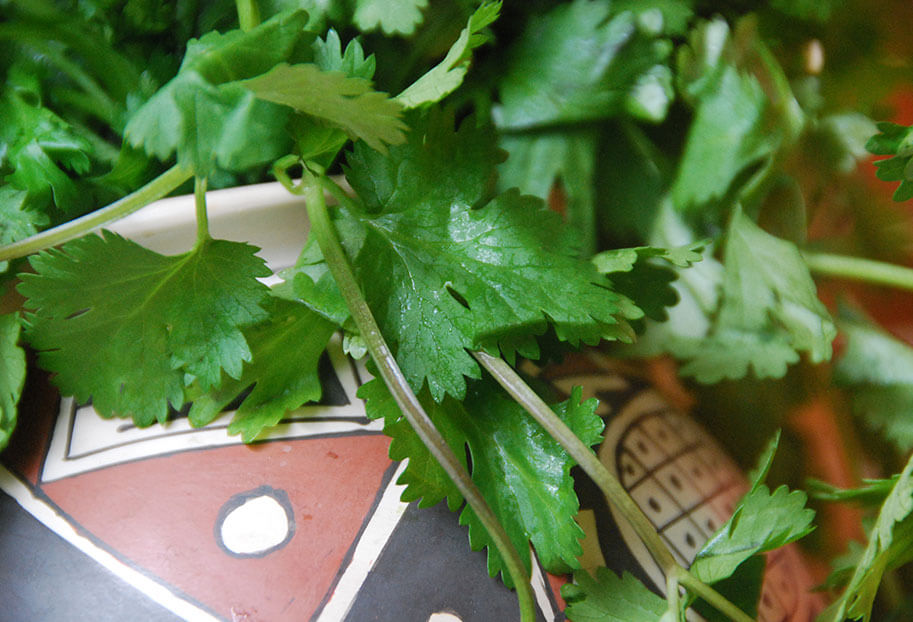
cilantro

Don’t like cilantro? Pick another one, such as chives, tarragon, mint, parsley… a combination of many.

But stick with me on cilantro for this one. This is one of my regular vinaigrettes. All you do is add the ingredients in a blender, puree, done. Don’t be deterred. In less time than it takes to run to the store for a bottle, you have a tastier one made at home.

cilantro vinaigrette

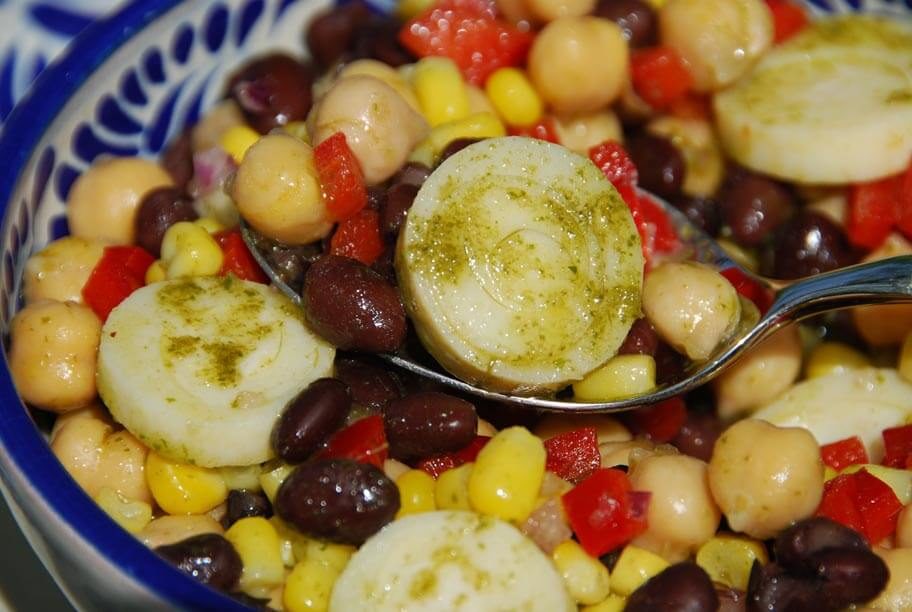
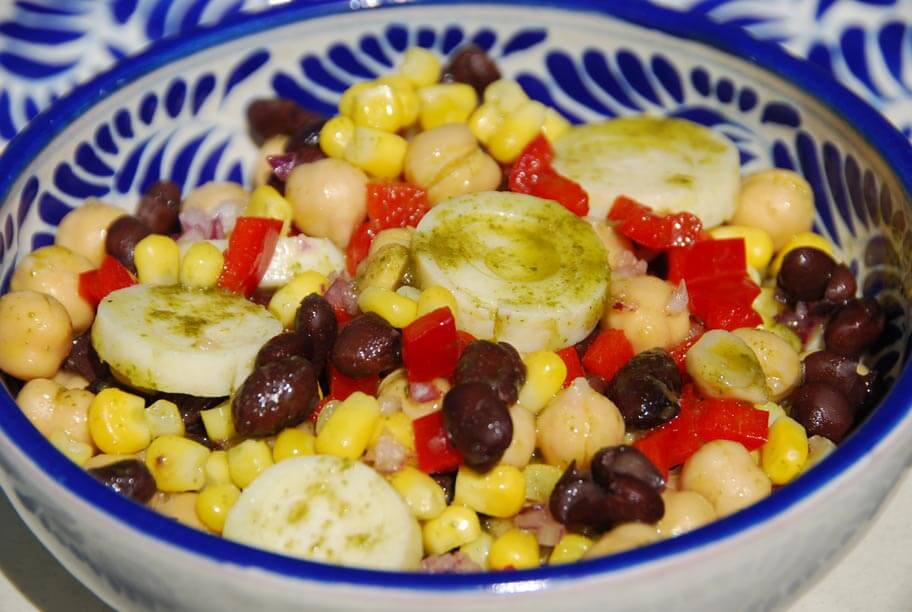
You can use it in a regular green salad, over tomato and mozzarella, soaking up other cooked vegetables like green beans or asparagus and sprinkled with fresh cheese. I tried it with this combination of corn, hearts of palm and black and garbanzo beans, and we all went wild over it. So many textures, so many flavors, so many colors, so very playful.

It can be your main dish, anytime of the year, with some crusty bread on the side. It can also be a great side salad for your barbecues and picnics in the summertime.
bean and corn salad

bean and corn salad
Print Recipe
4.80 from 5 votes

Hearty Bean & Corn Salad with Cilantro Vinaigrette

Salads are usually dressed up in an oil and vinegar treatment, and Mexican cooks get very creative with them. We whip up vinaigrettes quickly, either in the blender or simply shaking them up in a jar. After they are made they can be refrigerated and re-used, with just a re-shake to emulsify. Every Mexican home that I know, has their home staple vinaigrettes of choice. Pick a flavor of your choice: say, cilantro! Fresh, grassy, strong.
Prep Time5 minutes
Cook Time5 minutes
Course: Salad
Cuisine: Mexican
Keyword: bell peppers, black beans, chickpeas, cilantro, Corn, garbanzo beans, hearts of palm, Recipe, red onion, red wine vinegar, salad, vinaigrette
Servings: 6 to 8 servings
Author: Pati Jinich

Ingredients

For the salad:

  • 1 15.5oz can black beans drained and rinsed, or 1 ¾ cups black beans from the pot , drained
  • 1 15.5oz can garbanzo beans or chickpeas drained and rinsed, or 1 ¾ cups cooked garbanzo beans, drained
  • 1 15.2oz can corn drain and rinsed, or 1 ¾ cup fresh or frozen corn kernels cooked
  • 1 14oz can hearts of palm rinsed and cut into 1/4-inch rounds
  • 1 cup chopped red bell pepper
  • 2 tablespoons finely chopped red onion

For the vinaigrette:

  • 1/2 cup cilantro leaves and upper stems, roughly chopped
  • 1/4 cup olive oil
  • 1/4 cup vegetable oil
  • 1/4 cup red wine vinegar
  • 1 garlic clove peeled
  • 1 teaspoon granulated sugar
  • 1/2 teaspoon kosher or sea salt or more to taste

Instructions

  • Place all the ingredients for the vinaigrette in a blender and puree until smooth. You may make the vinaigrette up to a week ahead and store covered in the refrigerator. If made ahead, whisk with a fork or whisk to re-emulsify prior to using. You may also shake it in the covered container.
  • In a large mixing bowl, combine black beans, garbanzo beans, corn, red bell pepper and red onion. Pour vinaigrette and combine well. Add hearts of palm, gently toss and serve.

Notes

Ensalada de Frijol, Garbanzo y Elote con Vinagreta de Cilantro

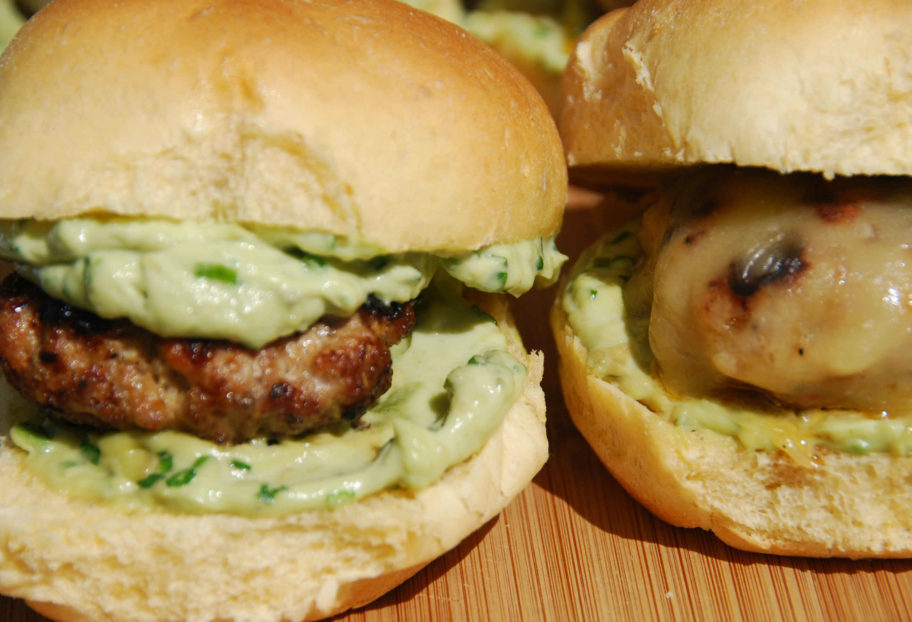
Sean’s Cheesy Chipotle Pork Sliders with Avocado Spread

It was my friend Tamara´s birthday party. Her husband, Sean, an American who speaks and acts like a Mexico City native (says a Mexico City native), made the dinner for the 40+ guests. The guests were drinking, eating and laughing until their stomachs were hurting, usual for their home. Sean came up to me when he saw me walk in, gave me a plate, placed two of these sliders on and said, “You are going to like these.”

I ate one. YUM.
I said, “There’s chipotle in them!”
I ate two. OMG.
I said, “I can take that platter”, and ate the remaining four. Of course, he was grilling some more.

No, I didn’t even try his Asian tuna sliders. No, I didn’t try his regular cheeseburger sliders. No, of course, I didn’t try his vegetarian sliders. All I wanted were these Chipotle Pork Sliders. I was hooked.

After I had my fill, I told Sean I had to post his recipe on my blog, as I was sure you all would love them just like I did. He obliged, and I tested his recipe many times giving it a few tweaks (hey, you know, I can’t help myself). I added a bit of onion, garlic and oregano to the meat mix and more chipotle (come on Sean, you talk like a Mexican!). I took some of the mayo out of the avocado spread and added the refreshing chives.

It’s what happens when you share recipes: they’re not yours anymore. They’re under the domain of the recipients who can do whatever they want with them. You killed yourself to make the best-ever sandwich and you hate mustard? Well, the next person printing your recipe may think all the sandwich needs is a little, or a lot of, mustard. I know this to be true, for I’ve heard from many of you wonderful personal touches and spins on my recipes through the comments on this blog. That’s the beauty of passing down recipes!

If you don’t go head over heels over these sliders, tweak them, and go ahead, make them your very own. The underlying notes for these sliders, for me, are: meat, especially pork, and chipotle are heavenly together; the melted cheese adds a rich welcome layer (all of my boys thought so too), and the avocado spread brings in a creaminess and freshness to everything inside that soft bun, it brightens it up (one of my beastly beasts skipped the avocado part, see? oh well..).

Sean uses brioche buns, which have a light sweetness and a soft and fluffy bite. If you find them, great! If you don’t, any mini hamburger buns work just fine. And then again, you may decide to turn these sliders into jumbo size burgers.

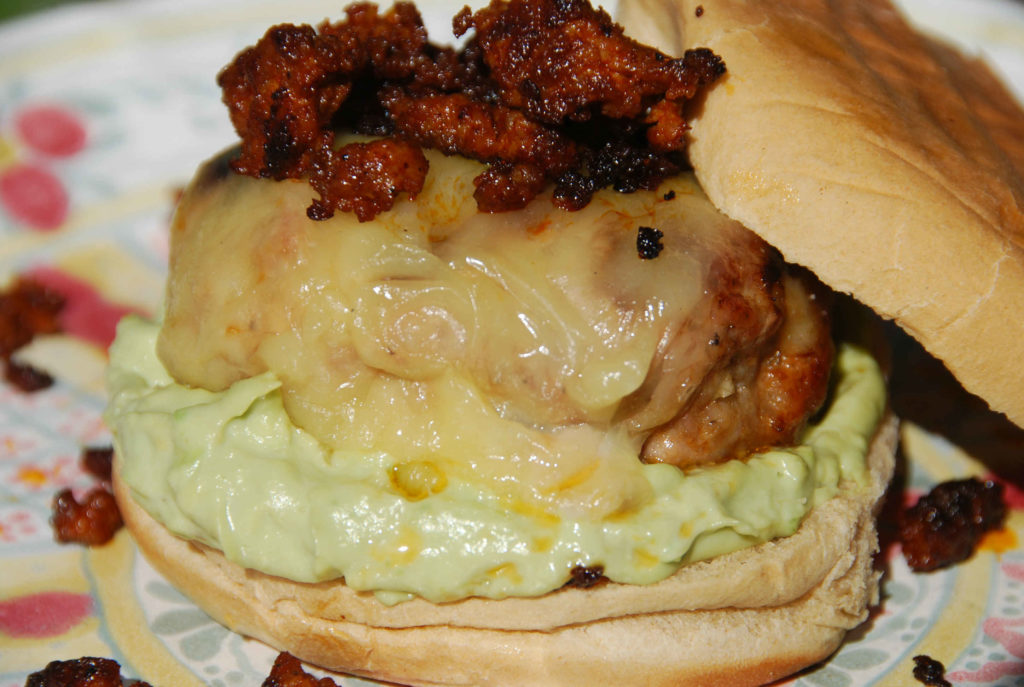
Want to go crazy? Top with crumbles of chorizo!

Sean's Cheesy Chipotle Chorizo Sliders

Sean's Cheesy Chipotle Sliders
Print Recipe
5 from 4 votes

Sean’s Cheesy Chipotle Pork Sliders with Avocado Spread

If you don’t go head over heels over these sliders, tweak them, and go ahead, make them your very own. The underlying notes for these sliders, for me, are: meat, especially pork, and chipotle are heavenly together; the melted cheese adds a rich welcome layer (all of my boys thought so too), and the avocado spread brings in a creaminess and freshness to everything inside that soft bun, it brightens it up (one of my beastly beasts skipped the avocado part, see? oh well..).
Prep Time10 minutes
Cook Time7 minutes
Course: Main Course
Cuisine: Mexican
Keyword: Avocado, burger, chipotles in adobo, lime, mayonnaise, Monterrey Jack cheese, Muenster cheese, pati's mexican table, pork
Servings: 16 sliders
Author: Pati Jinich

Ingredients

  • 2 pounds ground pork
  • 2 tablespoons finely chopped white onion
  • 3 garlic cloves finely chopped or pressed in garlic press
  • 3 tablespoons sauce from chipotles in adobo sauce
  • 1 chipotle chile in adobo sauce seeded and finely chopped, more to taste
  • 1 teaspoon dried Mexican oregano
  • 1 teaspoon kosher or sea salt or to taste
  • 1/4 teaspoon freshly ground black pepper
  • olive oil to grease the grill
  • 1 large Mexican avocado halved, pit removed
  • 2 tablespoons mayonnaise
  • 2 tablespoons fresh squeezed lime juice
  • 2 tablespoons chopped chives
  • 1/4 teaspoon kosher salt or to taste
  • 8 slices Monterey Jack or Muenster cheese
  • 16 mini brioche or mini hamburger buns

Instructions

  • Prepare your grill or grill pan over medium heat. While it heats, in a large mixing bowl mix the pork with the onion, garlic, adobo sauce, chipotle chile in adobo sauce, oregano, salt and pepper until well combined. With your hands (I find it helpful if hands are wet), make 16 round patties, about 3/4-inch thick, and place them on a baking sheet or platter.
  • In a medium-mixing bowl, place the avocado pulp and mash with a fork until smooth. Combine with the mayonnaise, lime juice, chives and salt, blend well. Set aside.
  • Once the grill or grill pan is hot, brush generously with olive oil. Place the patties on the grill and flip after 3 to 4 minutes. If adding cheese, place a thin slice of cheese on the already grilled side of the patties. Cook for another 4 minutes.
  • A couple minutes before the patties are ready, place the opened hamburger buns on the upper part of the grill (or after you remove the patties, will be fine too!), and let them warm up.
  • Slather a generous tablespoon or so of the avocado spread on the bottom bun, place a patty on top, and put on the top part of the bun. Eat them while hot!

Notes

Hamburguesitas de Cerdo con Chipotle, Queso y Crema de Aguacate

Chipilí­n Soup with Masa and Fresh Cheese Dumplings

I have a thing for soups.

Doesn’t matter what time of day, what season of the year, what place I’m in, if I want tasty comfort my entire self craves a big bowl of soup.

As far as soups go, I have concocted some, I religiously repeat some I grew up eating, and then there are others I’ve become enamored with as I’ve ventured deeper into my home country’s cuisine.

As soon as my feet touch new territory, I search for its signature soup: the one everyone knows; the one everyone loves; the one present at every home kitchen. As easy as it may sound, sometimes those soups stir away from restaurants. Luckily, the first meal we had during our trip to Chiapas included that soup.

Chipilin Soup 1

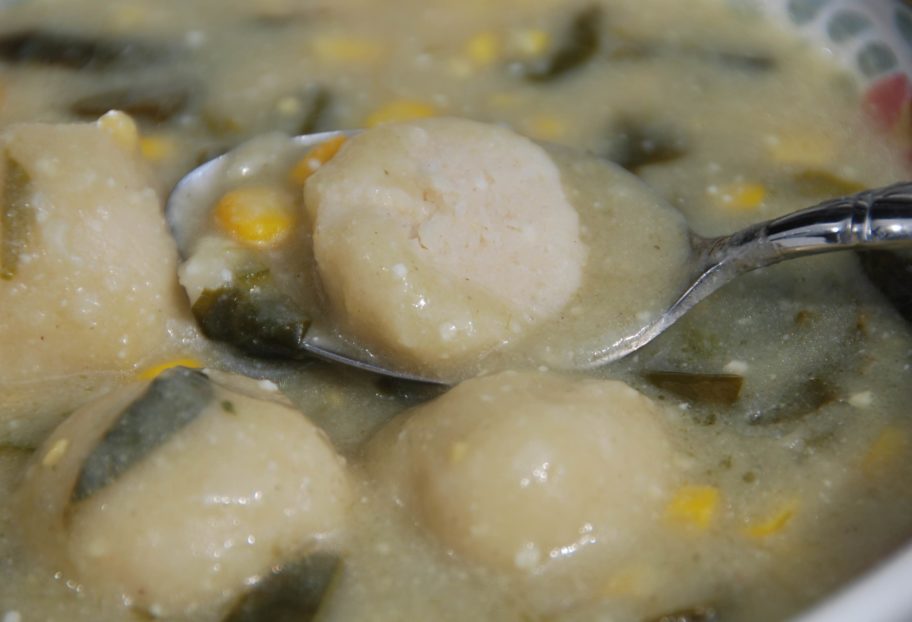
It was at a touristy restaurant serving a regional specialties buffet. The broth was thick and brimming with Chipilí­n, an herb with a grassy taste (like a mellow version of spinach or a gentle variation of watercress) and a silky delicate bite. The best part of the soup was the corn masa dumplings, dfferent from other I’ve tried, these had queso fresco mixed in the masa or dough, resulting in fluffier balls with a deep soft bite.

A couple days later, I bought a big bowl of Chipilí­n soup at a small fonda in Chamula. I sat on the sidewalk and ate it as I watched the church procession pass by.

The Church of San Juan Chamula is one of Mexico’s most famous: probably the most controversial as well, for its wildly eclectic combination of indigenous, pagan and Catholic rituals. Not to mention it’s particular architecture and decorations.

This second version of the soup was lighter, yet it had much more color, like the doors in the photo above. A bit of tomato spiked the broth and I tasted a bit of green heat. Don’t ask me why it didn’t occur to me to take a photo of the soup. Instead, I took photos of the Señores below.

Chipilin Soup 2

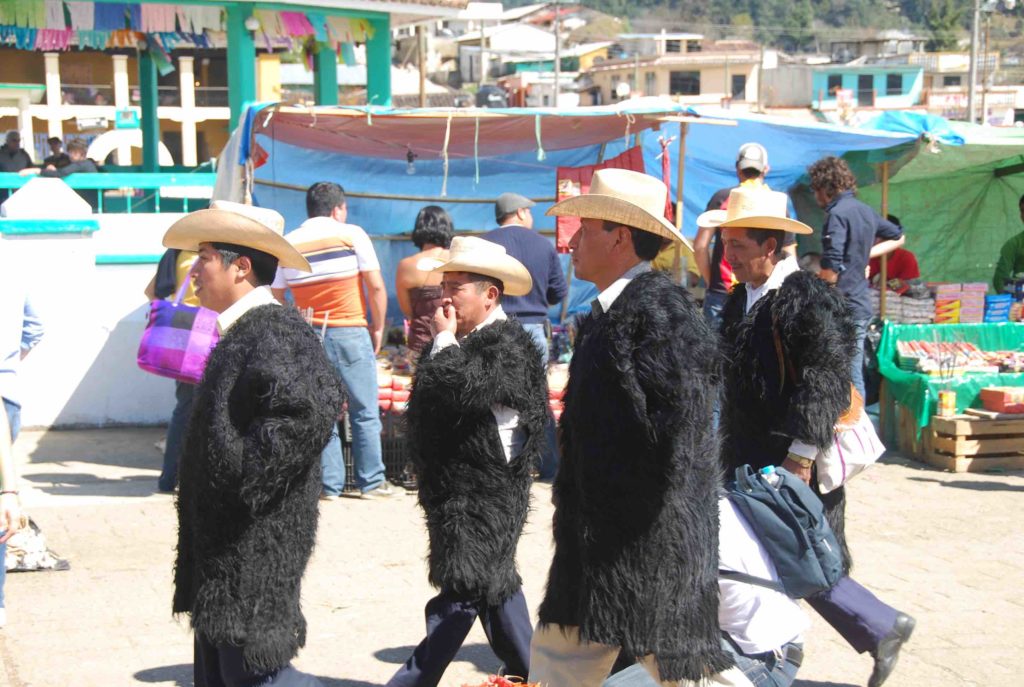
Tzotzil Mayas, which form part of one of the twelve indigenous groups that live in this state, were getting ready to walk in the procession, with their unique attire made with goatskin. Some men wear black, some wear white, and the women make skirts in the same style.

If you have never heard “Tzotzil”, a Maya language, you have missed listening to one of the sweetest sounds. As delicate as those Chipilí­n leaves.

Chipilin Soup 3

Ok, back to the soup. That same day, I tried a third version.

A short ride away we landed in a restaurant with a sumptuous buffet that was different from the first. This one boasted a larger display of typical dishes from the region. Their Chipilí­n soup had a much clearer broth, as if the masa dumplings had been cooked separately from the final soup and incorporated in the end. It had less Chipilí­n leaves in the broth, making it look more elegant and light, and there was queso fresco to add as a garnish, as well as Mexican crema and small pieces of chicharrón.

Chipilin Soup 4

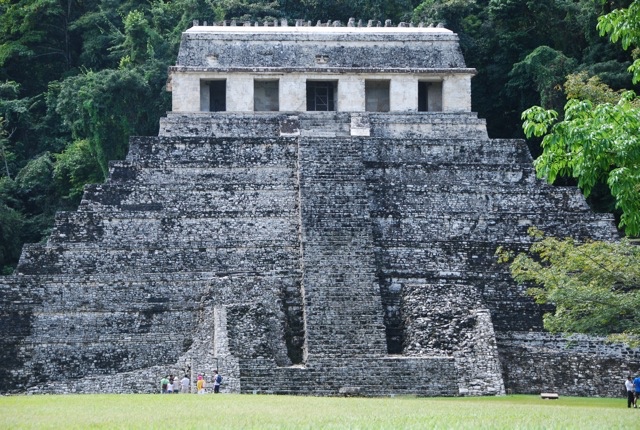
I tried a fourth version in a restaurant near the Palenque ruins (which can take anyone’s breath away and I am just adding more photos of the ruins because I can’t help myself)

Chipilin Soup 5

Let me indulge… and yes I climbed up so high to look at that view.

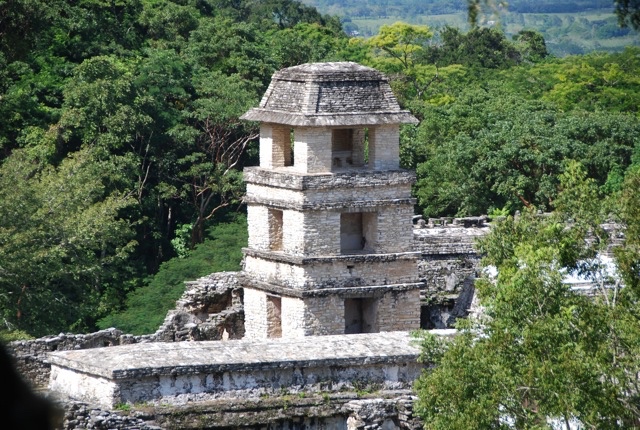
Chipilin Soup 6

Here is a close up.

Chipilin Soup 7

Alright, back to the soup. This one had the smallest of masa balls, and different than the soups before, aside from having Chipilí­n in the broth, there was a generous amount of Chipilí­n chopped into the masa balls. It also had extra garnishes of more queso fresco and thick Mexican cream. But no chicharrón.

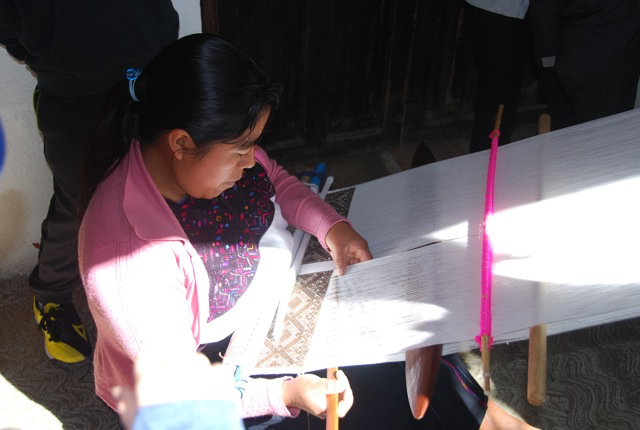
I did think about other things than trying more versions of the Chipilí­n soup and other foods I had no idea existed (which I will write about in other blog posts). Especially when we had the chance to learn about the insanely gorgeous textiles made in Chiapas.

Chipilin Soup 8

Once at San Cristobal de las Casas, I tried one last version of the soup in one of the restaurants in that busy street below. This soup included corn kernels in the broth. The contrast of that sweet crunch next to the soft masa balls in the flavored broth worked so well!

Chipilin Soup 9

No. I did not take a photo of it, because I didn’t know I was going to write about all the Chipilí­n soups I tried in Chiapas! Of course now I wish I had.

The good thing is that here is a recipe for you to try the soup.

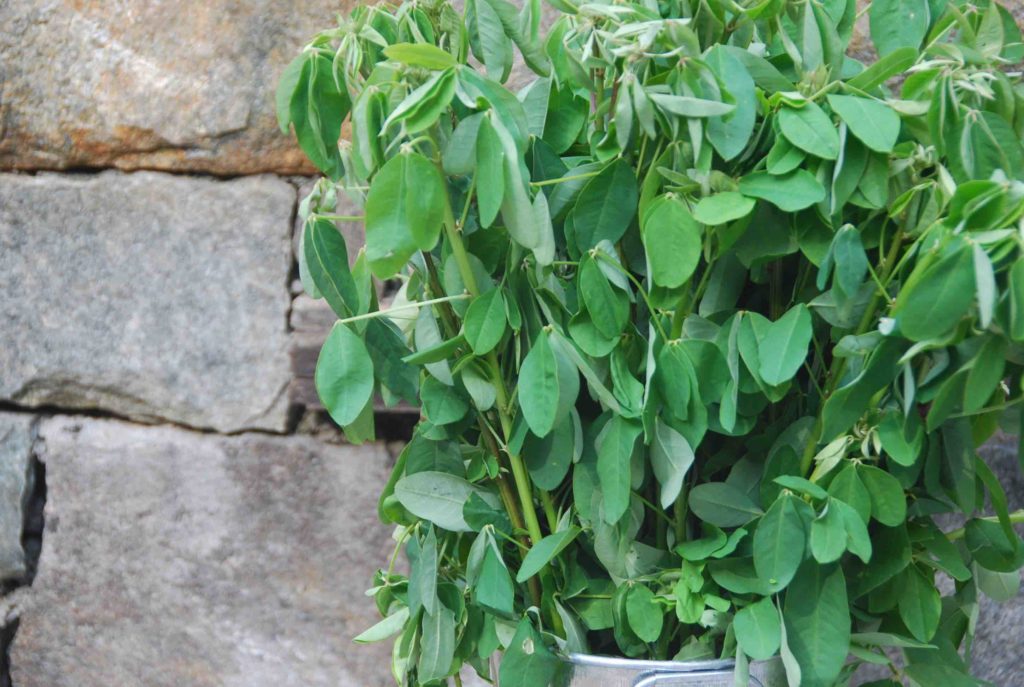
You can find Chipilí­n in the US these days, especially in Latin markets in the Summer and Fall. I just found some at Panam market in DC.

It looks like this. It is so pretty I put a big bunch in a flower vase and admired it as I ate it away and the bunch kept getting thinner.

Chipilin Soup 10

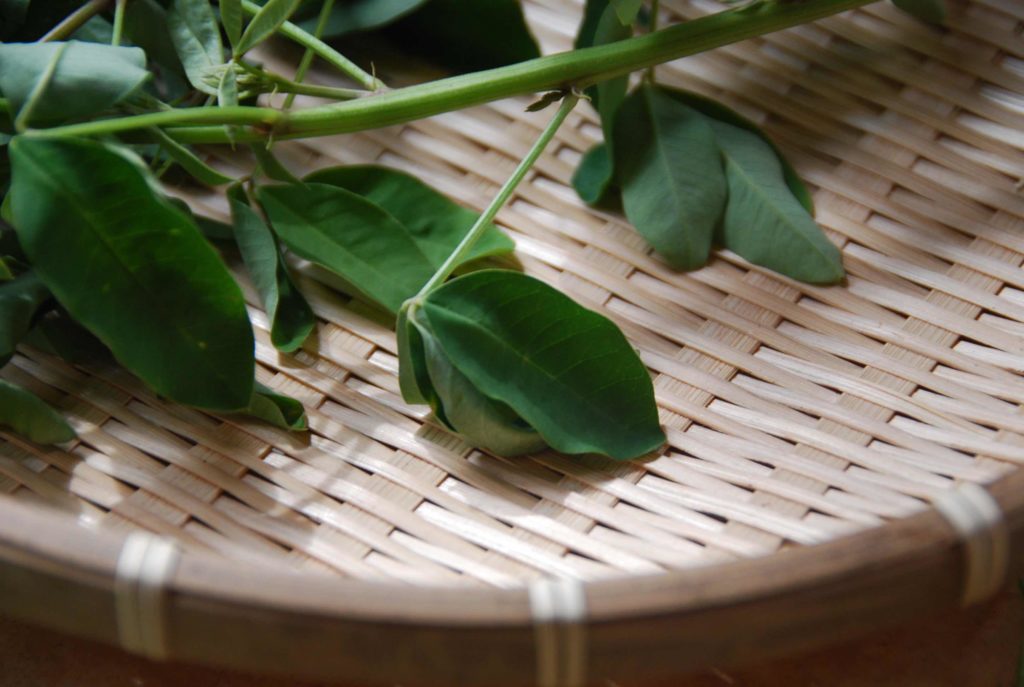
Here is a close up, so you can see just how delicate the leaves are.

Chipilin Soup 11

If you can’t find it, you can substitute it with sliced baby spinach or watercress.

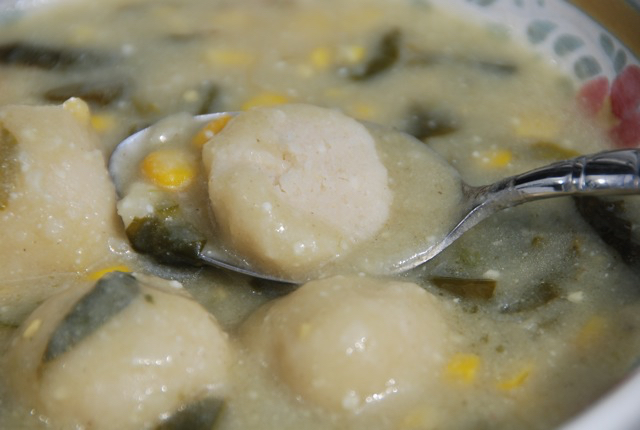
The recipe I am giving you here, was tested in my kitchen until I nailed down all the elements I enjoyed in the different versions: fluffy masa balls flavored with cheese, an abundance of Chipilí­n leaves in the broth but not in the masa balls, sweet crunchy corn seasoned along with the onion that makes the base of the soup, and cooking the masa balls in the soup so that as they cook, they thicken the broth. I find that extra thick broth to be irresisitible. It almost resembles atole or a very light porridge (in a good way).

Just like Chiapas is not so well known outside of Mexico, it’s cuisine remains to be enjoyed abroad. This soup has many of the features I recognized in the different meals I ate there: distinct, with a lot personality, yet at the same time homey, delicate and comforting. Thankfully, many of the ingredients used in Chiapas, are now accessible abroad too.

Chipilin Soup 12

A good soup recipe, I’ve learned, always comes in handy. Especially if it takes you somewhere. This one takes me right back to Chiapas.

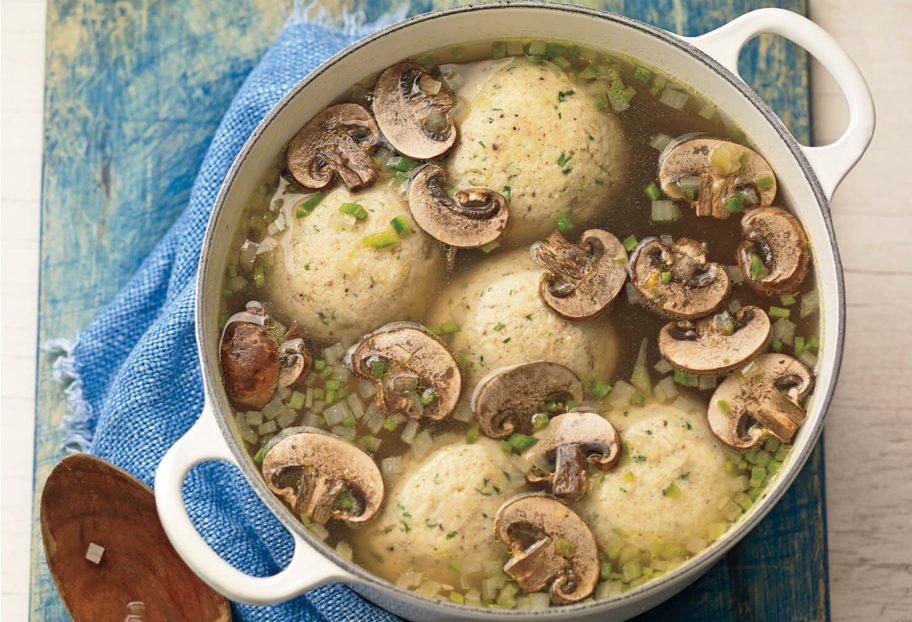
Chipilin Soup Main
Print Recipe
4.34 from 6 votes

Chipilí­n Soup with Masa and Fresh Cheese Dumplings

The recipe I am giving you here, was tested in my kitchen until I nailed down all the elements I enjoyed in the different versions: fluffy masa balls flavored with cheese, an abundance of Chipilí­n leaves in the broth but not in the masa balls, sweet crunchy corn seasoned along with the onion that makes the base of the soup, and cooking the masa balls in the soup so that as they cook, they thicken the broth. I find that extra thick broth to be irresistible. It almost resembles atoleor a very light porridge (in a good way).
Prep Time10 minutes
Cook Time35 minutes
Course: Soup
Cuisine: Mexican
Keyword: chicken broth, chipilí­n, Corn, masa, mexican crema, onion, queso fresco, Recipe, serrano chiles, soup
Servings: 6 to 8 servings
Author: Pati Jinich

Ingredients

  • 3 tablespoons vegetable oil
  • 3/4 cup white onion chopped
  • 1 serrano chile finely chopped, seeding optional, add more or less to taste
  • 3 cups fresh corn kernels or thawed from frozen
  • 8 cups chicken broth
  • 3 cups packed chipilí­n leaves rinsed
  • 2 cups corn masa flour or Maseca
  • 1 3/4 cups water
  • 8 ounces or about 1 cup queso fresco crumbled, may substitute for farmer's cheese or a mild feta
  • 1/2 cup vegetable shortening or lard
  • 1/2 teaspoon kosher or coarse sea salt divided
  • Mexican cream optional to garnish

Instructions

  • Heat oil in a soup pot over medium heat. Add the onion and cook for about 4 to 5 minutes, stirring occasionally, until it has completely softened, the edges have begun to slightly brown and there is a sweet smell stemming from the pot. Add the chile, stir and cook for another couple minutes. Toss in the corn, stir and let it cook for about 3 to 4 minutes. Pour in the chicken broth. While it comes to a simmer, prepare the masa for the dumplings.
  • In a bowl, combine the corn masa flour with the water, the vegetable shortening and a pinch of salt. Combine and knead with your hands until the dough is soft and homogenous, it will take a minute. Add the crumbled queso fresco and knead into the dough.
  • Once the soup comes to a gentle simmer, add the chipilí­n leaves. Once it is heated through, lower the heat to low and start shaping the dumplings. With your hands, make about 1 to 1½" balls, as you make them, gently drop them into the soup. Once you are done with all the balls, let the soup cook for about 20 more minutes. It should be gently simmering. The balls should be cooked through and as they cooked in the soup they should have thickened to the consistency of a thin porridge. But it will be a most delicious one! Serve hot. You may garnish with some fresh cream on top of each individual soup bowl.

Notes

Sopa de Chipilín con Bolitas de Masa y Queso

Cucumber Soup with Mint, Jalapeño and Pomegranate

Last post was about that Cucumber Martini I could drink an entire pitcher of. It feels like a century has passed, and I have so, so, so many stories and recipes to share with you. But only now, after a wildly crazy hectic summer desperately missing this blog, am I able to sit down and write. And guess what? I have no choice but to continue with cucumbers!

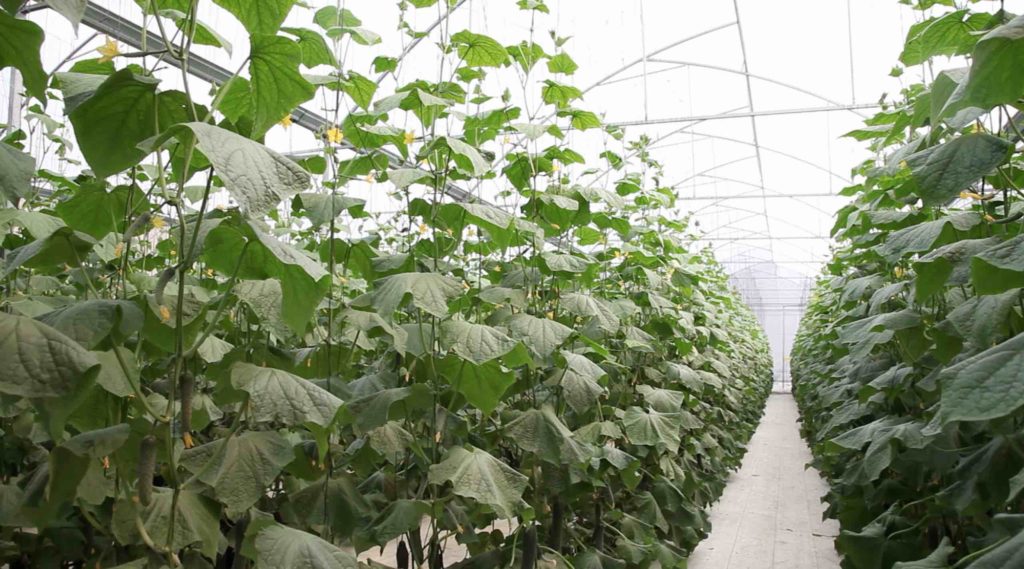
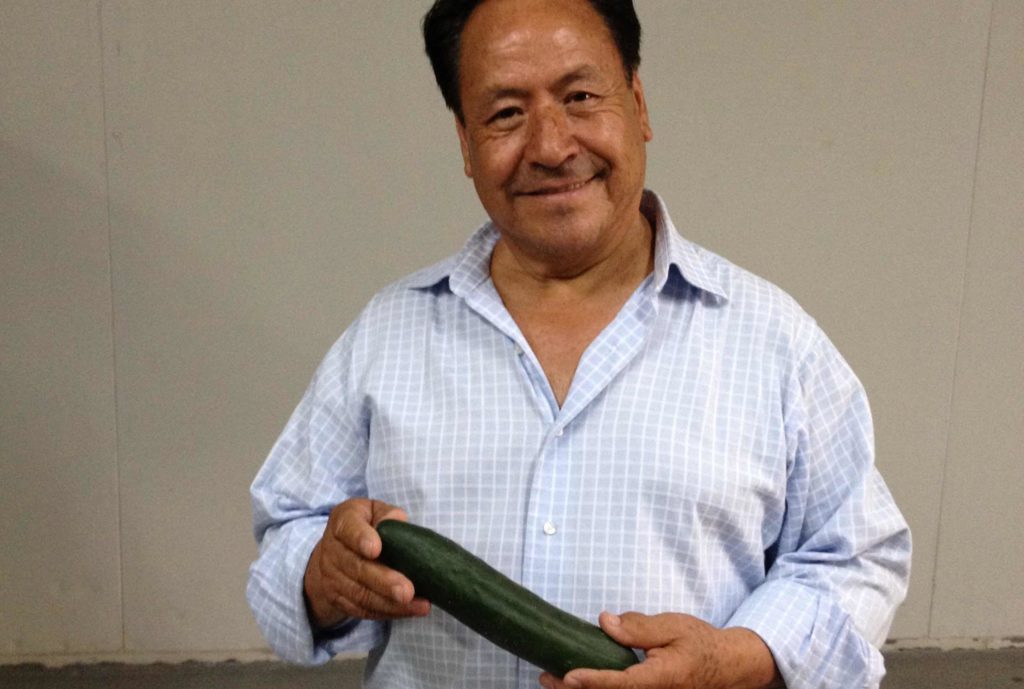
This is why: I thought I knew cucumbers, I really did, until I visited Mr. Jose Luis Rodrí­guez Rojas’ cucumber green house in the state of Morelos, a state known as “Mexico’s Spring”. Cucumbers grown there are the slicers, ironically called pepino Americano or pepino común in Mexico. Slicers are the cucumbers mostly used in Mexico’s kitchens. And the ones I use all the time.

Now I know how little I knew about them.

Sure I have peeled, sliced, diced and julienned a gazillion and have used them in so many ways, from salads to sorbets. I know it’s taste: mild, watery, fresh, wanting to be lemony. I know it’s bite: soft yet crisp. I know the coolest trick to help them never be bitter (cut ends and rub the opposing sides before peeling).

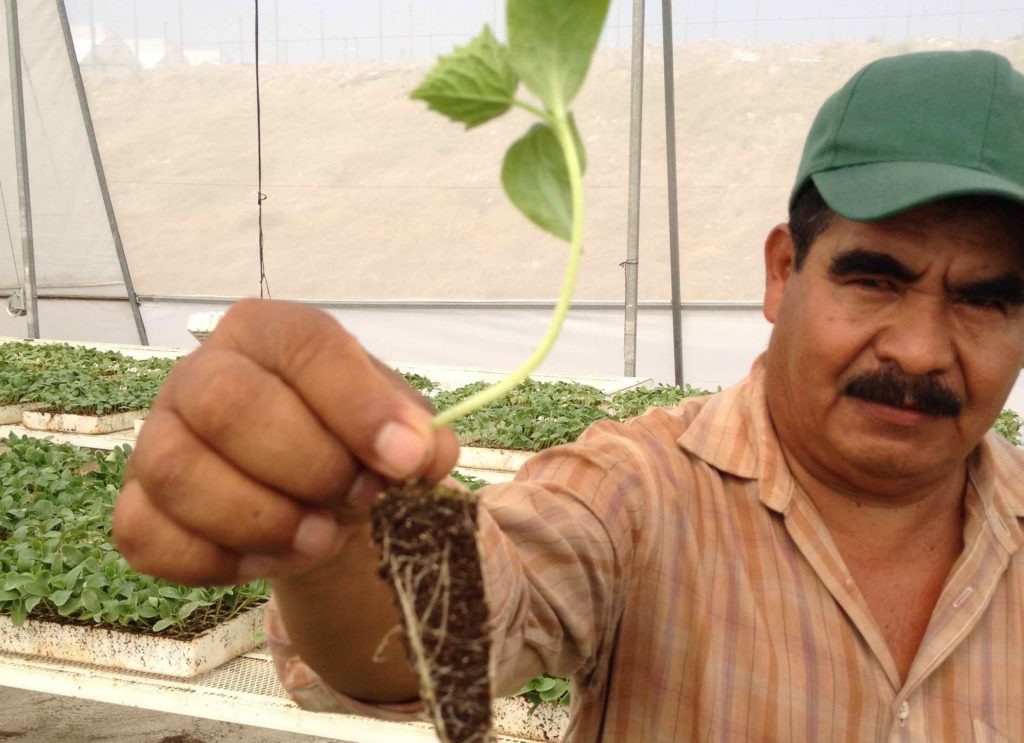
But I had never seen their plants in their youngest form, as Miguel, one of the farmers showed me.

Cucumber Soup 1

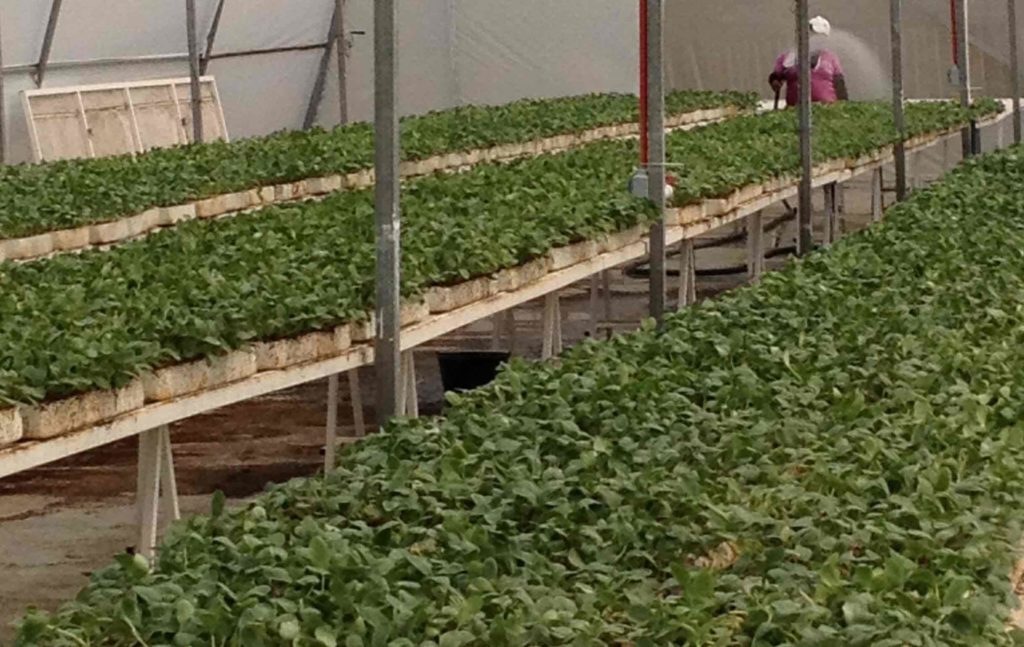
Nor was I aware, that after just one month of protected care, they grow to have jungle like looks and size.

Cucumber Soup 2

Look at them!

If I could only embed here the moist and clean smell of the plants and the velvety feel of their immense fully grown leaves, I would be so pleased.

Cucumber Soup 3

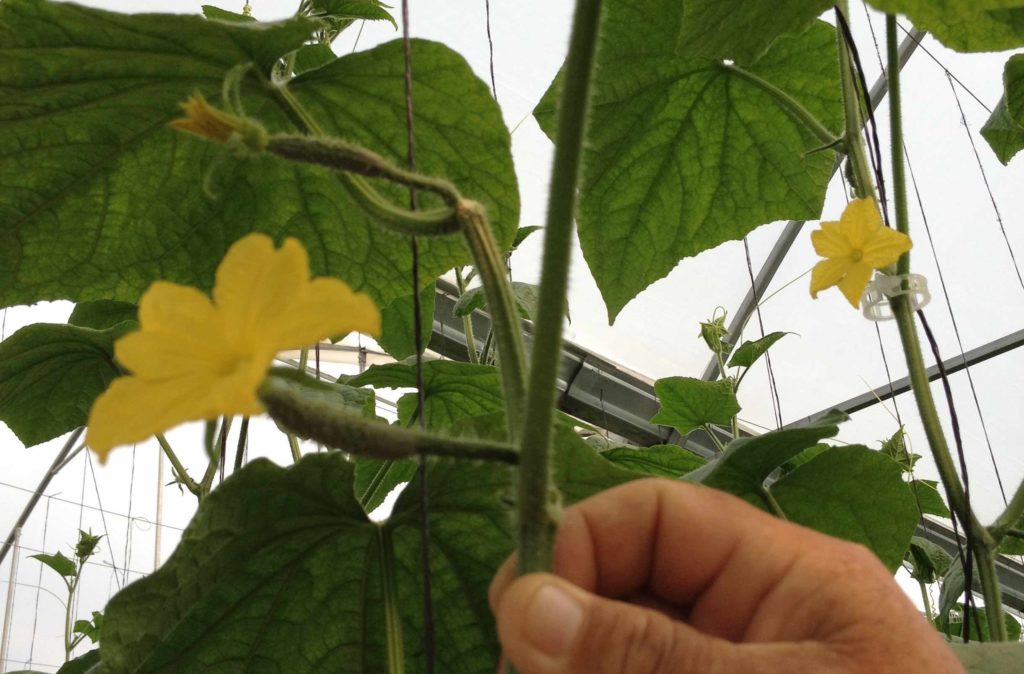
Much to my surprise, the flowers from where those huge cucumbers grow from are delicate and feminine. Their color a strong yellow that seems to want to fade right before your eyes, just as their petals seem to tell you to please be careful if you dare touch them.

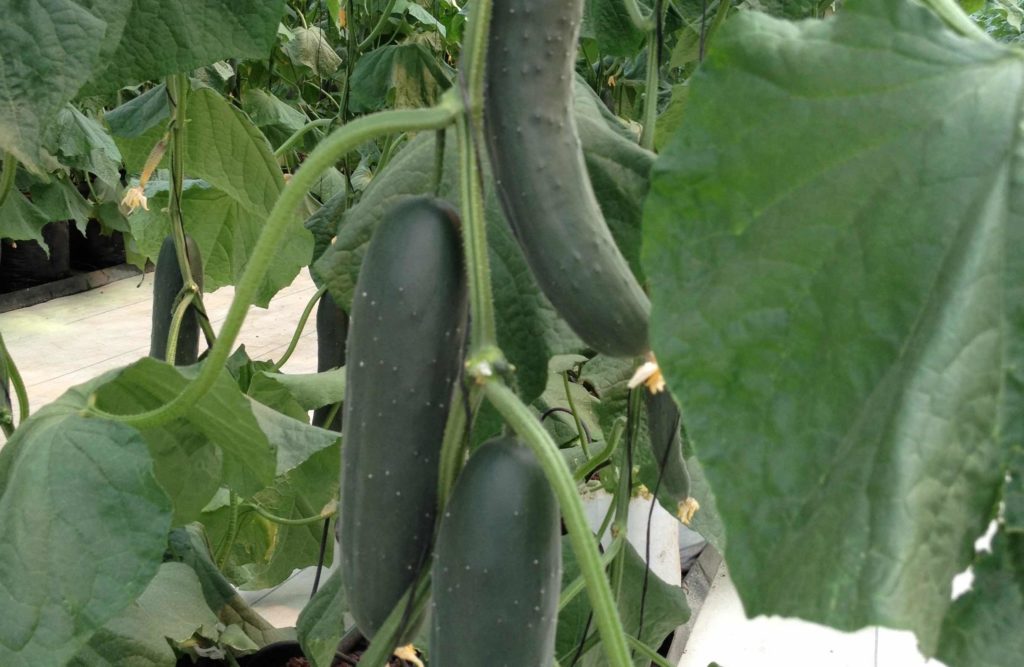
There are male and female cucumber flowers and they are both as pretty. It is the female pollinated flowers, which grow a miniature baby cucumber right behind, covered in tiny-prickly-thin-like thorns that protect it as it grows. So they have ways of telling you not to touch them.

Cucumber Soup 4

The flower holds on, as the cucumber grows. See below?

I marveled.

After a while, I had to make an effort to stop ooooohing and aaaaahing at every site (I have to act more my age, you know).

Cucumber Soup 5

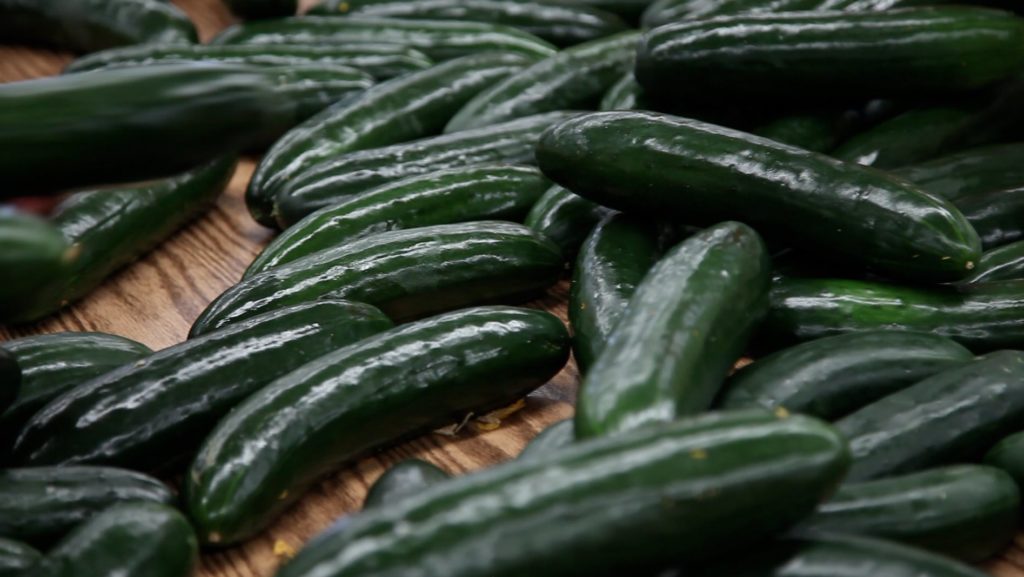
After they pick the cucumbers, they clean them and pack them up.

Cucumber Soup 6

Mr Jose Luis employs about 300 people a year. Each person I met, seemed proud about their job and meticulous in their care of the green house facilities and mostly, the plants. “No one kneels here to work”, Mr. Jose Luis repeated a couple times, “work here is worthy, dignified”. Truth is, it genuinely felt that way. It seemed that people felt vested in the business. Their faces lit up when I asked any question that popped out of my mouth (if you know me by now you know I have an endless stream of questions…).

Crazy Nacho Guani, who was filming with Cortez Brothers and I (for Season 2, which launches this weekend, yey!) was filming up there like a wild monkey (if you knew Nacho you’d know he climbs anything that has any height… )

Cucumber Soup 7

Mr Jose Luis’ chest seems to burst as he talks about the history of his green house, more so about the vegetables he grows. He drastically changed careers, like I did too. He, also, has never looked back.

After spending the day, Mr Jose Luis, who could not have been more friendly, asked if we were hungry. We were starved. He immediately offered to take us to his favorite place for a late lunch-early dinner. But that’s another story.

Cucumber Soup 8

Lesson learned, yet again: no ingredient, no single one is common. Even if it goes by the name pepino común, or common cucumber. Not even if you have used it a thousand ways and have chopped it a gazillion times.

Getting to know cucumbers, from flower to tops, made me think of so many new ways to use them. In a cold soup? With a bit of a bite from a jalapeño? With the wide echo from some mint? Topped with something sweet and crunchy and tart to make it all go wild in your mouth?

I played with the idea and once that I nailed a take I liked, I can’t stop making it.

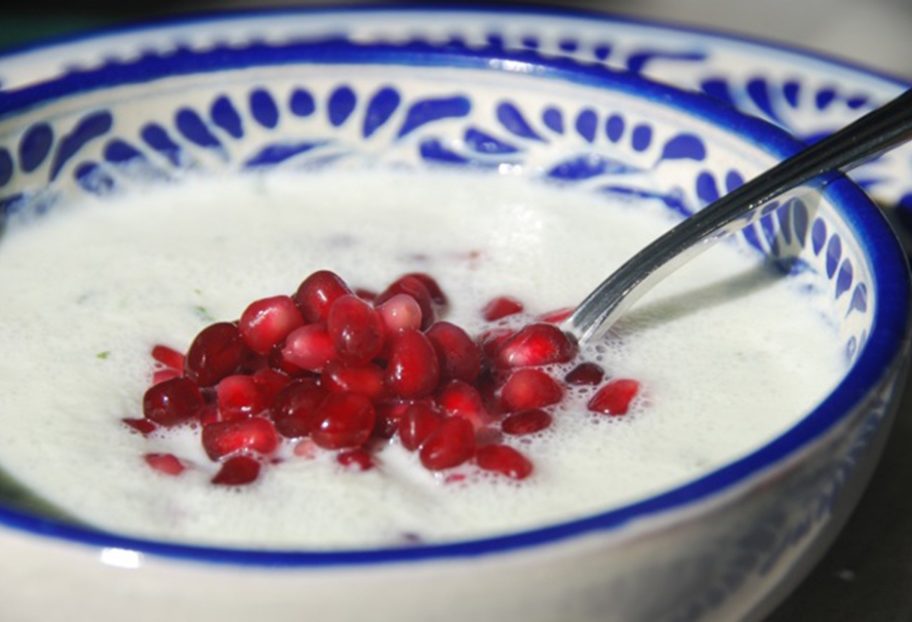
Think of it as a Mexican tzatziki or as a white cucumber gazpacho of sorts. Or better yet, indulge me please and just make it. To boot: takes but 2 minutes in the blender.

p.s. Party or Holidays coming soon? Serve it in little mugs or cups for people to drink and munch along.

Cucumber Soup main
Print Recipe
5 from 2 votes

Cucumber Soup with Mint, Jalapeño and Pomegranate

Getting to know cucumbers, from flower to tops, made me think of so many new ways to use them. In a cold soup? With a bit of a bite from a jalapeño? With the wide echo from some mint? Topped with something sweet and crunchy and tart to make it all go wild in your mouth? I played with the idea and once that I nailed a take I liked, I can’t stop making it.
Prep Time10 minutes
Cook Time5 minutes
Course: Soup
Cuisine: Mexican
Keyword: cucumber, jalapeno, lime, mint, onion, pati's mexican table, pomegranate, yogurt
Author: Pati Jinich

Ingredients

  • 1 1/2 cups thick Greek yogurt
  • 3 pounds slicer/common cucumbers about 2 1/2
  • 1 tablespoon red onion chopped
  • 1 clove garlic
  • 1 tablespoon jalapeño chopped or more to taste (seeding optional)
  • 15 mint leaves
  • 2 tablespoons fresh squeezed lime juice
  • 1 teaspoon kosher or coarse sea salt or more to taste
  • 3/4 cup pomegranate seeds or more to taste

Instructions

  • Wash cucumbers, cut the ends and use them to rub the opposing cut ends of the cucumber. Peel and cut lengthwise into 4 long strips and slice off the seeds. Discard the seeds and cut into chunks.
  • In the jar of a blender, place the yogurt, cucumbers, red onion, garlic, jalapeño, mint, lime juice and salt.
  • Puree until smooth. Pour inside a mug or container and store in refrigerator until ready to serve.
  • Serve and sprinkle pomegranate seeds on top.

Notes

Sopa de Pepino con Jalapeño, Menta y Granada

Creamy Poblano Soup

Growing up in Mexico City, I didn’t know a single person who celebrated Cinco de Mayo, except for the people who lived in the state of Puebla. We didn’t even get the day off! Sure we studied it in school–the unprecedented victory of a small Mexican militia against the large French army in 1862–but it was a short-lived victory, as the French won right back.

Fast forward 150 years to 2012: the French and Spanish are gone; Mexicans proudly celebrate Independence Day every September 16; yet, for reasons few of us can explain, Cinco de Mayo has become the greatest, most joyous, colorful celebration–for Mexicans living abroad. As strange as the nostalgia is, the longer I live abroad, the stronger the impact Cinco de Mayo has within my soul. These words fluff up like soft conchas right out of the oven, getting fluffier, sweeter and more comforting as the years go by.

As do so many Mexicans (and, increasingly, non-Mexicans), I celebrate anything that can be celebrated about our Mexicaness: our heritage, resilience, hard-working and accommodating nature, our warmth, hospitality, generosity, the vibrancy and richness of our music, dance and food. Above all, our tendency to tirar la casa por la ventana (to throw out the house through the window) when it comes to throwing a party.

Thankfully, as Cinco de Mayo celebrates its 150th anniversary this year, the spotlight is finally being cast on Puebla, the place where that famous battle took place. At last, the celebration that has become the rage beyond Mexico’s borders is coming back to the place where it originated. It’s about time!

Puebla is a hidden treasure, a colonial jewel with rich history, architecture, arts and culture, coupled with an exquisite overlay of modernity. Most important, its one of Mexico’s main culinary hubs.

Creamy Poblano Soup 1

Some of our most iconic (and most labor intensive) dishes come from Puebla, born in convents where Spanish and Mexican cuisines wedded so beautifully. There’s the classic mole Poblano, with its layers of complex flavors subtly coming together once in your mouth; and there’s the colorful Chiles en Nogada whose red, white and green represents the Mexican flag.

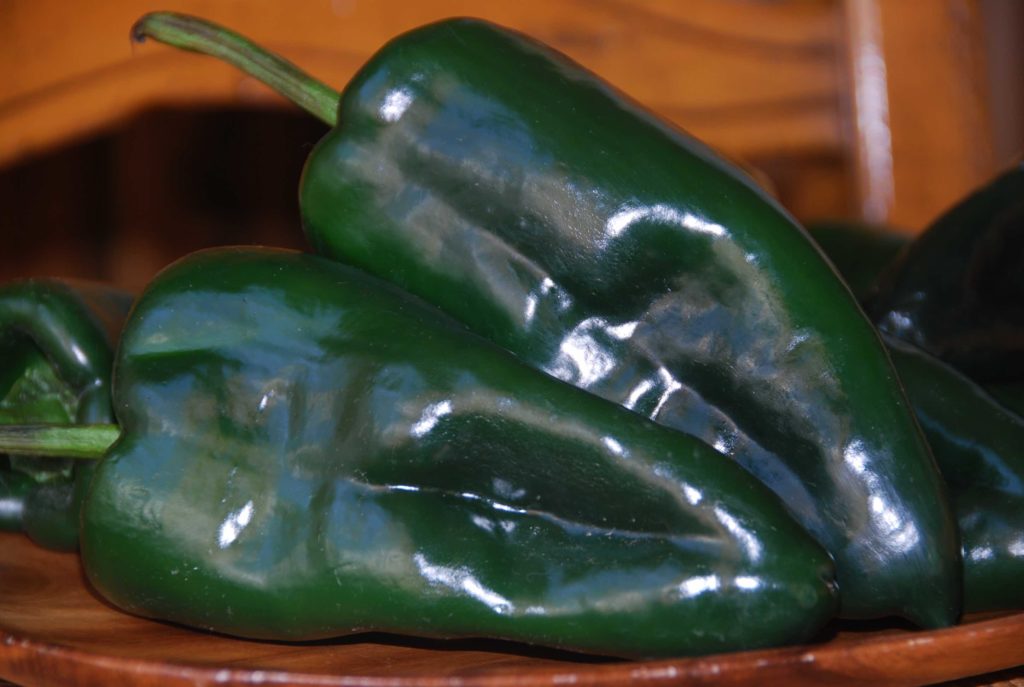
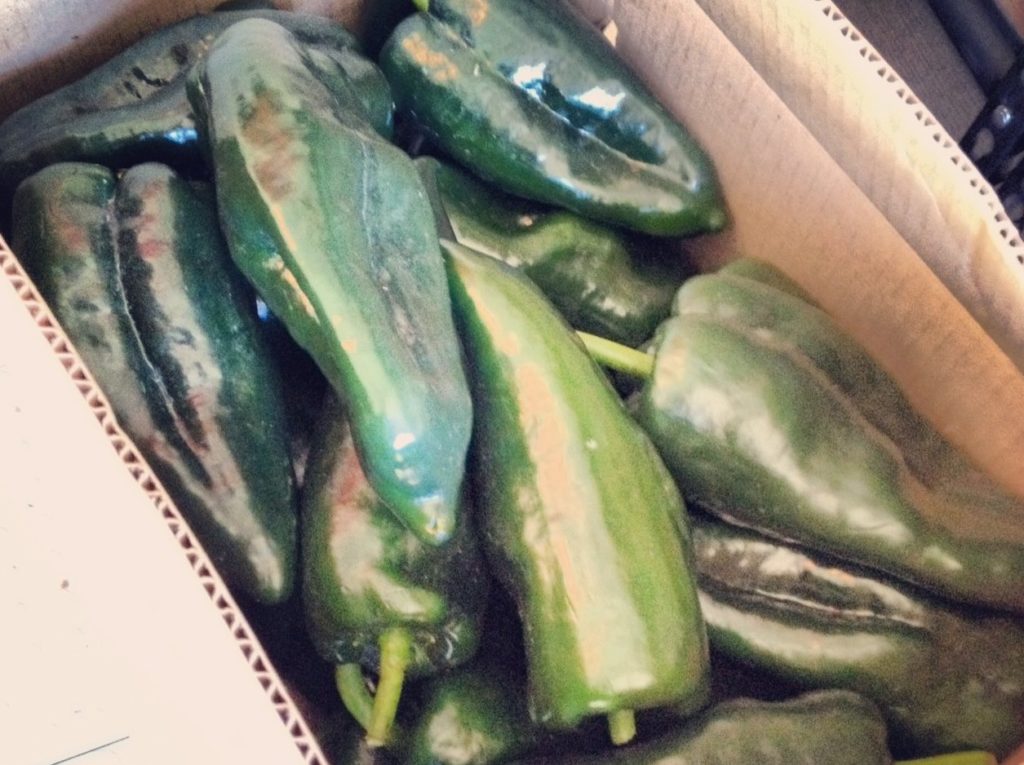
Yet Puebla is also home to a bounty of homestyle accessible dishes like the chicken tinga and the corn torte. And it’s home to one of my favorite Mexican ingredients: the chile Poblano. See below? That is how many Poblano chiles I go through a week in my house.

Creamy Poblano Soup 2

This key ingredient has never ceased to charm me, from the moment I get it at the store to the moment I taste its exuberant, fruity flavor. It is, quite simply, sublime. Each time I cook a dish with a Poblano it feels like a celebration, as if I were right there in Puebla, but the party just happens to unfold inside of my home.

If you can’t get to Puebla anytime soon, try this soup for a Cinco de Mayo moment, be it Cinco or not.

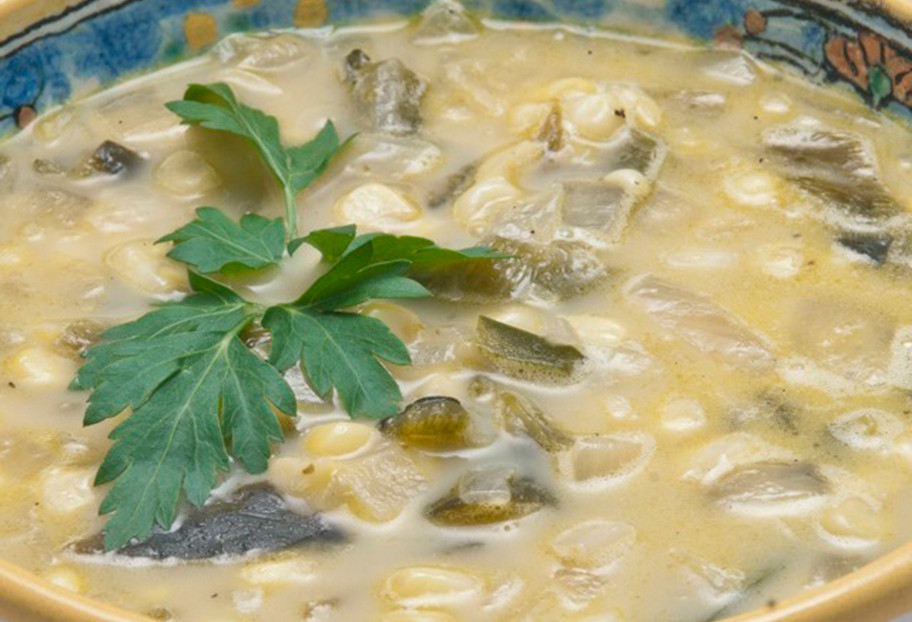
Article written for and published by NBC Latino, poblano soup photo by Jack Foley.

Print Recipe
3.86 from 7 votes

Creamy Poblano Soup

This key ingredient has never ceased to charm me, from the moment I get it at the store to the moment I taste its exuberant, fruity flavor. It is, quite simply, sublime. Each time I cook a dish with a Poblano it feels like a celebration, as if I were right there in Puebla, but the party just happens to unfold inside of my home. If you can’t get to Puebla anytime soon, try this soup for a Cinco de Mayo moment, be it Cinco or not.
Prep Time10 minutes
Cook Time25 minutes
Course: Soup
Cuisine: Mexican
Keyword: chicken broth, Corn, milk, onion, poblanos, Recipe, soup
Servings: 4 to 5 servings
Author: Pati Jinich

Ingredients

  • 2 tablespoons unsalted butter
  • 2 tablespoons vegetable oil
  • 2 cups chopped white onion
  • 5 to 6 poblano chile peppers (about 1 1/2 pounds total) roasted or charred, sweated, peeled, seeded and diced
  • 2 cups corn kernels shaved from a cooked fresh ear of corn, or cooked from thawed
  • 1/2 teaspoon kosher or coarse sea salt or to taste
  • freshly ground black pepper or to taste
  • 3 cups chicken broth may substitute for vegetable broth
  • 1 cup milk

Instructions

  • Place a large soup pot over medium heat; add oil and butter. Once the butter melts and begins to sizzle, add the onion. Cook the mixture, stirring occasionally, until the onions have completely softened, everything is cooked through and the edges turn slightly brown (about 10 minutes total).
  • Add the poblano chiles, stir and let them cook along with the onion for 3 to 4 minutes.
  • Make some room in the middle of the pot; add the corn and sprinkle the salt and pepper. Let everything cook, stirring occasionally, for another 3 to 4 minutes.
  • Pour in the chicken broth. Let it come to a simmer and cook for 3 to 4 additional minutes so the flavors start to blend. Reduce the heat to low, wait for about a minute, and slowly pour in the milk.
  • Heat the soup thoroughly for about 6 to 8 minutes, without letting it simmer or boil (if you do, it will appear curdled but still taste fine). Serve hot. Makes about 5 cups.

Notes

Crema Poblana

Apple, Radish, Watercress Salad with Pistachio and Chile de Arbol

A couple weeks ago, right as I was setting up for one of my classes, “A Culinary Compass of Mexico,” at the Mexican Cultural Institute, Alberto Roblest came over and asked me a great question.

“Pati, do you cook traditional Mexican recipes OR do you create your own?”

Alberto is doing a project with the support of The Office on Latino Affairs. It is called Hola Cultura and explores the contributions of Latinos to DC life and culture, from art to language to sports to cooking.

I think he meant for me to respond with an either or. He really did. Come on Pati, “traditional” OR “new,” he insisted. But I kept answering “BOTH!” As I kept trying to explain why, I realized so wholeheartedly that both traditional and new not only describe my cooking style but also one of the many wonders of Mexican cuisine.

See… I thrive on exploring, traveling, tasting, testing, recreating and passing on traditional Mexican cuisine and recipes. If I get to live to be 120 years old, I won’t have enough time to taste and share all the rich and vibrant regional cuisines and dishes that exist across Mexico.

Mexican cooking has such sturdy pillars and is so strong, partly because generation after generation, tried and true recipes are passed on, sometimes written and sometimes not. When a dish and its traditions somehow get lost in a family, neighborhood, or community… once it is found and recreated again, a lifeline that holds us together suddenly appears! Even if its on the other side of the globe.

When I receive a request for that “much needed but can’t be found” recipe, I jump for joy! I am sent on a serious mission, and I don’t stop until it is completed.

Apple Radish Watercress Salad 1

At the same time, Mexican cuisine is so strong because it has a treasure trove of fabulous ingredients that are so accommodating in their use. As long as one understands the ingredient and its genuine nature, there are so many ways to experiment with it. That is also how a cuisine expands, by creating new combinations and testing the limits, sometimes failing and sometimes succeeding. Surely, many of the traditional takes were once new too.

While I dedicate so much of my time researching and passing on what has existed for generations and centuries, I can’t resist creating new dishes. Funny, that it happens many times with salads, like the Watermelon and Tomatillo Salad.

For the one on this post, which I have been obsessively repeating, I use watercress, called “berros” in Mexico (I happen to love that word). They are used tremendously in Mexican kitchens for salads. They are delightful: a bit bitter, made up on thin leaves but packed with flavor and such a nice delicate bite.

On top goes a combination of thinly sliced tart green apples and pungent radishes. One ingredient snapped from a tree and another pulled from the ground! Both ingredients have a bright colorful outer skin, yet, inside are crisp white. I use them both raw, and get the most of their watery crunch and contrasting taste.

Then it is all covered in a light vinaigrette with a bit of mustard and a bit of honey. Then a stellar topping tries to steal away the show.

Apple Radish Watercress Salad 2

Toasted chile de árbol and pistachios, chopped together. A smoky, lightly spicy, crunchy, nutty and ironically sweet combination.

You won’t believe how sweet the pistachios taste on each bite.

Apple Radish Watercress Salad 3

Give it a try!!

Its fresh, its crunchy, lightly tart, with a nice kick and a combination of unexpected flavors that I hope will have you making it time and again as the seasons move on…

p.s. All that said: send along more requests for any more Mexican recipes you are craving at any time.

apple, watercress, radish and chile de arbol salad
Print Recipe
5 from 4 votes

Apple, Radish, Watercress Salad with Pistachio and Chile de Arbol

For the one on this post, which I have been obsessively repeating, I use watercress, called “berros” in Mexico (I happen to love that word). They are used tremendously in Mexican kitchens for salads. They are delightful: a bit bitter, made up on thin leaves but packed with flavor and such a nice delicate bite. On top goes a combination of thinly sliced tart green apples and pungent radishes. One ingredient snapped from a tree and another pulled from the ground! 
Prep Time10 minutes
Cook Time5 minutes
Course: Salad
Cuisine: Mexican
Keyword: chiles de arbol, green apple, honey, lime, mustard, pistachios, radish, Recipe, salad, vinegar, watercress
Servings: 4 servings
Author: Pati Jinich

Ingredients

  • 2 bunches watercress rinsed, dried and the tougher ends of stems removed
  • 1 green apple rinsed, and cut into thin wedges
  • 1 bunch radishes (or about 4 ounces or 1 cup already sliced), rinsed, stems and roots removed, halved and thinly sliced
  • 1/4 cup pistachios lightly toasted and chopped
  • 2 chiles de arbol toasted, chopped (seeding optional)
  • 1/4 teaspoon dijon mustard
  • 1/2 teaspoon honey
  • 1/2 teaspoon kosher or sea salt or to taste
  • freshly ground black pepper to taste
  • 1 tablespoon rice vinegar (natural unseasoned)
  • 2 tablespoons freshly squeezed lime juice
  • 3 tablespoons olive oil
  • 2 tablespoons vegetable oil

Instructions

  • Place the apple and the radishes in a bowl. Place the watercress in another bowl.
  • Heat a a small 6 inch skillet set over medium low heat, add the pistachios and toast anywhere form 3 to 5 minutes, stirring often, until they are nicely toasted, but don't let them burn. Remove form heat. In the same skillet, toast the chiles de arbol anywhere from 3 to 5 minutes, flipping sides, 1 or 2 times along the way, remove from the heat.
  • Remove the stems from the chiles de arbol. In a chopping board, chop the chiles de arbol. You may remove the seeds once they are chopped or keep them. Add the pistachios and chop them along with the chile de arbol creating a pistachio chile de arbol mixture.
  • In a small bowl, combine the mustard, honey, salt, pepper, rice vinegar and lime juice with a whisk or fork. Slowly, pour in the oils and whisk or mix very well until thoroughly combined. Pour half onto the apple-radish mix and half onto the watercress.
  • To serve, on small appetizer plates, add watercress, top with the apple-radish mixture and sprinkle some of the pistachio-chile de arbol mix on top.

Notes

Ensalada de Berros con Manzana y Rábanos

Make It, Freeze It, Take It: The Mexican Casserole

Every few months, my family gets together with a Latin group of friends and their families for a pot luck.

This winter it was our turn. As tradition goes, the host brings the main dishes to the table and the others bring the rest. I eagerly announced my plans to share Mexican casseroles, also called cazuelas, budines or pasteles. The Mexicans couldn’t hide their joy- “Pati! De veras? Budin Azteca? Cazuela de Tamal?!”- and quickly thought of other “very” Mexican sides to pair with them. The Argentines and Costa Ricans tried to understand what “Mexican casserole” meant and whether it was supposed to be any good. The Americans in the group (though they consider themselves Latin) were clearly not excited about it.

No doubt about it, casseroles have had their ups and downs in culinary history. Their weakest stand seems to have been in the United States, after being fashioned into “two-step-many-can” versions in the 1930 and ’40s. But think of all the bright stars in the casserole universe: French cocottes enveloped in mother sauces; British potpies encrusting fillings as wet as British weather; irresistible Italian lasagnas layered with pasta; Peruvian causas with seasoned meat encased in mashed potatos; Greek spanakopitas with an extra-savory cheese-spinach mix covered with phyllo dough; Middle Eastern moussakas stacked with layers of eggplant; and the not-so-well-known, yet gloriously tasty Mexican cazuelas…

All of those casseroles are assembled, baked and served in the same vessel, which makes them convenient, practical and savvy. They are cooked tightly covered without a hurry, giving their fillings time to become succulent with fully blended flavors. Then their messy beauty unravels on your plate. One has to wonder: Why don’t we see more of them around, when we all crave flexible meals that can be made in advance?

In the Old World, casseroles’ prestige may have peaked in the early Renaissance.They were served at royal feasts, with artful decorations fit for competitions and complex fillings; some even had live birds fly out of them with an exhilarating song as the first piece was cut. Such a high-pitched recipe is found in the first British cookbook published during the mid-16th century. It also was recorded as part of one of the most extravagant banquets ever: the wedding of Marie de Medici and Henry IV of France, held in 1600 in Florence. This theatrical dish might have inspired the nursery rhyme “Sing a Song of Sixpence,” in which “four and twenty blackbirds” are baked in a pie.

Fast-forward to 2009: British celebrity chef Heston Blumenthal felt obliged to replicate it in his Medieval episode of “Heston’s Feasts” in England.

Surprisingly, I recently found the nursery rhyme’s muse of a pie in the anonymous 1831 Mexican cookbook “El Cocinero Mexicano.” I am always amazed at how ingredients and recipes hop around the globe. But this I found to be absurdly funny: As if Mexican cooks needed any more outrageous ideas of what to do with casseroles.

Centuries before Old World cooks were trying to impress guests with interactive creations, Mexicans were baking casseroles in underground pits and cooking them over rustic fires. The fillings might not have been able to take flight, but they did contain wild turkey, boar and/ or iguana.

The first version of a Mexican casserole seems to have been the muk-bil (literally, “to put in the ground”). Made by the Mayans on the Yucatan Peninsula since pre-Hispanic times, it is the King Kong of tamales. Truly gigantic. The corn dough wraps around a filling of turkey (after the Spanish arrived, chicken and pork were used as well) rubbed with a pungent paste seasoned with achiote (annatto) seeds, spices and tomatoes. It resembles the flavors of cochinita pibil, a robust Yucatan dish.

So prized was this tamal in ancient times that it was designated meal for major festivities, and it still is. You can bet there will be a lot of muk-bils made this year with all the talk of 2012 marking the end of the Mayan calendar. So it is the right time to head down there if you want a true taste.

This tamal is traditionally wrapped in fragrant banana leaves and baked underground, which gives it a smoky flavor.

Other tamal casseroles throughout Mexico have regional spins, ingredients and salsas. Just across the border in neighboring American states, tamal pie recipes appeared in cookbooks at least a hundred years ago. They called for cornmeal rather than fresh corn masa; the former leads to a much grainier and less fluffy result. That was probably because making masa from scratch involves the ancient nixtamalization process, which takes days (drying, soaking, cooking and grinding) to treat corn so that its nutritious content is fully exploited. It makes a masa so soft that it is practically airy. Today, outstanding instant masa flour that has already gone through that process is widely available, so it’s a snap to put together a real tamal casserole at home.

Here my go-to version: The masa dough is set in two thick layers that hold a rich and baroque filling, typical of the Mexican colonial era, when nuns used to combine Spanish and Mexican ingredients in their convent kitchens. The filling has a sauce made with my preferred pairing of dried chili peppers: sweet, almost chocolaty and prune-flavored ancho and mild, bright-tasting guajillo. It’s seasoned with onion, garlic, oregano, cloves, cinnamon and a pinch of cumin, then made hearty with juicy ground meat that is sprinkled with crunchy almonds, chewy raisins and salty manzanilla olives.

Just like a tamal casserole is a giant version of a tamal, a tortilla casserole is like a hefty stack of open-face tacos with layers of sauce and cheese. It’s a homespun version of tacos, one of the most sought-after street foods in my native country: Taco elements are layered in a cazuela, or earthenware pot. That takes away the hassle of making individual portions and allows for endless filling possibilites, just as with tacos and tamales.

The most popular casserole of them all has an imperial name: Aztec. It is traditionally made with corn tortillas, as they are much more resilient than flour tortillas. Think of a lasagna gone way down south, soaked in a spiced-up tomato sauce with handfuls of exuberant, fruity, addictive roasted poblano peppers and crunchy, sweet corn. Chicken is sometimes added to the mix, which is then bathed with Mexican crema and melty cheese. When I was growing up, and Aztec casserole was a must for successful potlucks.

Some versions use salsa verde or mole sauce instead of a tomato sauce, as well as other kinds of meats and vegetables. Good-quality corn tortillas can be found at the market, so there’s no need to make your own.

The rice casserole is the most modern of the three I’ve offered here. Brought over from Europe by the Spanish, rice has grown deep roots in Mexican cooking. The dish I have been obsessively repeating came about because I wanted to use the bounty of fresh mushrooms found in stores this time of year. Although I don’t have the wild varieties that crop up in Mexico’s rainy season, I have experimented with an accessible mix of mushroom textures and flavors, fresh herbs, epazote, cilantro, parsley, that salty crema and tangy cheese. This stew goes on top of the rice with a topping of grated dry and aged cheese. As the casserole bakes, the rice absorbs the flavored cream, the mushrooms meld with the sauce and the cheese morphs into a perfectly browned crust.

I’m wondering whether Mexican renditions can lend a bit of prestige to the state of casseroles in the United States. They certainly receive a royal welcome from my potluck friends, who heap seconds on their plates.

Article written for and published by The Washington Post. Photo taken by Deb Lindsey Photography www.deblindsey.com.

Meaty Tamal Casserole
Print Recipe
4.41 from 5 votes

Meaty Tamal Casserole

My go-to version of a tamal casserole: The masa dough is set in two thick layers that hold a rich and baroque filling, typical of the Mexican colonial era, when nuns used to combine Spanish and Mexican ingredients in their convent kitchens. The filling has a sauce made with my preferred pairing of dried chili peppers: sweet, almost chocolaty and prune-flavored ancho and mild, bright-tasting guajillo. It’s seasoned with onion, garlic, oregano, cloves, cinnamon and a pinch of cumin, then made hearty with juicy ground meat that is sprinkled with crunchy almonds, chewy raisins and salty manzanilla olives.
Prep Time30 minutes
Cook Time1 hour 45 minutes
Total Time2 hours 15 minutes
Course: Main Course
Cuisine: Mexican
Keyword: ancho chiles, Casserole, Cazuela, guajillo chiles, masa, meat, tamal, Tamales, veal
Servings: 10 servings
Author: Pati Jinich

Ingredients

For the dough:

  • 1 1/4 cups vegetable shortening or lard
  • 1 teaspoon kosher or coarse sea salt
  • 2 teaspoons baking powder
  • 1 1/2 pounds (about 5 cups) corn masa flour for tortillas or tamales such as Maseca brand
  • 4 1/2 cups homemade or no-salt-added chicken broth may substitute water

For the filling:

  • 8 dried guajillo chiles stemmed, halved and seeded
  • 8 dried ancho chiles stemmed, halved and seeded
  • 2 cups hot water or as needed
  • 1 teaspoon dried oregano
  • 5 whole cloves
  • 1 teaspoon ground cinnamon
  • Pinch ground cumin
  • 3 tablespoons vegetable oil plus more for the baking dish
  • 1 medium white onion chopped (about 1 cup)
  • 6 cloves garlic chopped
  • 2 1/2 pounds ground meat such as veal, turkey, beef, pork or a combination
  • 1 teaspoon kosher or sea salt or to taste
  • 1/4 teaspoon freshly ground black pepper
  • 2 cups homemade or no-salt-added chicken broth may substitute water
  • 1 cup raisins
  • 3/4 cup slivered almonds
  • 3/4 cup pimento-stuffed manzanilla olives chopped

Instructions

For the dough:

  • Place the vegetable shortening or lard in the bowl of a stand mixer; beat on medium speed for about 3 minutes, until it is light and airy. Stop to scrape down the sides of the bowl.
  • Add the salt and baking powder; on low speed, gradually add the corn masa flour and the broth in alternating additions, making sure each time that the addition is well incorporated. Beat for about 10 minutes to form a masa dough that is homogeneous and fluffy. Let the dough sit at room temperature while you make the filling.

For the filling:

  • Heat a comal (tortilla griddle) or skillet over medium heat. Add the guajillo and ancho peppers; toast them for about 15 seconds per side, until they become more pliable, lightly toasted and fragrant and their inner skin turns opaque. Transfer to a medium saucepan and cover with at least 2 cups of hot water. Cook over medium-low heat for about 15 minutes, or until the peppers have rehydrated, plumped up and softened.
  • Transfer the peppers and 2 cups of the liquid to a blender and add the oregano, cloves, cinnamon and cumin. Remove the center knob from the blender lid and cover the opening with a dish towel to contain splash-ups. Puree to form a smooth sauce. The yield is 2 1/2 to 2 3/4 cups.
  • Heat the oil in a large, deep skillet over medium-high heat. Add the onions and cook for 4 to 5 minutes, stirring continuously, until the onions are cooked through and beginning to brown at the edges. Add the garlic and cook until fragrant, less than a minute, then add the ground meat, salt and black pepper. Cook for 12 to 15 minutes, stirring occasionally and using a spoon to break up the meat, until it has lightly browned. Add the sauce, the broth, raisins, almonds and olives, stirring to combine; reduce the heat to medium-low, cover the skillet and cook for 20 minutes. Uncover, stir and cook uncovered for 5 minutes.
  • Preheat the oven to 400°F. Use a little vegetable oil to grease a 9-by-13-inch baking dish or the equivalent.
  • Spoon half of the prepared masa dough into the dish, forming a bit of a lip on the sides and gently leveling it out; don’t press hard. Spoon all of the meat filling on top. Cover evenly with the remaining dough. Cover the dish tightly with aluminum foil and bake for 1 hour or until the masa is completely cooked and the top appears to be firm. Remove from the oven and let it sit, covered, for 10 to 15 minutes before serving.

Notes

Cazuela de Tamal
Chicken and Tortilla Aztec Casserole
Print Recipe
3.67 from 3 votes

Chicken and Tortilla Aztec Casserole

The most popular Mexican casserole of them all has an imperial name: Aztec. It is traditionally made with corn tortillas, as they are much more resilient than flour tortillas. Think of a lasagna gone way down south, soaked in a spiced-up tomato sauce with handfuls of exuberant, fruity, addictive roasted poblano peppers and crunchy, sweet corn. Chicken is sometimes added to the mix, which is then bathed with Mexican crema and melty cheese. When I was growing up, and Aztec casserole was a must for successful potlucks.
Prep Time15 minutes
Cook Time45 minutes
Total Time1 hour
Course: Main Course
Cuisine: Mexican
Keyword: Aztec, Azteca, Casserole, Cazuela, chicken, chile, Corn, corn tortillas, Mexican lasagna, Poblano
Servings: 8 servings
Author: Pati Jinich

Ingredients

For the sauce:

  • 3 tablespoons vegetable oil
  • 1 medium white onion chopped (about 1/2 cup)
  • 2 cloves garlic minced or pressed
  • 2 pounds ripe tomatoes cored and pureed, or whole canned tomatoes, drained and pureed (to make about 5 cups tomato puree)
  • 1/2 teaspoon dried oregano
  • 1 bay leaf
  • 1 teaspoon kosher or coarse sea salt

For the tortillas:

  • 1 cup vegetable oil or more as needed, for frying the tortillas
  • 8 to 10 (9 ounces total) corn tortillas

For assembly:

  • 4 cups cooked shredded chicken
  • 4 cups fresh corn may substitute frozen (see NOTES)
  • 1 pound poblano chiles roasted, peeled, seeded and cut into rajas (see NOTES)
  • 1 cup Mexican cream (crema) Latin-style cream, creme fraiche or heavy cream
  • 12 ounces (about 3 cups) grated Oaxaca, mozzarella, Monterey Jack or mild white cheddar cheese

Instructions

For the sauce:

  • Heat the oil in a large saucepan over medium heat. Stir in the onion and cook until soft and translucent, stirring occasionally, about 6 minutes. Stir in the garlic and cook until fragrant, 30 seconds to 1 minute. Add the tomato puree, oregano, bay leaf and salt and cook for about 10 minutes, stirring occasionally, until the sauce thickens and darkens in color. Remove from the heat and discard the bay leaf.

For the tortillas:

  • Cover a large plate or baking sheet with several layers of paper towels. Pour the oil into a medium 10-inch skillet to a depth of 1/4 inch (about 1 cup). Heat over medium-high heat until hot but not smoking, about 2 to 3 minutes. Working with one tortilla at a time, use a pair of tongs to pass the tortilla through the oil for 10 to 15 seconds per side; this will make the it pliable and resistant to the sauce. The tortilla will first appear to be softening and then will become barely crisp, and its color will darken. Drain on the paper towels.

To assemble:

  • Spread one-third of the tomato sauce on the bottom of a 9-by-13-inch baking dish or the equivalent. Cover with half of the cooked chicken, half of the corn, half of the poblanos and one-third of the cream and cheese. Top with half of the tortillas, tearing them into large pieces if needed to make an even layer without much overlap. Repeat, adding one-third of the tomato sauce; the remaining half of the cooked chicken, corn and poblanos; and one-third of the cream and cheese. Top with a layer of the remaining tortillas, the remaining one-third of the sauce and the remaining cream and cheese.
  • When ready to bake, preheat the oven to 375°F. Cover the casserole dish with a lid or with aluminum foil. Bake for 25 minutes, then remove the lid or foil and bake for 15 minutes or until the top is bubbly and the cheese has melted. Serve hot.

NOTES:

  • To create rajas, or strips, char or roast the chiles, either by placing them under the broiler or directly on a grill or hot skillet. Roast for 6 to 9 minutes, turning every 3 to 4 minutes, until they are charred and blistered but not burned. Immediately place in a plastic bag; close the bag tightly and cover with a kitchen towel; this will facilitate skinning. One by one, remove each chili from the bag, peel off the skin and lightly rinse the chili with water. Cut out the stem and cut each pepper in half. Remove and discard the seeds, then cut the peppers into strips 1/2-inch wide and an inch long.
  • Frozen corn will make the dish watery if it is not precooked to remove moisture. First, defrost the corn completely. Heat a large skillet or saute pan over medium-high heat. Add 1 teaspoon of unsalted butter; when it has melted, add the corn and cook for 2 minutes, stirring frequently.

Notes

Cazuela Azteca
Meaty Tamal Casserole
Print Recipe
3.84 from 6 votes

Mushroom and Rice Casserole

Although I don’t have the wild varieties of mushrooms that crop up in Mexico’s rainy season, I have experimented with an accessible mix of mushroom textures and flavors, fresh herbs, epazote, cilantro, parsley, that salty crema and tangy cheese. This stew goes on top of the rice with a topping of grated dry and aged cheese. As the casserole bakes, the rice absorbs the flavored cream, the mushrooms meld with the sauce and the cheese morphs into a perfectly browned crust.
Prep Time10 minutes
Cook Time45 minutes
Total Time55 minutes
Course: Main Course
Cuisine: Mexican
Keyword: arroz, Casserole, Cazuela, cheese, cheesy, Hongos, Mushroom, queso, rice
Servings: 8 servings
Author: Pati Jinich

Ingredients

  • 4 tablespoons (1/2 stick) unsalted butter plus more for the baking dish
  • 3 tablespoons vegetable oil
  • 2 medium white onions chopped (2 cups)
  • 2 cloves garlic minced or put through a garlic press
  • 1 jalapeño or serrano pepper finely chopped (seeding optional if you want less heat; may add more to taste)
  • 2 pounds mixed mushrooms (such as white button, baby bella, portobello and shitake), cleaned, dry part of stem removed, sliced
  • 1 teaspoon kosher or coarse sea salt or more to taste
  • 1/4 teaspoon freshly ground black pepper
  • 2 tablespoons chopped cilantro leaves and thin part of stems
  • 2 tablespoons chopped parsley leaves and thin part of stems
  • 1 cup Mexican cream or Latin-style cream, or heavy cream
  • 8 ounces (about 2 cups) farmers cheese or queso fresco crumbled
  • 6 cups cooked white rice
  • 1 cup freshly grated queso anejo Parmigiano-Reggiano, or Romano

Instructions

  • Heat the butter and oil in a large, deep 12-inch skillet over medium heat. Add the onions and stir to coat; cook for about 12 minutes, stirring occasionally, until they are translucent and the edges begin to brown. Add the garlic and jalapeño or serrano pepper; cook for 2-3 minutes, until softened. Add all of the sliced mushrooms; sprinkle with salt and pepper, and gently combine with the onions. Cover and cook for 5 to 6 minutes, until the mushrooms have exuded their juices and the flavors have melded. Uncover and cook for 7 to 8 minutes or until the juices have evaporated.
  • Add the cilantro and parsley, stirring to combine. Add the cream and the crumbled queso fresco or farmer cheese; stir until the mixture is thoroughly combined and the cheese has melted. Continue cooking for 3 to 4 minutes, adjusting the heat to keep the mixture barely bubbling at the edges. It should still be very saucy. Turn off the heat.
  • Preheat the oven to 375°F. Use a little butter to grease a 9-by-13-inch baking dish or the equivalent.
  • Spoon the cooked rice into the baking dish and level it out without pressing down hard. Pour the mushroom-cilantro mixture on top and gently spread to level it. Sprinkle with the grated cheese. Bake for 15 to 20 minutes or until the cheese has melted and gently browned.
  • Serve hot.

Notes

Cazuela de Arroz con Hongos

Lamb Barbacoa in Adobo

Barbacoa is one of those iconic Mexican foods.

Juicy, tender meat that falls off the bone, infused with a rustic, smoky flavor and a jungle like fragrance. It uses a cooking technique that began in ancient times, long before the Spanish arrived, and it lives on to this day across Mexico in places that specialize in making it. Of course, there are accessible homestyle versions too.

Abroad, so many people have heard of barbacoa and want to have a taste of the real thing. The people I’ve talked to that have tried it are dying to repeat the experience. In Mexico it has never ever gone out of fashion, and it is especially rooted in the central part of the country, where I grew up.

True, that barbacoa sounds much like barbeque. Though it is from a type of barbacoa that Americans got the idea to cook barbeque, it’s not the Mexican kind, but the Native American found here in the US, which used to be outdoors and above the ground. In Mexico we call ours barbacoa too (thanks to the Spanish!), but the Mexican way is completely different: the meat is wrapped tightly in banana leaves, cooked for many (so very many!) hours in an underground pit with an initial heating base of burning wood, walls of brick and smoldering rocks that are sealed with a kind of clay, and finally steamed and cooked overnight.

If you haven’t tried it, this is your chance to make it! And no, you don’t need an underground pit, there are ways to go about it and you can cook it away while you are tucked away in your bed…

barbacoa 1

The most common meat to use for barbacoa is lamb, goat or mutton, which fits the rustic nature of the barbacoa so well, as these meats are so gamey. I go for a meaty lamb leg or shoulder, bone in. But there is also barbacoa of other milder meats, even chicken.

There are variations for what the thick marinade of the meat should be. I like to make a version I’ve tweaked over the years based off two takes: one is the basic rub that has been used for decades in a restaurant in Mexico City called El Caballo Bayo -where my dad used to go for take out to make barbacoa tacos some Sundays- and the other contains more spices, vegetables and grains from a recipe that my mother makes, which was passed down from her nana.

You can make the marinade, which looks more like a paste… ahead of time too. Aside from the guajillo and ancho chiles, it has tomato, garlic and onion.

barbacoa 2

Then it has oregano, allspice, cinnamon, cloves, and a good dose of salt and ground pepper.

The chiles are first quickly toasted and rehydrated in simmering in water.

barbacoa 3

You can of course do whatever you want with the water that the chiles were simmering in, but if you want my opinion: DON’T ever throw it ALL away, EVER! That liquid has a ton of flavor and color, and you really want it in your dish. You really do.

Just look at the depth of color.

barbacoa 4

Pour it in the blender along with the rest of the ingredients.

barbacoa 5

After blending, the mixture should be nice and smooth. After seasoning it in a pan, just letting it simmer down, it should develop a deeper, richer color.

Rub this all over the meat and marinate anywhere from a couple hours to a day. The more your marinade it the better.

barbacoa 6

If you want to really give it the rustic kick, place the wet meat on banana leaves, which will help keep it moist and juicy and add a grassy, fresh, aroma and flavor to the meat. The steam bath in the leaves gives it a jungle-y warm flavor; as if you were really cooking the meat in an earth pit.

Then place that bundle on the roasting rack of a roasting pan. If you aren’t able to find banana leaves, you can just wrap the top of the roasting pan before it goes in the oven.

barbacoa 7

Before wrapping up the meat in the banana leaves, place some fresh or dried avocado leaves on top of the meat. They will add extra depth and a flavor similar to anise (but don’t eat them later!). Again, if you can’t find them, don’t worry, you can skip them.

barbacoa 8

On the bottom of the roasting pan, add all the vegetables: carrots, potatoes and garbanzo beans.

Place the wrapped meat on the rack over the vegetables and as the meat cooks, some of the juices will run out of the bottom of the banana leaves, creating a rich broth for the vegetables to cook in. Those vegetables, after absorbing all that flavor and cooking so long, bring about a lot of depth and sweetness, at the same time.

barbacoa 9

Then wrap up the top of the roasting pan in foil really tight. Remember this is to make up for not cooking it in an underground closed pit. And place it in the oven.

putting barbacoa in the oven

Once done, remove the meat from the oven, give it a little time to cool down and unwrap the foil and banana leaves. Be careful, because the steam that comes out will be burning hot.

lamb barbacoa

While I love American barbecue in the summer, Mexican barbacoa is a perfect dish for the winter months. Cooking the meat in the oven for hours will fill your home with amazing smells and warmth; not to mention a bounty of incredibly flavorful food.

All you do is shred the meat in big chunks, have the vegetables on the side, invite some friends over and start making some tacos, there is a lot to share here. Dig in!

p.s. It’s even better with some salsa verde on the side.
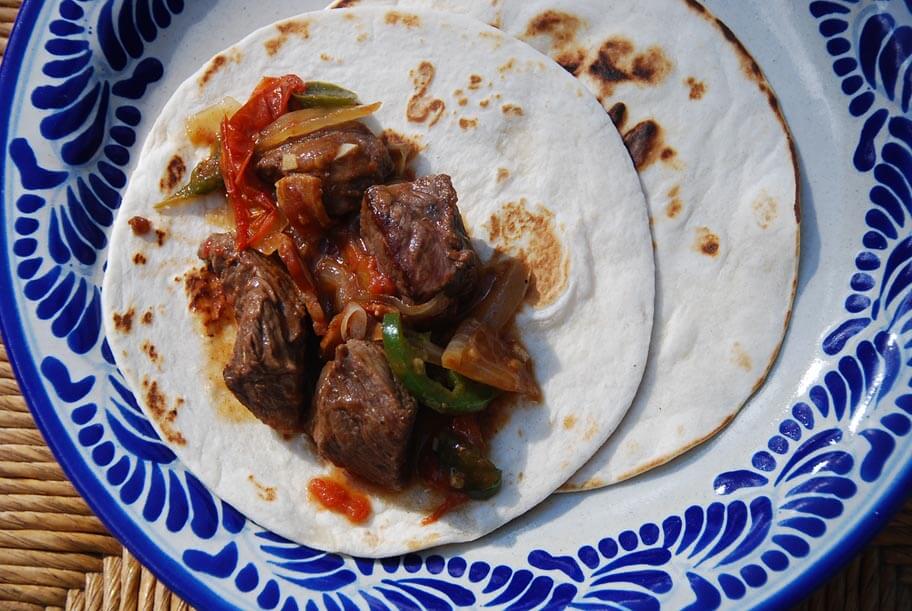
Note: I researched, tested, tasted, edited and submitted this recipe to The Washington Post for an article published on February 24, 2010.

Print Recipe
5 from 5 votes

Lamb Barbacoa in Adobo

Barbacoa is one of those iconic Mexican foods. Juicy, tender meat that falls off the bone, infused with a rustic, smoky flavor and a jungle like fragrance. It uses a cooking technique that began in ancient times, long before the Spanish arrived, and it lives on to this day across Mexico in places that specialize in making it. Of course, there are accessible homestyle versions too.
Prep Time3 hours
Cook Time8 hours
Course: Main Course
Cuisine: Mexican
Keyword: ancho chiles, apple cider vinegar, avocado leaves, banana leaves, beer, carrots, corn tortillas, garbanzo beans, guajillo chiles, lamb, onion, pati's mexican table, Tomatoes
Servings: 12 servings
Author: Pati Jinich

Ingredients

For the marinade:

  • 10 dried guajillo chile peppers stemmed and seeded
  • 10 dried ancho chile peppers stemmed and seeded
  • 5 cups water
  • 1/3 cups apple cider vinegar
  • 1 medium Roma tomato cut into quarters
  • 1/2 medium white onion coarsely chopped (about 1/2 cup)
  • 3 medium cloves garlic
  • 1 tablespoon dried oregano
  • 1/2 teaspoon ground cinnamon
  • 1/2 teaspoon ground allspice
  • 1/2 teaspoon freshly ground black pepper
  • 5 whole cloves stems removed
  • 2 1/2 teaspoons kosher or sea salt
  • 3 tablespoons safflower or vegetable oil

For the vegetable base:

  • 2 medium white onions coarsely chopped (about 2 1/2 cups)
  • 1 1/2 pounds carrots peeled and cut crosswise into chunks
  • 1 1/2 pounds red potatoes peeler and cut into large cubes
  • 8 ounces dried garbanzo beans soaked overnight in 3 cups of very hot water, then drained
  • 12 ounces light colored beer such as Corona, 1 bottle
  • 3 cups water
  • A few bay leaves
  • 1 1/2 teaspoons kosher or sea salt

For the meat:

  • 8 pounds bone-in leg or shoulder of lamb or both
  • 1 pound Banana leaves
  • 5 to 6 fresh or dried avocado leaves optional

For assembly:

  • Lime wedges for serving
  • Warmed corn tortillas

Instructions

To make the marinade:

  • Heat a large, dry skillet over medium heat. Add the dried chile peppers and toast them for no more than 20 seconds per side, taking care not to burn them.
  • Transfer them to a medium saucepan and add the water, place over medium heat and cook for 12 to 15 minutes, until the peppers have softened and rehydrated.
  • Transfer the peppers to a blender. Add 2 cups of their cooking liguid (discard the remaining liquid), the vinegar, tomato, onion, garlic, oregano, cinnamon, allspice, black pepper, cloves (stems removed) and salt; puree until smooth.
  • Wipe out the medium saucepan and add the oil. Place over medium heat for 1 to 2 minutes, then add the pureed marinade, being careful to avoid any splatters. Partially cover, and cook for 10 to 12 minutes, stirring once or twice, until the color darkens and the mixture thickens to a pastelike consistency.
  • Rinse the lamb and pat dry with paper towels. Place in in a large, nonreactive dish. Use the marinade to cover it completely, rubbing the mixture into the meat. Cover and refrigerate for 2 to 24 hours.

To make the vegetable base:

  • Just before the lamb is finished marinating, prepare the vegetable base. Have a large roasting pan at hand with a rack that fits inside, preferable with some space underneath. Remove the lamb from the refrigerator about 20 minutes before you place it in the over.
  • Combine the onions, carrots, potatoes, and soaked and drained garbanzo beans in a large raosting pan. Pour the beer and water over the top. Add the bay leaves and season with salt to taste; toss to combine. Place the roasting rack over the mixture.

To make the meat:

  • Preheat the over to 325 degrees.
  • Unfold the banana leaves and arrange a few layers of them on the roasting rack, leaving a generous amound of overlap on the pan long sides for wrapping the meat (alternatively, you may use a few long pieces of aluminum foil). Place the meat on top of the leaves and use all of the marinade to cover it. PLace the avocado leaves, if using, on top of the meat, then fold the leaves over to cover the meat. If using the foil, poke a few small holes near the bottom edges to allow the meats juices to fall into the vegetable base below during cooking. The juices will natually fall through the spaces between the banana leaves.
  • Cover the banana leaf package or foil package tightly with a layer of foil. Slow-roast for 8 to 10 hours; until the meat comes off the bone easily and the vegetables should be well seasoned and tender. Transfer to the stovetop (off of the heat), and let everything rest for 15 to 20 minutes before opening the package. Discard the avocado leaves, if using.

To assemble:

  • Serve with lime wedges, warmed corn tortilla and a salsa you like.

Notes

Barbacoa

Pumpkin and Ancho Chile Mole

You can do fabulous things with pumpkins aside from spooky faces and pumpkin pie… Just ask any Mexican. We have a way with pumpkins.

Native to Mexico, pumpkins have been devoured there for centuries, in their entirety. The seeds are addicting as snacks, used as a hefty base for salsas, soups and sauces and more recently sprinkled on top of many dishes. The pumpkin meat is used for soups and stews, and along with the entire rind cooked in a piloncillo syrup, becoming a traditional favorite known as Tacha.

Yet there is something else you can make with those fall pumpkins: Mole!

An easy to make, silky textured and exquisite tasting mole sauce, that can bathe anything you can think of. From chicken to meat, fish, seafood and veggies; it all goes beautifully swaddled in it. I like it mostly with chicken or turkey, which is how I am most used to eating thick and rich Mole sauces….

So that you can try it too, here it goes.

As simple as it is to make, it uses two ancient and crucial techniques of Mexican cooking that enhance the flavors of the ingredients and bring a ton of personality to a dish: charring and toasting.

Pumpkin and Ancho Chile Mole 1

First the onion and garlic take a quick turn under the broiler to be charred. Their sharp, crisp and pungent flavors become transformed…

Pumpkin and Ancho Chile Mole 2

…as if their alter ego came out to show depth and sweetness. While at the same time becoming a bit rustic.

Then the ancho chiles, almonds, cinnamon, allspice and whole cloves take a turn either in a skillet or comal, to lightly toast.

Pumpkin and Ancho Chile Mole 3

Toasting them intensifies and deepens their flavor, it releases new aromas and adds a kind of warmth to the dish.

Pumpkin and Ancho Chile Mole 4

As the chiles have been dried for a long time, aside from giving them a light toast, you need to rehydrate them and plump them back to life. And it takes just 10 minutes of soaking them in a hot bath.

Pumpkin and Ancho Chile Mole 5

Then you also use that water from the chile bath, as it has some of the intense flavors and colors of the chiles, as well as the chiles to make the Mole Sauce.

Then everything in the blender goes!

Pumpkin and Ancho Chile Mole 6

If you used True or Ceylon cinnamon, puree it along with the rest of the ingredients. As it is light and thin, it crumbles and purees easily. It is gentle and kind to the blades of the blender. If you only found the hard Cassia kind, use it to simmer in the mole sauce further on.

Then you add it all along with the pumpkin puree in a big pot. You can use already made pumpkin puree from the store…

Pumpkin and Ancho Chile Mole 7

Or make your own pumpkin puree with those extra pumpkins that are sitting on your front porch… Making the puree is pretty simple: Quarter the pumpkin, remove the seeds and fibers, roast in the oven at 400 ºF until soft and process the pumpkin meat in a blender of food processor until smooth.

After you simmer the pumpkin puree along with the ancho chile puree (that has the charred and toasted ingredients), it will look like this. Incredibly rich, just like its flavor.

Pumpkin and Ancho Chile Mole 8

You can make the Pumpkin and Ancho Chile Mole ahead of time, and just heat it when you are ready to serve it.

Topping it with toasted pumpkin seeds makes the dish all the more fabulous.  You can taste it already, right?

Pumpkin and Ancho Chile Mole 9

Pumpkin and Ancho Chile Mole main
Print Recipe
4.41 from 5 votes

Pumpkin and Ancho Chile Mole

An easy to make, silky textured and exquisite tasting mole sauce, that can bathe anything you can think of. From chicken to meat, fish, seafood and veggies; it all goes beautifully swaddled in it. I like it mostly with chicken or turkey, which is how I am most used to eating thick and rich Mole sauces….So that you can try it too, here it goes.
Prep Time5 minutes
Cook Time45 minutes
Course: Main Course
Cuisine: Mexican
Keyword: almonds, ancho chiles, brown sugar, ceylon, chicken, cinnamon, cloves, Mole, pumpkin, pumpkin seeds, Recipe
Servings: 6 servings
Author: Pati Jinich

Ingredients

  • 1/2 white onion peeled, charred or broiled
  • 6 garlic cloves charred or broiled, peeled
  • 3 ancho chiles stemmed, seeded and opened
  • 1/4 cup slivered almonds
  • 5 whole cloves
  • 1/2 stick true or ceylon cinnamon about 1 inch (or substitute for 1/2 teaspoon ground cinnamon)
  • 8 whole allspice berries or 1/8 teaspoon ground
  • 2 tablespoons vegetable oil
  • 1 15-ounce can pumpkin puree about 1 3/4 cup
  • 3 cups chicken broth
  • 1 1/2 teaspoon kosher or sea salt or more to taste
  • 3 tablespoons brown sugar or more to taste
  • 1/2 cup pumpkin seeds lightly toasted

Instructions

  • Place the onion and garlic in a baking sheet under the broiler. Char for 9 to 10 minutes, flipping once in between. Once they are soft and charred, remove from the heat. When the garlic is cool, peel.
  • In an already hot skillet or comal set over medium-low heat, toast the ancho chiles for about 15 to 20 seconds per side, until they brown and crisp without burning. Place toasted ancho chiles in a bowl covered with boiling water. Soak for 10 to 15 minutes until they are plumped up and rehydrated.
  • In the same skillet or comal, toast the cloves and all spice until aromatic, about a minute. Remove from the heat. Toast the almonds and cinnamon, stirring often, until lightly browned, 4 to 5 minutes.
  • Place the onion, garlic, chiles, 1/2 cup of chile soaking liquid, almonds, cloves, cinnamon and allspice in the blender and puree until smooth.
  • In a soup pot or casserole, heat the oil and pour the pureed mixture over medium heat. Add the salt and sugar. Cook for about 5 minutes, stirring frequently to help prevent the sauce from sticking to the bottom of the pan. The color will darken considerably.
  • Add the pumpkin puree and chicken broth to the sauce. Stir well until the pumpkin puree has dissolved, it will have a silky consistency. Continue to cook for about 12 minutes, stirring occasionally.
  • Use the mole sauce to pour over grilled, broiled or boiled chicken, meat or fish. Sprinkle with toasted pumpkin seeds for some added flavor and crunch.

Notes

Mole de Chile Ancho y Calabaza

Mushroom-Jalapeño Matzo Ball Soup

My grandfather on my mother’s side, Francisco, whom we called “Yeye,” was wild about chiles. Not very common in his native Bratislava, I guess. He used to say that what he loved the most about his new country was the predictable weather (especially the bright sunny winters), the colorful markets, and most of all, the chiles. All of them.

He was oh so very crazy about them, that my grandmother used to hide them from him. She complained that he had no boundaries, no sense of measure, when eating chiles. He simply would not stop.

But he knew all her tricks, discover all her hiding spots, and when he found the prized chiles, he would stuff them in his pockets. Not only fresh jalapeños or serranos but also wet pickled jalapeños... Those must have been some messy pockets to wash…

My “Lali,” liked to please him though. She had Austrian training in the kitchen and made exquisite and elegant foods. Once in Mexico, she fell in love with the cuisine and learned how to combine the two culinary traditions. She became a master at it.

She created a classic dish out of her Mushroom-Jalapeño Matzo Ball Soup.

Mushroom-Jalapeño Matzo Ball Soup 1

See? Just because you add a chile to something does not mean it becomes Mexican. You have to know how to add it, how much of it, and most importantly, when to not add….not every dish that is Mexican has a chile in it.

Lali made a mushroom base with a traditional Mexican treatment. Gently cooked onion, garlic and chopped jalapeños (with the seeds please) until the edges begging to brown. Then, she added the mushrooms and covered them, so they would steam in the mix. Once their liquids came out, she would open the pot again and let them dry, and begin to brown.

Mushroom-Jalapeño Matzo Ball Soup 2

Of the thousands of ways to use chiles, steaming them with other ingredients brings out their flavor in such a subtle way.

Then she poured her home made chicken broth on top.

Her Matzo balls were fluffy, round and simply seasoned with parsley (which has been growing so happily in my garden).

Mushroom-Jalapeño Matzo Ball Soup 3

Grated nutmeg is also added to the matzo ball mix. No need to add freshly ground black pepper.

Mushroom-Jalapeño Matzo Ball Soup 4

The eggs are the glue that holds the matzo balls together, combined with a bit of oil…

Mushroom-Jalapeño Matzo Ball Soup 5

Then she had a trick to make the matzo balls fluffy. That is, if you like them fluffy. Which most of my family does.

It seems that the main division in the matzo ball world, is between those that like the matzo balls hard and those that like them fluffy. Cooks debate all the time on how to make them fluffy or hard: more egg or less egg, more oil or less oil, matzo meal or matzo mix…

My grandmother’s trick to make them fluffy was to add sparkling water. But just a tablespoon for a full recipe. I always separate a bit of the mix without any, because I am the only one around here that likes the matzo balls hard.

Mushroom-Jalapeño Matzo Ball Soup 6

As much as my grandfather begged, my grandmother added little jalapeños. She argued that one needs to taste everything else, which in principle sounds right. But if he were here, I would make him an extra batch, with as many jalapeños I could find in my backyard. And there are oh so many…

Mushroom-Jalapeño Matzo Ball Soup 7

pati jinich mushroom jalapeno matzo ball soup
Print Recipe
4.67 from 6 votes

Mushroom-Jalapeño Matzo Ball Soup

If you're looking for a Mexican style matzo ball soup, this is one my grandmother used to make.
Prep Time10 minutes
Cook Time30 minutes
Course: Soup
Cuisine: Jewish, Mexican
Keyword: chicken broth, jalapeno, Jewish Mexican, matzo, Mushroom, nutmeg, parsley, pati's mexican table, Recipe, soup
Servings: 6 to 8 servings
Author: Pati Jinich

Ingredients

  • 1 cup matzo ball mix
  • 2 tablespoons parsley finely chopped
  • 1/4 teaspoon grated nutmeg
  • 3/4 teaspoon kosher or coarse sea salt or to taste
  • 4 large eggs
  • 8 tablespoons vegetable oil divided
  • 2 tablespoons toasted sesame oil
  • 1 tablespoon sparkling water optional, to make the matzo balls fluffy
  • 1/2 cup white onion finely chopped
  • 1 garlic clove finely chopped
  • 2 jalapeño chiles finely chopped, seeded optional, more or less to taste
  • 1/2 pound white mushrooms wiped clean with cloth, sliced
  • 3/4 teaspoon kosher or sea salt or to taste
  • 8-10 cups chicken broth

Instructions

  • In a large mixing bowl, combine the matzo ball mix, parsley, nutmeg, and 1 teaspoon of salt. In another small bowl, lightly beat the eggs with 6 tablespoons the of vegetable oil and the sesame oil. Fold in the beaten eggs to the matzo ball mixture with a spatula. Add the sparkling water if you want the matzo balls fluffy, and mix well until well combine. Cover the mix and refrigerate for at least half an hour.
  • Bring about 12 cups of salted water to a rolling boil in a large soup pot. Bring heat down to medium and keep at a steady simmer. With wet hands, make about 1 inch balls out of the matzo ball mix and gently drop them into the water. Cover and simmer for about 25 to 30 minutes.
  • Meanwhile, heat the remaining 2 tablespoons of vegetable oil over medium heat in a large cooking pot. Add the onion, garlic and chiles and sauté for 4 to 5 minutes until they have softened. Incorporate the sliced mushrooms. sprinkle the salt, stir and cover with a lid. Steam the mushrooms for about 6 to 8 minutes.
  • Take off the lid and pour the chicken broth over the mushroom base. Once it is simmering, incorporate the already cooked matzo balls, without their cooking liquid, and serve.

Notes

Sopa de Bolas de Matzo con Hongos y Jalapeño

Pozole: Try It Green!

Red pozole, or Pozole Rojo, Jalisco style, has been my favorite pozole of all time. It is bold and gorgeous in every possible way. I am so attached to it, we even served it at our wedding.

For decades now, I’ve refused to replace it with another. And then, I tried a unique green version, Pozole Verde, Guerrero style. It has not surpassed my Pozole Rojo, but it is attempting to tie with it at my table. And that is a lot to say.

Treasured all around Mexico, pozole has many variations, mainly green, red and white. Each distinct and beautiful, and coincidentally, represent the colors of the Mexican flag. Since September is the month of Mexican independence and The Day of El Grito is just around the corner, there is no excuse not to find an excuse to celebrate! And in my mental Mexican dictionary, pozole equals celebration.

Pozole has been made for centuries, and according to Fray Bernardino de Sahagún, a Spanish missionary, Moctezuma -greatest Aztec Emperor of all times- would honor the God of the Sun by eating and serving it. I don’t know though, what color it was!

What makes a pozole red or green is the seasoning sauce added to the stew. If there is no sauce, it is a white pozole. Though there are many kinds of green pozole, they all use green ingredients, and this one has: tomatillosepazote (or cilantro if you can’t find it), pumpkin seeds and jalapeños.

greeningre.jpg

Making that green seasoning sauce is simple. Tomatillos, garlic and chile simmer in water until the color of the tomatillos changes from bright, happy and loud to a mellow green. The texture goes from firm, to very mushy, but not coming apart.

The toasted pumpkin seeds are ground, they are pureed with that cooked tomatillo mix and white onion. The pumpkin seeds give the sauce a nutty, velvety base. Then the sauce is taken a step further and simmered until it is seasoned, thickened and its flavors have concentrated. It must be powerful, as it will dilute in the pozole. See? The spoon on the left has the green sauce before it is seasoned.

sauce.jpg

What is common about any pozole is not only the many garnishes that dress it at the end, but also the very large corn known here as hominy, and in Mexico as maí­z cacahuacintle, also known as maí­z mote and giant corn. It gives pozole its signature mealy bite.

Cooking hominy is simple, but takes a while, so it is available already cooked in cans or refrigerated bags if you do not feel like preparing it. This is how it looks when you buy it at the stores before cooking.

hominyingredients.jpg

But I love to cook it at home. It is as simple as throwing it in a pot, covering it in water and waiting for it to “bloom”.  Literally, when it opens up at the top, you know it’s ready.

cookedhominy.jpg

Just like when cooking beans, add salt after they are cooked, or they will toughen up.Then in a big pot, combine the cooked hominy, the shredded chicken that was simmered in a simple broth (complete recipe below) as much green pozole sauce as you want, and a leafy stem of epazote, which will have anywhere from 5 to 10 leaves. If you don’t find epazote, add like 5 sprigs of cilantro. I personally add all the sauce. Then, you want to let all the ingredients cook together for about 20 minutes.

Once it is ready: dress it up! Radishes, lettuce, white onion, ground dried chile, oregano and quartered limes to squeeze juice on top, are placed at the table for you to choose. Tostadas to be munched on the side. And, in particular for the green pozole, Mexican avocado and chicharrones (crispy pork rind), are often too, which gives it an extra crunch. If you find some, add it on!
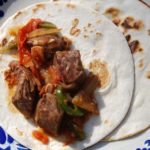
Whatever you choose, do squeeze fresh lime juice onto it.

Pozole is so popular in Mexico that there are pozolerí­as, restaurants that only serve pozole. That would be like a restaurant in the US that only served chicken noodle soup! How is that possible? Take a bite into this one-stop meal. You’ll see.

soup2.jpg

P.S. Pozole tastes even better reheated. Great excuse for making the soup ahead of time. Also, watch out for this recipe: It serves a hungry party of 12.

green pozole or pozole verde
Print Recipe
4.67 from 6 votes

Green Pozole

Red pozole, or Pozole Rojo, Jalisco style, has been my favorite pozole of all time. It is bold and gorgeous in every possible way. I am so attached to it, we even served it at our wedding. For decades now, I’ve refused to replace it with another… And then, I tried a unique green version, Pozole Verde, Guerrero style. It has not surpassed my Pozole Rojo, but it is attempting to tie with it at my table. And that is a lot to say.
Prep Time5 minutes
Cook Time3 hours 30 minutes
Course: Soup
Cuisine: Mexican
Keyword: chicken, chile, cilantro, epazote, hominy, jalapeno, lime, piquí­n chiles, pumpkin seeds, radish, Recipe, soup, tomatillos, tortilla chips
Servings: 12 to 15 servings
Author: Pati Jinich

Ingredients

For the white pozole:

  • 1 pound dried hominy rinsed, the same as giant white corn or maiz mote pelado
  • 1 head garlic
  • 2 whole chickens or about 6 pounds, cut up in serving pieces, rinsed (combine with pork butt or shoulder if desired)
  • 1 onion
  • Couple fresh cilantro sprigs
  • 1 tablespoon kosher or course sea salt or to taste

For the green pozole sauce:

  • 1/2 cup pumpkin seeds lightly toasted
  • 1 pound tomatillos husks removed, rinsed
  • 1 to 2 jalapeños stemmed
  • 1 fresh large leafy stem of epazote or 5 sprigs cilantro
  • 3 cloves garlic
  • 1/3 cup onion coarsely chopped
  • 1 teaspoon kosher or sea salt or to taste
  • Freshly ground pepper to taste
  • 2 tablespoons vegetable oil

For the garnishes:

  • 5 to 6 limes cut in half
  • 10 radishes rinsed, halved and thinly sliced
  • 1 head of romaine lettuce rinsed, drained and thinly sliced
  • 4 tablespoons onion finely chopped
  • 1 Mexican avocado halved, pitted, meat scooped out and dried
  • Piquí­n chile or a Mexican mix of dried chiles, ground
  • dried oregano crumbled
  • Tostadas or totopos

Instructions

  • Place the hominy in a large soup pot with cold water at least 3 inches on top. Take off the dried skin layers from the head of garlic and add it into the pot. Do not add salt, because the hominy will toughen. Bring to a boil, then gently simmer over low medium heat uncovered for 3 hours or until hominy is tender and has begun to "bloom" or open up. Alternatively, you can buy precooked hominy and continue from this point.
  • In the meantime, place chicken in a large soup pot and cover with at least 1 inch of water above. Add white onion, cilantro and a tablespoon of salt and bring to boil. Simmer uncovered until chicken is cooked and tender, about 30 minutes. Drain and reserve the cooking liquid. When the chicken is cool enough to handle, remove the skin and the bones, and shred the meat into bite size pieces.
  • Meanwhile, make the green pozole sauce. Place tomatillos, garlic and chile in a medium 3-quart saucepan. Cover with water and set over medium-high heat. Bring to a simmer; cook until the tomatillos have changed color from a bright to a dull green and are soft but not breaking apart, about 10 minutes. Remove from the heat and reserve 1/2 cup of the cooking liquid. Drain the cooked vegetables and set aside.
  • In a blender, add toasted pumpkin seeds and chop until finely ground. Then add the cooked tomatillos, jalapeños and garlic, onion, salt and reserved liquid. Puree until smooth. Heat the oil in a saucepan over medium high heat until hot. Add the tomatillo sauce from the blender. Bring to a boil and simmer 15 to 18 minutes, stirring occasionally, so it will thicken, season and deepen its color.
  • When the hominy is ready, incorporate the shredded chicken and its cooking broth. Add the green pozole sauce and the epazote or cilantro. Let it cook for 30 minutes more. Check for seasoning - at this point I always add more salt - and serve.
  • You may present the Pozole in a big soup pot and place the garnishes in smaller bowls on the side. Each person can serve Pozole in their individual soup bowls, and then add as many garnishes to their soup as they would like. I do, however, recommend that some fresh lime juice be squeezed into it! Tostadas or totopos are eaten on the side.
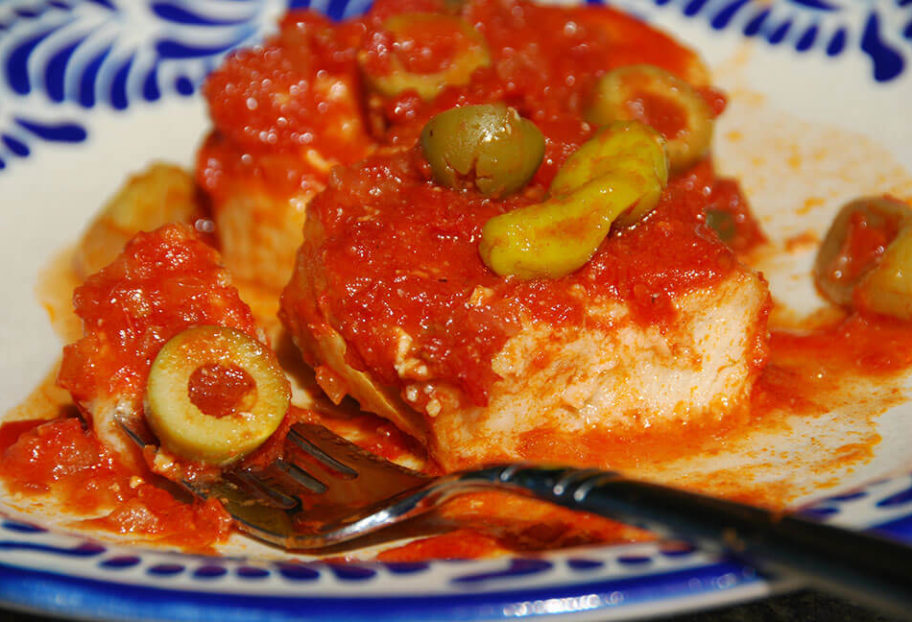
Notes

Pozole Verde

Summertime Watermelon & Tomatillo Salad: Beat the Heat!

This year I promised my boys we would plant goodies in the backyard to harvest ourselves. At the nursery, jumping up and down as in a candy shop, they dragged so many plants to the counter, I had to give an absolute NO to half of them.

We ended up with thyme, oregano, bay leaves, rosemary, mint, parsley, and cilantro.  Ok, and tomatoes, cherry and roma. Fine, corn too, don’t know what I was thinking. And wait! We couldn’t leave without jalapeños, which led me to run for some tomatillos. And scallions. I stopped there. I did.

Then Sami came back with a little watermelon plant.  That was the wildest idea, oh, that monster of mine. We’ve no room to grow watermelon. I told him about the big wide fields in Northern Mexico, in states like Sonora, Chihuahua, Jalisco and Sinaloa where watermelon is grown extensively. Our backyard is not so big.

Beats me.

We brought home Sami’s watermelon plant.

chopped up watermelon
As the weeks went by, we saw many of the plants thrive, except the watermelon which seemed to take an awful long time to  grow. Then one day the editors from Babble asked me for a custom recipe. By then, I was eagerly thinking about what would make the sweet, watery crunch from that soon to grow watermelon shine the most.

This is what I came up with.

tomatillos
Thinly sliced, raw, punchy and tart tomatillos. Much firmer than the watermelon, and just look at the color contrast. Not to say about the flavor combination.

To coat this unconventional pairing, I wanted a vinaigrette with some some gentle heat. I got it from the jalapeños, which you will never have trouble finding in our backyard as Juju made markers for each plant… I am proud to say, the boy knows his Ñ’s.

jalapenos in the garden
I coarsely chopped the chiles, as I like to feel their friendly bite. But you can give them a finer chop and even remove the seeds.

jalapeno

With the already unusual watermelon and tomatillo pairing, I went unusual again and added some chopped fresh mint.

Mint  has been growing wild here, as all mint tends to. Although we planted ours in the ground while still in their protective pots, to keep them in check. It doesn’t seem to give a hoot. Its wild.

mint
Soaked the jalapeño and the mint with fresh squeezed lime juice, a bit of straight forward white distilled vinegar which makes everything it coats more crisp, the oils and salt… Gave it a bit of time, 5 to 10 minutes, to sit and get acquainted.

limes
Poured the vinaigrette over the red and green. Yet not only was the salad screaming for some white (partly to round the colors of the Mexican flag, for one thing…) but also for some salty taste with some heartiness to it. Hence the Feta Cheese. Now you can go for anything tangy, salty and crumbly: queso fresco or farmers’ cheese works well too.

feta cheese
While we had the chance to harvest and eat the jalapeño, mint and tomatillos from our backyard, that watermelon never came to be, some bunnies got to it before we did.

But just day dreaming about it made me come up with one of my favorite recipes. It is so bright, so alive, so peppy and so summery!

Luckily there are plenty of amazing watermelons at the stores. We will have to give it another go next summer to harvest our own.

watermelon and tomatillo salad
Meanwhile I can’t help but repeat this salad that hits all the taste buds!  Sweet from the watermelon, salty from the cheese, spicy from the chile, tart from the lime and tomatillos and refreshing from the mint. Oh, you just have to give it a try.

watermelon and tomatillo salad with feta cheese
Print Recipe
4.34 from 6 votes

Summertime Watermelon & Tomatillo Salad

I can’t help but repeat this salad that hits all the taste buds!  Sweet from the watermelon, salty from the cheese, spicy from the chile, tart from the lime and tomatillos and refreshing from the mint. Oh, you just have to give it a try…
Prep Time15 minutes
Cook Time5 minutes
Course: Salad
Cuisine: Mexican
Keyword: feta, jalapeno, lime, mint, pati's mexican table, queso fresco, tomatillos, vinaigrette, vinegar, watermelon
Servings: 4 servings
Author: Pati Jinich

Ingredients

For the salad:

  • 4 cups watermelon cut into bite size chunks or cubes
  • 2 cups, about 1/2 pound tomatillos husks removed, thoroughly rinsed, quartered and thinly sliced
  • 2/3 cup, about 3 ounces mild feta or queso fresco crumbled or cut into small dice

For the vinaigrette:

  • 1 tablespoon fresh mint leaves about 5 to 6, chopped
  • 1 tablespoon jalapeño or serrano chile or to taste (seeding optional)
  • 2 tablespoons fresh squeezed lime juice
  • 1 teaspoon white distilled vinegar
  • 1 teaspoon salt
  • 2 tablespoons olive oil
  • 2 tablespoons vegetable oil

Instructions

  • Place the watermelon cubes and tomatillo slices in a large bowl.
  • In a small bowl, add the chopped mint and jalapeno. Squeeze the fresh lime juice on top, stir in the vinegar, sprinkle the salt and mix. Pour the olive oil and vegetable oil, and mix with a whisk or fork until well emulsified.
  • Pour the vinaigrette on top of the watermelon and tomatillos, toss well and sprinkle the cheese on top.

Notes

Ensalada de Sandía y Tomate Verde

Enchiladas Verdes in a Tomatillo Sauce

When Cinco de Mayo is around the corner, friends start asking me what we will be eating to celebrate… and what I am craving most are Enchiladas Verdes. The perfect yummy family food that stays messy on the casserole.

Even though most native Mexicans know that Cinco de Mayo isn’t a big celebration in Mexico (as a matter of fact, it is mostly celebrated in Puebla), we embrace it outside of Mexico with all our hearts without really knowing why. I guess it is a great excuse to celebrate what we love and miss about Mexico- like the tomatillo, a native Mexican ingredient that is the corner stone of so many dishes.

Enchiladas Verdes 1
The tomatillo, like Cinco de Mayo, has been adopted in the U.S. It can now be found in most supermarkets and it seems to me it will grow big time in American kitchens as it is such a spectacular ingredient.

While on the outside it isn’t the most appealing ingredient because of the papery and dusty husk, but once you peel it, rinse it and try it, you will see what a gorgeous jewel it is, both in looks and in flavor!  Most people know it from being used to make salsa verde, which is exactly what these enchiladas are covered in. You can also find cans and jars of ready made salsa, but it is so easy to make at home, that you should give it a try. It’s tastier too.

To make the salsa, simmer the tomatillos in water with the garlic, until they are soft and pale green.  Then transfer the tomatillos and garlic to the blender and puree with the jalapeño or serrano chiles, cilantro leaves, onion and salt.

Enchiladas Verdes 2

Then to make your enchiladas the best they can be, one at a time, pass each corn tortilla through already hot oil until they change color and soften.  This will prevent them from breaking as you roll them.  The oil also makes the tortillas resilient, so they will hold on to that yummy tomatillo sauce.

Enchiladas Verdes 3

Place some of the shredded chicken into each of the corn tortillas and roll them up.  I like them chunky. You can cook the chicken at home or use a store-bought rotisserie chicken, they both work great here!

Place the rolled tortillas seam side down in a casserole dish.  Pour the tomatillo sauce, generously, over the top. Then bake them for 10 to 15 minutes.

Enchiladas Verdes 4

When they are out of the oven, drizzle Mexican crema over the top, it has a tangy flavor, and when it hits the warm enchiladas, it will warm up, become melty, and become even more creamy, and at the same time it will add some fresh notes to the dish.

Enchiladas Verdes 5

Crumble up some queso fresco on top too. It will keep on crumbling right in your mouth as you eat it.  Add some onion for a nice crunch, and then they are ready to go!

Enchiladas can be made with many different sauces and fillings.  This take has the traditional salsa verde or green tomatillo sauce and chicken, but you can play with the fillings.

Enchiladas Verdes 6

If you have extra tomatillo salsa left over…  Try serving it over tilapia filets, baked in the oven; or serve on top of sunny side up eggs in the morning.  This tomatillo sauce is truly limitless.

You can eat Enchiladas Verdes like me, to celebrate Cinco de Mayo. But you can also eat them everyday. After all, everyday is worthy of being celebrated, with a Mexican excuse or not.

Print Recipe
4.80 from 10 votes

Enchiladas Verdes in a Tomatillo Sauce

Enchiladas can be made with many different sauces and fillings. This take has the traditional salsa verde or green tomatillo sauce and chicken, but you can play with the fillings.
Prep Time20 minutes
Cook Time30 minutes
Course: Antojos, Main Course
Cuisine: Mexican
Keyword: Antojo, chicken, Enchilada, Recipe, salsa verde
Servings: 6 to 8 servings
Author: Pati Jinich

Ingredients

For the sauce:

  • 2 pounds green tomatillos husks removed and rinsed
  • 2 cloves garlic
  • 2 serrano chiles or to taste
  • 1 cup cilantro leaves
  • 1/4 cup white onion roughly chopped
  • 1 teaspoon kosher or sea salt more or less to taste
  • 1 tablespoon safflower or corn oil

For the enchiladas:

  • 2 cups shredded cooked chicken home cooked or rotisserie works great!
  • Oil for frying the tortillas
  • 12 corn tortillas
  • 1/2 cup Mexican style cream can substitute for heavy cream
  • 1/2 cup crumbled queso fresco farmers cheese, cotija or mild feta
  • 1/3 cup white onion chopped, for garnish

Instructions

To make the sauce:

  • Place the tomatillos and garlic cloves in a pot and cover with water. Place over medium-high heat until it comes to a boil. Simmer on medium heat for about 10 minutes, or until tomatillos change their color from bright to pale green, are cooked through, and are soft but not coming apart.
  • Place the tomatillos, garlic and 1/2 cup of the cooking liquid in the blender and puree. Add the chiles serranos, cilantro leaves, onion and salt, and puree again until smooth. Heat a tablespoon of oil in a pot over medium-high heat. Once it is hot, but not smoking, pour in the sauce and bring to a simmer. Let it simmer over medium heat for about 6 minutes, until it thickens and deepens in color. Taste for salt and add more if need be.

To make the enchiladas:

  • In a large saute pan over medium heat, add enough oil to have about 1/2 inch depth. Let it heat about 3 minutes. Gently "pass each tortilla through the oil," one by one, for about 15 seconds on each side, they will soften and become resilient. You should be able to fold them without breaking them. Transfer them to a paper towel covered plate.
  • Preheat the oven to 375°F.
  • Place about 2 to 3 tablespoons chicken inside of each tortilla and roll them up. Place them, seam side down on a baking dish. Cover, generously, with the green sauce. Place them in the oven for 10 to 15 minutes. Remove them from the oven, sprinkle with the crumbled cheese, the cream, and the chopped onion. They are very satisfying with a side of rice and/or beans, as well as with a light green salad.
  • Eat the enchiladas while they are hot!

Notes

Enchiladas Verdes

A National Public Television Series and an Avocado Chop Chop Salad: Take a Peek!

I’ve been wanting to write this post for days. Every time I try, it feels like hundreds of flowers bloom in my head, clouding my thoughts. My tongue gets tied too. Which is not common. I usually don’t hesitate to express my thoughts.

So, pushing aside the flowers and the thing with the tongue…

Dearest friends, here’s the news: if you like Mexican food, if you like Public Television, if you like my approach to cooking, then… I hope you’ll like to hear that Pati’s Mexican Table is premiering on National Public Television, this spring.

I can tell you so many things about how the series came together and why I am so passionate about it. It’s been a fascinating journey: radically switching careers, launching the Culinary Program at the Institute, starting the blog, and now, embarking on the TV series.

What a wild zigzag. But with each turn I’ve confirmed that I want to keep on sharing and exploring Mexican food and all that surrounds it for as long as I can.

Avocado Chop Chop Salad 1

It pleases me to no end to watch my students devour the food at the Institute’s events, and more so when they write to say they’ve made the recipes at home. I love the stories you’ve shared in the blog’s comments and your requests for different cravings. I try to give you the most reliable recipe for that special cookie, dish, soup, or drink that brings you good memories or that you’ve been dying to try. Your filled and happy tummies, stories and requests, fuel my appetite to cook and share more.

See… there is a side of Mexican cuisine that is yet to be fully savored and appreciated: home-style Mexican food.  And for that, thankfully, many preconceptions become broken.

Take this Avocado, Tomato, Corn and Hearts of Palm Chop Chop Salad. One of the first recipes I thought of including in the series.

Avocado Chop Chop Salad 2

The buttery and luxurious Mexican avocados, the plump and fresh tomatoes, the sweet and crunchy corn, are all native Mexican ingredients. The hearts of palm are not, but its an ingredient that has been popular in Mexican kitchens for ages. Called palmitos, or little palm trees, when I was growing up in Mexico city, my grandmother and mother used to pair Palmitos and avocado for special occasions, just like many restaurants do.

See the mix! It is colorful, it is fresh, it is wholesome. Not many adjectives given to Mexican food outside of Mexico.

This salad is not laborious, as many consider good Mexican food to be. Ingredients here have to be simply, roughly chopped. Just like that!

Avocado Chop Chop Salad 3

The vinaigrette has crisp and clear ingredients: olive and safflower oils, the always straight forward apple cider vinegar, the lively fresh squeezed lime juice, salt, pepper, oregano (commonly used to season Mexican food, though not that well known) and brown sugar to help all of those flavors shine.

Simple, but layered flavors that feel so smooth when you take a bite.

And no. This salad isn’t spicy. Though I am wild about fresh and dried chiles, like most Mexicans (we need them! we do! there is sooo much one can do with each different kind!), and they are a staple in Mexican cooking (you will see some of my favorite ones in the series…) not all Mexican food is spicy nor has chiles.

What gives this salad a bit of pungency is a bit of chopped red onion.

Avocado Chop Chop Salad 4

There is nothing here battered or fried. Nor is this salad stuffed inside a giant tortilla with a gazillion other ingredients (OK, my boys do like U.S.-style burritos and I have come to appreciate them, but we also love Mexican-style ones… which I share in one of the show’s episodes).

Avocado Chop Chop Salad 5

What tops the salad, and gives it a healthy, crunchy and lightly nutty flavored bite are the toasted pumpkin seeds. An ingredient that since long before the time of the Aztecs, has been the base of moles, stews, sauces and pastes. They are used for all that, and for this too.

Avocado Chop Chop Salad 6

So of course I will share traditional dishes that have been passed down in families for generations, the pepitos, the soups, the tacos, the stews, the salsas, the practical moles, the flans and the panes dulces. But I will also share some of the modern spins made within the genuine boundaries of Mexican cooking: so you can explore along with me, a cuisine that keeps on evolving, inside and outside of Mexico.

Avocado Chop Chop Salad 7

So tune in!! And please, keep on sharing what you like and what you don’t, and mostly: send me your requests, I will try to keep on honoring them all.

p.s. The series premieres on WETA TV 26 Saturday April 2nd at 11:30 am in DC/MD/VA. Check your local public television station for their schedule this Spring!

Print Recipe
5 from 4 votes

Avocado and Hearts of Palm Chop Chop Salad

The buttery and luxurious Mexican avocados, the plump and fresh tomatoes, the sweet and crunchy corn, are all native Mexican ingredients. The hearts of palm are not, but its an ingredient that has been popular in Mexican kitchens for ages. Called palmitos, or little palm trees, when I was growing up in Mexico city, my grandmother and mother used to pair Palmitos and avocado for special occasions, just like many restaurants do.
Prep Time10 minutes
Cook Time5 minutes
Course: Salad
Cuisine: Mexican
Keyword: apple cider vinegar, Avocado, Corn, hearts of palm, lime, pumpkin seeds, Recipe, red onion, salad, Tomatoes, Vegetarian, vinaigrette
Servings: 4 to 6 servings
Author: Pati Jinich

Ingredients

For the salad:

  • 3 ripe Mexican avocados about 2 pounds, pulp cut into large chunks
  • 14 ounces hearts of palm drained, rinsed and thickly sliced, about 1 1/3 cups
  • 1 cup corn kernels from freshly cooked ears of corn or thawed and cooked from frozen
  • 1 tablespoon red onion chopped
  • 6 ounces cherry tomatoes or about 1 cup, whole or halved according to your preference
  • 3 tablespoons pumpkin seeds toasted

For the vinaigrette:

  • 2 teaspoons apple cider vinegar
  • 1 tablespoon lime juice
  • 1/4 teaspoon oregano
  • 3/4 teaspoon sea salt
  • 1/4 teaspoon brown sugar
  • 1/4 teaspoon black pepper
  • 2 tablespoons olive oil
  • 2 tablespoons safflower oil

Instructions

To make the vinaigrette:

  • Pour the vinegar and lime juice in a small bowl. Add oregano, salt sugar and black pepper. Pour the oils in a slow stream, whisking with a whisk or fork to emulsify. The vinaigrette can be made a day ahead of time, just emulsify before using.

To toast the pumpkin seeds:

  • Place the pumpkin seeds in an already hot small saute pan, set over medium heat. Stir often, being careful not to burn them, until you start to hear popping sounds (similar to pop corn), and they begin to acquire a nice tanned color, about 4 to 5 minutes later. Remove from heat and place in a bowl.

To make the salad:

  • In a separate bowl, gently mix the avocado chunks, hearts of palm slices, corn kernels, cherry tomatoes and red onion with the vinaigrette. Sprinkle with the toasted pumpkin seeds and serve.
  • This salad can be served as a main salad with a side of toast or pita bread, or it can be served as a side salad to grilled chicken, fish or meat.

Notes

Ensalada de Aguacate y Palmitos

Ham and Cheese Quesadillas

Ham and Cheese Sincronizadas with Flour Tortillas
Print Recipe
4 from 7 votes

Ham and Cheese Quesadillas

Ham and Cheese Quesadillas recipe from Pati's Mexican Table Season 1, Episode 1 “Quesadillas”
Prep Time5 minutes
Cook Time10 minutes
Total Time15 minutes
Course: Antojos, Main Course
Cuisine: Mexican
Keyword: Avocado, Chihuahua cheese, flour tortillas, ham, Monterrey Jack cheese, Muenster cheese, Oaxaca cheese, pati's mexican table, Quesadilla, turkey
Servings: 6 sincronizadas
Author: Pati Jinich

Ingredients

  • 12 flour tortillas
  • Safflower or corn oil optional
  • 8 ounces Chihuahua, Oaxaca, Monterey Jack, Muenster or melty cheese of your choice
  • 6 to 12 thin slices ham or turkey
  • Mexican avocado slices optional
  • Salsa of your choice

Instructions

  • Heat a non-stick sauté pan or a comal over medium heat. Place a couple flour tortillas, many as will fit in the pan or comal, top with a generous amount of shredded cheese and one or two slices of ham or turkey. Cover with a second flour tortilla.
  • Heat until the flour tortillas in the bottom become lightly toasted and cheese starts melting. With the help of a spatula, flip them to the other side and let it heat and crisp a bit. I like to wait until the cheese oozes out, browns and crisps a little! Transfer to a plate and slice in half or quarters.
  • Serve with a salsa of your choice and slices of ripe avocado on the side.
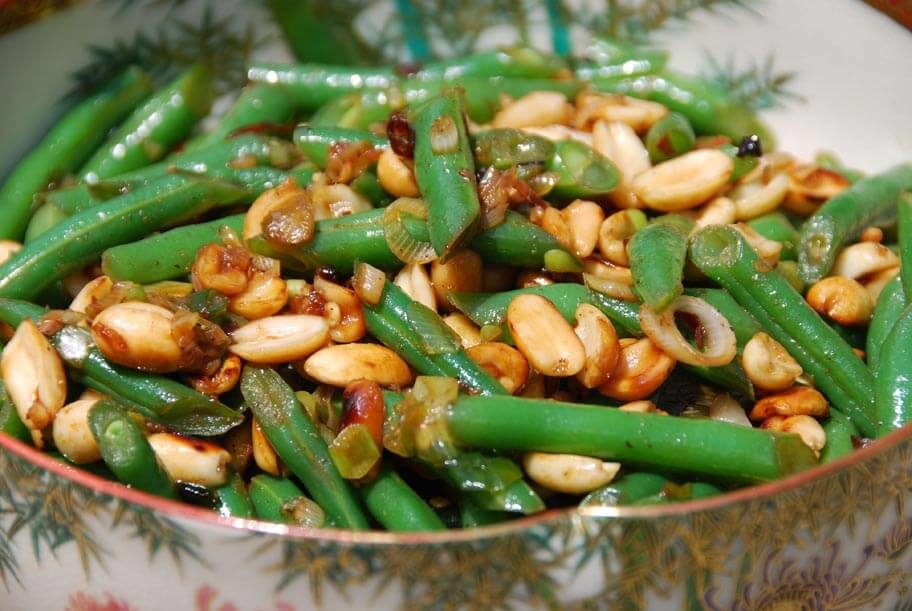
Notes

Sincronizadas de Jamón con Queso

Where to Find Caldo de Camarón? Make Your Own!

When I was in high school in Mexico City, Tecamacharlie’s was one of the most popular meeting spots. The name came from Tecamachalco, the neighborhood where it sits tucked away in a corner, and the chain of Restaurants it belongs to, Anderson’s Carlos & Charlies. There, my friends and I would meet some Friday afternoons after school, to have a late and long lunch or comida and embrace the weekend.

Even before school started those Friday mornings, there would be one thing in my mind: Tecamacharlie’s top notch Caldo de Camarón. A rich and thick soupy broth made with dried and salted shrimp, and seasoned with a base of Guajillo chile sauce.

A soup so flavorful and filling, it was served as a courtesy as soon as you finally sat down in that incredibly busy and loud place. The waiters brought it out of the kitchen still simmering, served in a little caballito, the little glass shots used to serve Tequila.

There were plump limes already quartered at the table, waiting to be squeezed into the soup before you drank it in one gulp. If you were lucky, the bottom of the shot had a shrimp, and maybe a couple pieces of potato and carrot. Then you could stick your fork or finger in there, to eat those little treasures that tasted like adventures at the sea port. Far away from the City.

Caldo de Camaron 1

That was 20 years ago and I haven’t been back to that Restaurant since those teen years. So I can’t vouch for how good it is these days… Plus, nostalgia has its way of overpowering memories sometimes too.

But one can find that Caldo de Camarón, with slight variations in many restaurants in Mexico city, and it is even more popular throughout the long Mexican coasts.

The latest one I’ve tried and I think even a better one, regardless of the power of nostalgia, is at one of the Guadiana Restaurants, which I always visit each time I go to the city.

Caldo de Camaron 2
As much as I have looked, there is no Caldo de Camarón to be found around DC. But one can find the handful of ingredients that the soup calls for. Although they are just a handful, they have enough personality to power a rock band.

The dried shrimp, of course, pictured above. Which need to be soaked for 5 to 10 minutes, as they have been salted not only to concentrate their flavor but also to preserve them, so the salt is, truly, intense.  Then the shrimp are rinsed and cooked in water, creating a broth which provides the main and matchless flavoring of the soup.

Then, the Guajillo chiles, with their mild heat and crowd pleasing taste. After they are quickly stemmed, seeded and toasted, beautifully toasted, really, look at the color…

Caldo de Camaron 3
They are then simmered with one of Mexico’s workhorse combinations: onion, garlic and tomato. Some people add parsley to the mix. Some add Bay Leaf, like me.

Caldo de Camaron 4
That goes into the blender, and then strained into a pot with some hot oil waiting to season the mix.

Caldo de Camaron 5
Once seasoned, in goes that deep amber colored dried shrimp broth.

Caldo de Camaron 6
The traditional cubed potatoes and carrots…

I like to add more than the usual recipes call for, so that neither me nor my guests have to be hunting those little soft chunks in the soup bowl.

Caldo de Camaron 7
When the shrimp have cooled, remove their heads, tails, and legs. Most cooks keep the shells on. They are a salty and crunchy addition in the soup. However, you can remove the shells if you feel like it. For a softer feel. Then cook for 10 more minutes so all of the flavors can come together.

Caldo de Camaron 8
Do serve the soup really hot. And always, always, always, have fresh limes ready to be squeezed in the soup.

Caldo de Camaron 9
That fresh squeezed lime juice is what makes all of the flavors in the soup, truly shine.

Print Recipe
4.75 from 4 votes

Dried Shrimp Soup

A rich and thick soupy broth made with dried and salted shrimp, and seasoned with a base of Guajillo chile sauce. A soup so flavorful and filling, it was served as a courtesy as soon as you finally sat down in that incredibly busy and loud place. The waiters brought it out of the kitchen still simmering, served in a little caballito, the little glass shots used to serve Tequila.
Prep Time20 minutes
Cook Time45 minutes
Course: Soup
Cuisine: Mexican
Keyword: achiote paste, garlic, guajillo chiles, lime, onion, potatoes, Recipe, seafood, Shrimp, soup, Tomatoes
Servings: 6 to 8 servings
Author: Pati Jinich

Ingredients

  • 1 pound Mexican dried shrimp
  • 3 ounces guajillo chiles about 8-10 chiles
  • 1/4 pound ripe tomatoes
  • 1 clove garlic
  • 2 bay leaves
  • 1 large slice of onion or about 3 tablespoons, roughly chopped
  • 1 pound potatoes rinsed, peeled and cubed
  • 1/2 pound carrots rinsed, peeled and cubed
  • 3 to 4 limes
  • 2 tablespoons oil

Instructions

  • Cover the shrimp with cold water and let sit for 15 minutes. Drain the shrimp, rinse them and place them in a medium pot. Cover the shrimp with 10 cups of water and bring to a simmer over medium-high heat. Once at a simmer, lower the medium heat and simmer for 10 minutes. Strain the broth, reserving both the broth and the shrimp. Allow everything to cool.
  • Once the shrimp have cooled, remove the heads, tails and legs from the shrimp. Be sure to keep the shells on the shrimp if you want them to add some crunch to the soup.
  • Remove the stems and seeds from the chiles and place them on a hot comal. Toast until their color changes to opaque, for about 10 to 15 seconds and flip to the other side.
  • Place the chiles, tomatoes, garlic, bay leaves, and onion into a saucepan and cover with water. Simmer for 10 minutes over medium heat, then puree until smooth.
  • Over medium heat, add two tablespoons of oil to a large soup pot. Strain the puree over the oil and then simmer for 8 to 10 minutes over medium-high heat, allowing the puree to season and thicken.
  • Add the shrimp broth, potatoes, carrots, and shrimp to the puree and simmer for 10 minutes over medium-high heat.
  • Serve the soup with fresh lime to drizzle over the top.

Notes

Caldo de Camarón

Fava Bean Soup: Time to go Mainstream!

When I think about my mother, I think about her fava bean soup (fine, and a couple other things too). That’s how strong an impact that soup has had on me.

But not many people are wild about favas, habas in Spanish. Different from pasta or potatoes, Favas haven’t gone mainstream.

Okay. I can see why.

First, the fact that they come in many forms can be confusing (fresh in their pod, fresh out of the pod, dried with their skin on, or dried and peeled). Also, the ways to cook them in their different forms haven’t been widely publicized. On top of that, favas have a strong flavor that can be overpowering, and to some, hard to bear.

Now, bear with me here. If you know what form of favas to get for which kind of dish, the confusion is almost gone. With the right recipe, the confusion evaporates further and their overpowering flavor is tamed. Thus, beloved cooks, favas become what they must: filling, rich, wholesome and deliciously intense.

dried and peeled favas

Since we are almost in the middle of winter, and I started talking about my mother’s soup, let’s consider dried favas which can be found year round and store forever in your pantry (fresh ones are found from Spring to Summer).

You can find them with shells on, like these on top. They are pretty, but you need to soak them, cook them and peel them. Quoting my mother: “Ay no Pati, eso de pelar una por una es una monserga” (translates to something like: peeling them one by one is a pain).

If you are looking for a relaxing therapy that will take hours, that’s fine. If you are not, go for the already peeled dried favas, like the ones below. They don’t look as pretty, but have more personality.

dried favas skin on
To cook, soak them in cold water anywhere from 2 to 12 hours. If you forgot to soak them, they will take a bit longer to cook, that’s all.

soaking favas
Now, drain them and place them in a pot with chicken broth and let them simmer, with the cover ajar, for about 50 to 55 minutes. They will be soft, thoroughly cooked and coming apart. That’s what you want.

See the broth? Its thick and lightly hay colored. Soothing looking already.

cooked fava beans
Next step, seasoning base: tomatoes, onion and garlic. My mom makes a rustic kind of soup. She chops the tomatoes, onion and garlic, cooks them with a little oil for 5 minutes and adds it to the cooked fava beans and broth.

I prefer a more smooth version of the soup because:
a) It lets me trick my monsters into eating the beans.
b) It looks more fancy if I want to serve it to guests.
c) With this cold, I find it much more comforting.
d) I like creamy things, so let me indulge myself.

So, I puree the fava beans with the broth once they are ready.

pureed fava beans
As for the seasoning base, with the blender in working mode, I puree the tomatoes with the onion and the garlic too.

tomatoes garlic onion
Cook that nice and thick puree over medium high heat for 5 or 6 minutes, until it thickens and darkens its color. Which means that the ingredients have seasoned and transformed from having a raw flavor to a cooked one.

tomato puree
Pour the fava bean and chicken broth puree right on top of that seasoned tomato base. Add salt, pepper, a pinch of cumin and let it all come together and season for about 10 more minutes.

Meanwhile, slice some bolillos, teleras or baguettes.

slicing baguette
Brush them with a light coat of olive oil, on both sides, if you must. Toast them until tanned and crispy.

brushing baguette
With the soup seasoned and thickened, you are ready to pour it into a bowl.

serving soup
Lay a piece of toast right on top…

place bread on soup
Crown it with some Pasilla chile crisps if you want an extra layer of flavorful crunch (see recipe below).

garnish with pasilla crisps
And jump in!

fava bean soup
Just watch as that piece of toast jumps in along with me.

fava bean soup
And if this blog had sound you would have heard the toast crack in the midst of that fava bean bath.

fava bean soup
And yes it is fabulous! What are you waiting for?

Print Recipe
4.50 from 2 votes

Fava Bean Soup with Crunch Toasts and Pasilla Crisps

When I think about my mother, I think about her fava bean soup (fine, and a couple other things too…). That’s how strong an impact that soup has had on me. But not many people are wild about favas, habas in SpanishDifferent from pasta or potatoes, Favas haven’t gone mainstream.
Prep Time2 hours
Cook Time1 hour
Course: Soup
Cuisine: Mexican
Keyword: bolillo, chicken broth, cumin, fava beans, garlic, onion, pasilla, pati's mexican table, Tomatoes
Servings: 6 servings
Author: Pati Jinich

Ingredients

  • 1 pound fava beans peeled and dried
  • 12 cups chicken broth
  • 1 pound ripe Roma tomatoes quartered
  • 1/2 cup white onion roughly chopped
  • 2 garlic cloves peeled
  • 3 tablespoons safflower oil corn or vegetable oil
  • 1 teaspoon salt
  • 1/4 teaspoon black pepper
  • Pinch of cumin
  • 2 pasilla chiles stemmed, seeded, and cut into small strips and quickly fried
  • 6 diagonal slices of bolillo telera or baguette, lightly brushed with oil and toasted
  • Olive oil to brush over the toast

Instructions

  • In a bowl, cover the fava beans with cold water and let them soak anywhere from 2 hours to overnight. Drain. Place the lima beans and chicken broth in a large soup pot set over medium heat. Let it come to a medium simmer with the lid ajar and cook until the beans are thoroughly cooked and tender, about 50 to 55 minutes. Turn off the heat and let them cool a little bit. Puree in batches in the blender. Place in a container or a large bowl.
  • Meanwhile, puree the tomatoes along with the onion and garlic until smooth. In a large soup pot, heat 3 tablespoons oil over medium-high heat. Once it is hot, but not smoking, pour in the tomato puree. Let it cook, stirring occasionally, until it deepens in color and thickens, about 5 to 6 minutes. Pour in the lime bean puree. Sprinkle the salt and black pepper, and continue cooking for about 8 to 10 minutes, until all of the flavors have combined.
  • Ladle the soup in individual bowls. Garnish with a piece of toast, brushed with olive oil, and sprinkle some crunchy chile strips on top.
  • Note: To make the chile crisps, quickly fry the chile pieces in a saute pan with 1/4" oil set over medium heat. Once oil is hot but not smoking, quickly fry the crisps, literally 2 seconds, remove and place on a plate covered with paper towel.

Notes

Sopa de Habas con Pan Tostado y Chile Pasilla

On a Soup and a Book

It is partly because of a soup like this, that I want to write a cookbook.

A soup that makes me feel all warm inside when I spoon it into my mouth.

A soup that has the earthiness and simplicity that grounds me.

A soup that, aside from having a comforting base, has layers of surprising life and color and crunch.

A soup that makes me want to eat nothing else for an entire week.

A soup that speaks of centennial traditions and is passed down through generations recipes.

A soup that is a pleasure to think about, to write about, to talk about, to prepare and to savor.

It is mostly because I want to share a soup like this with you, dear friends, that I am jumping to write this cookbook.

So with great news to share: I will be working with the delightful Rux Martin, editor at Houghton Mifflin Harcourt, to make this cookbook come to life.

In this book, I will write about -and tell you how to make- all of those foods that make me want to scream out of joy, along with the stories that revolve around them.

for tomato and bean soup-thumb-510x342-1527

So here you go, for this Fall season, which has already galloped in front of me as I was barely putting away my monsters’ bathing suits: The Sopa Tarasca. One of my favorite soups in the whole entire world.

As with many Mexican dishes, it has a base of tomato, onion and a bit of garlic.

Tarascan Soup 2
But it also has the addition of the prune like, exuberant flavor of the Ancho chile.

After those ingredients are cooked, pureed and seasoned, they are mixed with a bean puree.

Tarascan Soup 3
And chicken broth.

Queso Fresco A1-thumb-510x342-1933
As if that earth shattering base wasn’t enough, this soup is garnished, to your liking with Queso Fresco.

Tarascan Soup 5
Tortilla crisps.

Tarascan Soup 6
Ripe Mexican avocado chunks.

Tarascan Soup 7
And the tangy and salty notes from Mexican cream.

Of course you can toss in some Chile crisps in there too.

Tarascan Soup 8
From the Purépechas -also known as Tarascos- who inhabit the mountainous regions of the soulful state of Michoacán, and after whom this soup was named in its colonial capital of Morelia where I have eaten it one too many times, to the city of Washington DC in the United States of America, where I make it regularly for my Mexican American family: and hopefully it will find a place at your table too.

I lost my breath in that sentence!

Enjoy!

p.s. If you have any Mexican food craving, just name the dish, I will try to make a page for it in that cookbook.

Print Recipe
5 from 5 votes

Tarascan Bean and Tomato Soup

So here you go, for this Fall season, which has already galloped in front of me as I was barely putting away my monsters’ bathing suits: The Sopa Tarasca. One of my favorite soups in the whole entire world. As with many Mexican dishes, it has a base of tomato, onion and a bit of garlic.
Prep Time5 minutes
Cook Time30 minutes
Course: Soup
Cuisine: Mexican
Keyword: ancho chiles, beans, chile, corn tortillas, cotija cheese, garlic, mexican crema, onion, pati's mexican table, queso fresco, Recipe, refried beans, soup, Tomatoes, Vegetarian
Servings: 6 to 8 servings
Author: Pati Jinich

Ingredients

For the soup:

  • 6 cups of bean puree
  • 1 pound ripe plum or roma tomatoes
  • 1 clove garlic
  • 1 ancho chile steam and seeds removed
  • 1/2 cup white onion roughly chopped
  • 2 tablespoons safflower or corn oil
  • 3 cups chicken broth vegetable broth or water

For the garnishes:

  • 4 Corn tortillas cut in half and into strips, fried until lightly golden or toasted
  • 1/2 cup cotija or queso fresco cheese crumbled (farmers cheese, ricotta salata, mild feta or shredded mozzarella cheese may be substituted)
  • 1/2 cup fresh Mexican cream heavy cream or cream fraiche may by substituted
  • 1 ancho chile stem and seeds removed, cut into thin strips, flash fried (optional)
  • 1 Mexican avocado peeled, seeded, flesh scooped out and diced

Instructions

  • Place the tomatoes, garlic, and the seeded and stemmed ancho chile in a saucepan, cover with water and simmer over medium-high heat for 10 to 12 minutes or until tomatoes are completely cooked through. Once the tomato mix cools down, place it in a blender or food processor with a cup of the cooking liquid, the raw white onion and a teaspoon of the salt; puree until smooth.
  • Heat the oil in a large soup pot over medium-high heat. Add the tomato puree and cook for 5 to 8 minutes, stirring occasionally, until it darkens in color and thickens in consistency. Reduce the heat to medium and stir in the bean puree and broth or water, simmer for 10 to 15 minutes, or until the soup has seasoned and has a creamy consistency. Taste for salt and add more if needed. Turn off the heat as it thickens quickly.
  • The soup without the added garnishes may be cooled and stored in a closed container and refrigerated for up to 4 days. Since it thickens a bit as it cools, you may need to add some chicken broth or water to thin it out when you reheat it.
  • Ladle the soup into bowls and drizzle on top a tablespoon each of cream and cheese, a handful of tortilla strips, a few fried chile strips and some diced avocado. You can also place garnishes in bowls on the table to let your guests garnish to their liking.

Notes

Sopa Tarasca

Chicken Tinga for Today (Show) and Everyday!

What to cook for the Today Show?

With so many options being juggled in my head, I was growing restless as the date got closer.

As I started exchanging emails with one of the producers, I began to throw ideas: what about different kinds of Salsas, variations of that irresistible cold and wet Tres Leches cake, funky versions of Guacamole, or a sample of fresh Ceviches?

Or, wait. How about something easy, tasty and flashy like Tequila, Cream and Chipotle Shrimp? It’s so much fun to prepare, I told the producer. You ignite the pan, the flames come up right after the shrimp begin to brown, and then they wind down right before you pour the cream. Your guests feel special and impressed.

I had to agree that we were better off staying away from igniting anything on the set.

Oh, I got it! A chicken dish. Everyone wants a good chicken dish in their recipe box. And one of the tastiest ways to eat chicken in Mexican kitchens, no doubt about it, is Chicken Tinga.

Although it comes from the state of Puebla, it is so popular, that it is eaten throughout the country. So of course there are countless variations.

I have a favorite version. One that I have tweaked through the years until I found a balance of flavors that needs no more tweaking, if you ask me.

Chicken Tinga 4c-thumb-510x342-1318
A great thing about the Tinga, is that you only need a handful of ingredients. Some are familiar to everyone, like tomatoes, onion and garlic. The other needed Mexican ingredients are readily available throughout the US these days, and people should become familiar with them, as they are absolutely blissful.

Such is the case of the Tomatillos, pictured above next to their cousins, the tomatoes, and the Chipotle Chiles in Adobo Sauce.

Chicken Tinga 6-thumb-510x342-1324
Pump up the sweetness of the tomatoes, the tart notes of the tomatillos and the rich smoky, depth of the chipotles with some Marjoram, Oregano and Thyme, Salt and Pepper.

Chicken Tinga 5a-thumb-510x342-1320
Add some already cooked and shredded chicken, and you have a winner.

Catchy and irresistible, starting with the name, the Tinga is easy to prepare, packed with flavor, and once you make it, can be refashioned in a thousand ways. Plus it stores in the refrigerator well, and it’s one of those dishes that add on flavor as its reheated.

After talking with Bianca, the food stylist in charge at the Today Show, we decided to cook the Tinga, and show the viewers a couple choices of how to play with it: Tostadas and what can be called Tinga’Dillas.

Here is Bianca on the set, right before the segment. She rocks, friends.

Chicken Tinga 2-thumb-510x342-1306
This is Bianca’s hand, making a beauty out of the deliciously messy Tostada…

Chicken Tinga 1-thumb-510x342-1305
Here, that’s a zoom out.

OK. It is so crazy in that set, but oh so fun, fun, fun crazy. And the whole food styling team is amazing.

Chicken Tinga 7-thumb-510x342-1326
That is the front of the set. Allison (there in the corner of the photo below) and I chose some colorful pots and pans to do the demo.

And do you see that clock under the screen? It says 9:39. Segment was going to be shot at 9:46. Yes, I got dizzy and nauseated, and hyper and sleepy all at the same time.

Chicken Tinga 8-thumb-510x342-1328
So aside from the Chicken Tinga demo, there were the Tinga’Dillas paired with Guacamole and Grilled Corn.

Chicken Tinga 10-thumb-510x342-1334
And the Tostadas, set on that rustic piece of stone. We were going to do the Fresh Cheese and Mexican Cream last minute to take it over the top. Why not?

Chicken Tinga 11-thumb-510x342-1336
The 4 minutes flew by.

When all was said and done, we ate the Tostadas and the Tinga ‘Dillas. And after that, we hugged. I hugged them so tight, out of thankfulness, everyone there was so generous and warm.

From the lovely Roma, who fixed my hair (thank the heavens, I never know what to do with it and always pull it up), to the hilarious Gilberto, who did my make up (thank the seas,  because I can hardly curl my eye lashes properly), to the professional food styling team with Bianca and Allison and the rest, to the generous and kind producers Vivian and Alicia.

Chicken Tinga 12-thumb-510x342-1338
A
nd the gorgeous and warm hosts Natalie Morales and Ann Curry (who are even prettier in person, I swear!).

Chicken Tinga 9a-thumb-510x342-1330

Oh Boy. What a team! If you want to watch the segment click here.

The Tostadas and Tinga’Dillas are perfect for casual entertaining. They can be messy, but its a delicious kind of messy. And after all, its the middle of the summer. If you get too messy, just turn on the hose.

chicken tinga or tinga de pollo
Print Recipe
4.80 from 5 votes

Chicken Tinga

One of the tastiest ways to eat chicken in Mexican kitchens, no doubt about it, is Chicken Tinga. Although it comes from the state of Puebla, it is so popular, that it is eaten throughout the country. So of course there are countless variations. I have a favorite version. One that I have tweaked through the years until I found a balance of flavors that needs no more tweaking, if you ask me…
Prep Time1 hour 10 minutes
Cook Time30 minutes
Total Time1 hour 40 minutes
Course: Antojos, Main Course
Cuisine: Mexican
Keyword: chicken, chipotles in adobo, Pollo, Puebla, quesadillas, Recipe, tacos, tinga, tortas, tostadas
Servings: 4 servings (makes about 5 cups)
Author: Pati Jinich

Ingredients

  • 3 tablespoons safflower or corn oil
  • 1/2 white onion about 1/4 pound, slivered
  • 2 garlic cloves chopped
  • 8 roma tomatoes or about 2 pounds, rinsed
  • 2 tomatillos or about 1/4 pound, husks removed, rinsed
  • 1/2 teaspoon crumbled dried oregano
  • 1/4 teaspoon dried marjoram
  • 1/4 teaspoon dried thyme
  • 1 1/2 to 2 teaspoons kosher or sea salt or more to taste
  • 1/4 teaspoon black pepper freshly ground
  • 2 tablespoons sauce from chipotle chiles in adobo can add whole chiles if more heat is desired
  • 5 cups cooked shredded chicken

Instructions

  • Place the rinsed tomatoes and tomatillos in a medium saucepan and cover them with water. Set the saucepan over medium heat. Once it comes to a simmer, cook for 8 to 10 minutes, or until the tomatoes and tomatillos are soft, thoroughly cooked, and smooshy but not coming apart. Remove them with a slotted spoon. Place in the jar of a blender or food processor and blend until smooth.
  • Heat the oil in a large and deep pan over medium heat. Once it is hot but not smoking, stir in the onion and cook until soft and translucent, for about 5 to 6 minutes. Stir in the garlic and cook until it becomes fragrant and lightly browned, about 1 minute.
  • Pour the tomato/tomatillo sauce on top and sprinkle the oregano, marjoram, thyme, salt and black pepper. Spoon in the chipotle Chiles in Adobo sauce. If you want it spicy, you may drop a whole Chipotle Chile in Adobo in there as well. Let the sauce simmer, stirring now and then until it seasons and deepens its red color, about 10 to 12 minutes. You may want to partially cover the pan as the sauce may want to jump out over your burners.
  • Toss in the chicken and combine with the sauce. Let it cook, stirring casually, until the chicken has absorbed almost all of the juices and the mix is moist but not juicy.

Notes

Tinga de Pollo
chicken tinga or tinga de pollo
Print Recipe
4 from 3 votes

Chicken Tinga Tostadas

Catchy and irresistible, starting with the name, Chicken Tinga is easy to prepare, packed with flavor, and once you make it, can be refashioned in a thousand ways, such as on tostadas.
Prep Time10 minutes
Cook Time0 minutes
Total Time10 minutes
Course: Antojos, Appetizer, Main Course
Cuisine: Mexican
Keyword: chicken, Pollo, Recipe, tinga, tostadas
Servings: 12 tostadas
Author: Pati Jinich

Ingredients

  • 12 corn tostadas such as Guerrero or Mission
  • 1 1/2 cups refried beans warmed up (can be home made or store bought)
  • 3 cups chicken tinga recipe above
  • 1 cup iceberg or romaine lettuce thinly sliced
  • 1 ripe Mexican avocado pitted, peeled, and sliced
  • 1/2 cup queso fresco Cotija or farmers cheese, crumbled
  • 1/2 cup Mexican or Latin style cream
  • Salsa of your choice such as salsa verde, optional

Instructions

  • Place the tostadas on a large platter.
  • Layer a couple of tablespoons of refried beans on the tostada. Spread a couple tablespoons of chicken tinga on top and garnish with about 1 or 2 tablespoons lettuce, 1 or 2 slices of ripe avocado, 1 or 2 tablespoons of crumbled queso fresco and Mexican cream.
  • Serve the salsa on the side for people to drizzle as much as they want.

Notes

Tostadas de Tinga de Pollo
chicken tinga or tinga de pollo
Print Recipe
3.60 from 5 votes

Tinga Dillas

Catchy and irresistible, starting with the name, Chicken Tinga is easy to prepare, packed with flavor, and once you make it, can be refashioned in a thousand ways, such as a filling for quesadillas.
Prep Time0 minutes
Cook Time10 minutes
Total Time10 minutes
Course: Antojos, Appetizer, Main Course, Snack
Cuisine: Mexican
Keyword: Antojo, chicken, Pollo, Quesadilla, Recipe, tinga, tortilla
Servings: 4 servings
Author: Pati Jinich

Ingredients

  • 8 large flour tortillas
  • 4 slices Monterey jack cheese muenster cheese, or Mexican manchego
  • 2 cups chicken tinga recipe above
  • 2 cups guacamole home made or store bought, on the side

Instructions

  • Heat a non-stick skillet or comal over medium-low heat. You may also use the grill. Once hot, after 3 or 4 minutes, layer 2 flour tortillas, the cheese slices and the Chicken Tinga. Place 2 flour tortillas on top of the open ones, and let them cook until the tortilla on the bottom has begun to harden a bit. Flip to the other side with the help of a cooking spatula and let the quesdillas continue to warm up, until the cheese has completely melted and the tortillas have hardened on both sides.
  • Repeat with the rest.
  • Serve with guacamole for your guests to spoon on top.

Notes

Quesadillas de Tinga

Tequila, Mexican Cream and Chipotle Shrimp

Shrimp tend to be perceived as a treat. That fancy item on a menu.

Think about what happens at a shrimp station on a Sunday buffet. It gets crowded. Even if you didn’t feel like eating shrimp, if there’s a shrimp station, chances are you will eat them. Your mom, your dad, your husband or friends will look at your shrimp-less plate and push some shrimp onto your plate.

Growing up in Mexico City, family Sunday lunches with the dozens and dozens members of our immediate family included giant shrimp from the Mercado de la Viga.  There was so much anticipation as to when they would majestically appear on that huge platter carried by my grandmother. Before they got to the table, people started sneaking away some. So my grandmother decided to set a pre-lunch agreement on the number of shrimp per head, to avoid childish grown up wording snaps like “YOU always get the extra shrimp” or sudden door slams.

So when I was asked to develop a Mexican menu for the 2010 RAMMYS Awards I just had to include shrimp. I paired them with some signature Mexican ingredients: smoky and hot Chipotle Chiles in Adobo, tangy and salty Mexican Cream and the iconic Tequila Reposado.

And so, they were served to the 1600 attendees.

Tequila Shrimp 1
But before that day, the cooking staff under the expert guidance of the Marriott Wardman Park Hotel Executive Chef Horst Lummert, had to test the recipe.

That day of testing and tasting was incredibly fun. Here we were, as we watched how the tequila drunken shrimp were ignited…

Tequila Shrimp 2
And here we were, watching a crowded shrimp station serve hundreds of plates.

Tequila Shrimp 3
And here is how you can get a taste of those shrimp, right at home. Along with some igniting which is such a thrill.

First of all. Get some good shrimp. Though it is always  better to use fresh ingredients, truth is, it is hard to get fresh shrimp. Although sold thawed, they tend to traveled frozen. A wonderful thing about shrimp though, different from fresh fish, is that shrimp freeze well and can survive the thawing process in great shape, keeping their crispness and flavor.

Here is a suggestion: If you are using them today, buy them thawed, but ask your fishmonger how long they have been sitting there. It should be 1 or 2 days tops. They shouldn’t seem limp or sad and should have a light saltwater smell. Get them with the shrimp and tail on.

If you are using them tomorrow or further on, buy them frozen. Then you are on top of how long they have been thawed.To thaw, have them in the refrigerator a day before using and rinse them under cold running water.

Don’t thaw them at room temperature or in a microwave, or you will end up with shrimp ready for a Halloween party.

Tequila Shrimp 4
Once thawed, peel and season them with Kosher or sea salt and freshly ground pepper.

Tequila Shrimp 3

Heat a large pan over medium high heat, once your butter is sizzling, toss in some fresh minced garlic. Let it become fragrant, 10 seconds or so… and add the shrimp.

Cook the shrimp just 1 or 2 minutes per side, so they will be soft, crispy and sweet instead of chewy, rubbery and boring.

Then pour your Tequila and watch it. Once you add the Tequila, slightly tilt the pan to the flames of your burners as you lightly step back. It will ignite fast and furiously, but only for less than half a minute. Igniting the Tequila gets rid of the alcohol presence and retains the bold flavors from the Tequila.

Continue to cook the shrimp until the flames disappear and add the Mexican cream

Tequila Shrimp 7
…and the Chipotle Chile in Adobo sauce. If you feel like it, drop in a Chile too.

Tequila Shrimp 8
Stir it and turn off the heat.

Tequila Shrimp 9
Plate the shrimp covered in the sauce, just like that, while they are hot, hot, hot! And toss some fresh chopped chives right on top.

Tequila Shrimp 10
The chives not only add a fresh flavor and color, but add a vibrant contrast to the creamy sauce.

Tequila Shrimp 11
Here is a close up of for you.

Tequila Shrimp 12
Crispy and sweet, smoky and tangy, and oh so bold with the presence of the Tequila. Plus they are, sooooooo much fun to prepare! Go on and impress someone.

Print Recipe
4.41 from 5 votes

Tequila, Mexican Cream and Chipotle Shrimp

So when I was asked to develop a Mexican menu for the 2010 RAMMYS Awards I just had to include shrimp. I paired them with some signature Mexican ingredients: smoky and hot Chipotle Chiles in Adobo, tangy and salty Mexican Cream and the iconic Tequila Reposado. And so, they were served to the 1600 attendees.
Prep Time5 minutes
Cook Time6 minutes
Course: Antojos, Main Course
Cuisine: Mexican
Keyword: chipotles in adobo, mexican crema, pati's mexican table, Recipe, seafood, Shrimp, tequila
Servings: 12 appetizer portions
Author: Pati Jinich

Ingredients

  • 1 pound large shrimp in shell thawed, peeled and deveined (about 25 shrimp)
  • 1/2 teaspoon kosher or sea salt or more to taste
  • 1/4 teaspoon freshly ground black pepper
  • 2 tablespoons unsalted butter
  • 1 garlic clove finely minced
  • 1/4 cup Tequila Reposado
  • 1/4 cup Mexican style cream such as Rio Grande
  • 1 teaspoon Chipotles in adobo sauce or add more to taste
  • 1 bunch chives chopped

Instructions

  • Peel and devein the shrimp. Place in a bowl and sprinkle with salt and pepper. In a large and heavy saute pan set over medium-high heat, let the butter melt. Once it starts to sizzle, add the garlic. Stir and cook for 10 to 15 seconds, until the garlic becomes fragrant. Incorporate the shrimp, making sure that the pan is not over crowded, and let them brown on one side and then the other, just for about 1 to 2 minutes per side. Don't let them over cook, they should brown on the outside, but barely cooked through.
  • Add the tequila, and slightly tilt the pan over the flame to ignite the tequila. Let it cook until the flames disappear. Stir in the cream and the chipotle sauce and turn off the heat. Serve immediately sprinkled with the chives on top.

Notes

Camarones al Tequila

Chef Solis’s Mexican Crab Cakes with Jalapeño Aioli

I was invited to design a Cinco de Mayo menu for Ceiba Restaurant along with their Chef de Cuisine, Alfredo Solis. The invitation included teaching a class covering that menu. As always, I was eager to teach whatever I know. But as always, I learn much more as I go. This time, I also learned, that you never know what foods you are going to like the best.

Solis and I were thrilled with the class menu. He was going to feature a tasty Shrimp Ceviche and some succulent Shredded Beef Tacos. I was going for a Red Snapper with a simple yet stylish Almond and Chipotle sauce, with a side of the ever exuberant Poblano Green Rice and a fresh Radish Salsita. I was also covering dessert: a textured and sweet coconut flan paired with fresh mangoes. And whipped cream. With a hint of Rum.

The whole experience was fun, from beginning to end. From meeting Solis for the first time -who shared his to die for mussels in a spicy tomato broth with chorizo, along with fascinating bits and pieces of his life story as he went from being a dishwasher to Chef de Cusine-  to designing the menu, to tasting and testing it a week before class for a full dinner run, to prepping for class and lunch the day of. Day which, with the excuse of needing sweetened condensed milk for the coconut flan, I kept splashing some in their good coffee and sipping it all along.

And there we were, laughing it out, as we set up the demo stations, before we even started the class.

DSC_0436.jpg
And there we were, ready and steady, a couple minutes before the guests were seated.

DSC_0493

But when all was said and done and the guests were gone -hopefully happy and with a full belly- I looked at Solis and said what my friends know me for: what are WE eating now?

Solis responded: Anything you want to try from our menu!

Having eyed the already shaped crab cakes in the refrigerator that morning, I asked him what was in their mix.  Just with the word Habaneros, I knew I was going for those.

So yes, I loved the menu we designed. And yes, I think it was a fun and yummy class. But I can tell you, those crab cakes are a pair of Rock Stars.

If you are not near DC or can’t go to Ceiba anytime soon, Solis graciously shared the recipe for you to sample at home. I just did as I posted those for you.

To make them, here we go: Lump crab meat, chopped Habanero -yes with seeds for me please-, cilantro, just a bit of bread crumbs and mayonnaise to bind the meat together, as well as the egg I am cracking there.

Crabcake 1-thumb-510x342-1041
Then I am adding the juice of that shinny and juicy lime, some salt and fresh ground pepper.

Crabcake 6-thumb-510x342-1051
That’s all that goes into the crab cakes.  Shape them up and you can keep them in the refrigerator for a couple of days, covered, until you are ready to cook them up.

When ready, prepare Solis’s tangy and light Jalapeño aioli, to drizzle over them.  Just place the ingredients into a blender or food processor: mayonnaise, lime juice, Jalapeños, cilantro, salt and pepper.

Crabcake Crabcake 10-thumb-510x342-1059
And there you go, Mexican style crab cakes fit for Emperor Montezuma. I bet you he would have liked them.

DSC_0606-thumb-510x342-1033
Just as I did.

Print Recipe
4.60 from 5 votes

Mexican Crab Cakes with Jalapeño Aioli

Having eyed the already shaped crab cakes in the refrigerator that morning, I asked him what was in their mix.  Just with the word Habaneros, I knew I was going for those. So yes, I loved the menu we designed. And yes, I think it was a fun and yummy class. But I can tell you, those crab cakes are a pair of Rock Stars. If you are not near DC or can’t go to Ceiba anytime soon, Solis graciously shared the recipe for you to sample at home. I just did as I posted those for you.
Prep Time15 minutes
Cook Time6 minutes
Course: Antojos, Main Course
Cuisine: Mexican
Keyword: aioli, cilantro, crab, habanero, jalapeno, lime, mayonnaise, pati's mexican table
Servings: 4 to 6 servings
Author: Pati Jinich

Ingredients

For the crab cakes:

  • 1 pound jumbo lump crab meat
  • 1 habanero chile seeded (optional), chopped
  • 2 teaspoons fresh squeezed lime juice
  • 2 teaspoons fresh cilantro chopped
  • 3 teaspoons bread crumbs
  • 1 egg
  • 2 teaspoons mayonnaise
  • 1/2 teaspoon kosher or sea salt more or less to taste
  • 1/4 teaspoon ground black pepper more or less to taste
  • 1 tablespoon butter
  • 1 tablespoon olive oil

For the jalapeño aioli:

  • 1 or 2 jalapeño chiles seeded if desired
  • 2 tablespoons fresh squeezed lime juice
  • 2 cups mayonnaise
  • 1/4 cup cilantro leaves
  • 1/4 teaspoon kosher or sea salt more or less to taste
  • 1/4 teaspoon black pepper ground

Instructions

  • Combine the crab meat, habanero chile, cilantro, breadcrumbs, mayonnaise, egg and lime juice in a large bowl. Season with salt and pepper. Form 4 to 6 crab cakes, depending on how chubby and big you want them. You can prepare them in advance and keep them refrigerated for up to 2 days.
  • Heat a large skillets set over medium-high heat, melt 1 tablespoon of butter into 1 tablespoon of oil. Once it starts to sizzle, add as many crab cakes as will fit without being crowded. Cook anywhere from 2 to 3 minutes per side.
  • To prepare the aioli, place all the ingredients in the blender and process until smooth. Drizzle over the crab cakes and if you want, sprinkle the top with freshly chopped cilantro.

Notes

Croquetas de Cangrejo con Aioli de Jalapeño, Adapted from Ceiba's Chef Alfredo Solis

Chilorio for Cinco de Mayo!

Memories from growing up in Mexico City revolve around one celebration or another and mostly center on the foods that just had to be there.  If there was no holiday, anniversary, birthday or special occasion for a formal celebration, then we celebrated the food itself.  Just say the magic words and a get together would spring right up.

Nana made tamales? Fiesta!

Mami made mole? Well, what are you waiting for?

Papi brought real quesadillas potosinas? It is Sunday brunch everyone.

However, as much as I can remember, we didn’t celebrate Cinco de Mayo. As kids we reviewed it in passing at school, unless you lived in the state of Puebla.  The place, where on a Cinco de Mayo in 1862, a small Mexican militia won an unexpected victory against the large French army.  It was a short-lived victory, as the French won right back.

But fast-forward almost a couple centuries later: the French and Spaniards are gone, Mexicans proudly celebrate Independence Day every September 16th, and for a reason no Mexican can explain, Cinco de Mayo has become the most celebrated, joyous and colorful holiday for Mexicans living abroad.  It even surpasses the noise we make for Independence Day.

But of course! Any cause is worthy of celebration, especially if it has become the most grandiose occasion to rejoice on Mexican-ness throughout the world.  Thus, at home, we celebrate Cinco de Mayo every year, since we moved to the US more than a dozen years ago.

Pati Jinich with her 3 sons
My food of choice tends to be Chilorio, originally a cowboy dish from the state of Sinaloa, in the North of Mexico.  Chilorio has transcended international boundaries and retained its bold personality.  It is so tasty and popular, that it is even sold in cans inside and outside of Mexico.  But the canned version can’t compare to the home made one, which is very simple to prepare.

Made by cooking meat in orange juice until tender and then finished off in a non-spicy ancho chile sauce, it screams out Fiesta in every single bite.  Not only because of the richness of its colors and flavors, but because of how fun it is to assemble.

Just serve it at the table with a side of warm flour tortillas and your guests can roll their own burritas or burras, however skinny or chubby them want them to be.  You can also serve refried beans and Mexican avocado slices or guacamole that can be eaten inside or on the side of the burritas.  At home we tend to go for eating the beans and guacamole on the side, but it’s up to you!

Say the word Chilorio and I can hear my monsters start to shout out: “Mami made Chilorio, come on over!”

And I say: Roll ’em up boys!

chilorio burritas recipe
Print Recipe
4 from 5 votes

Chilorio

My food of choice tends to be Chilorio, originally a cowboy dish from the state of Sinaloa, in the North of Mexico.  Chilorio has transcended international boundaries and retained its bold personality.  It is so tasty and popular, that it is even sold in cans inside and outside of Mexico.  But the canned version can’t compare to the home made one, which is very simple to prepare.
Prep Time15 minutes
Cook Time1 hour 10 minutes
Course: Main Course
Cuisine: Mexican
Keyword: ancho chiles, garlic, onion, orange juice, pati's mexican table, pork, Recipe, tortilla, vinegar
Servings: 8 servings
Author: Pati Jinich

Ingredients

  • 3 pounds boneless pork butt, shoulder or loin (with some fat on!) cut into 2" chunks, or substitute with chicken
  • 1 1/4 cup orange juice preferably freshly squeezed
  • 1 1/4 cup water
  • 1 teaspoon kosher or sea salt
  • 5 (about 55 grams) dried ancho chiles tops and seeds removed
  • 1 1/2 cup of the chile soaking liquid see below
  • 1/2 cup roughly chopped white onion
  • 4 garlic cloves peeled
  • 1/2 cup fresh parsley leaves
  • 1 teaspoon dried oregano
  • 1/4 teaspoon ground cumin
  • 1/4 teaspoon ground black pepper or more to taste
  • 2/3 cup cider vinegar or distilled white vinegar
  • 3 tablespoons corn oil
  • 1/4 teaspoon kosher or sea salt or more to taste
  • Flour tortillas warmed, optional

Instructions

  • Place rinsed meat chunks in an extended heavy pot. Barely cover with the orange juice and water, add a teaspoon of salt and set over high heat. Once it comes to a boil, bring the heat down to medium and let is simmer for about 40 to 45 minutes, or until most of the liquid has cooked off and the meat is thoroughly cooked and has rendered most of its fat.
  • Meanwhile, remove the stems from the chiles, make a slit down their sides and remove their seeds and veins. Place them in a bowl, cover them with boiling hot water, and let them sit and rehydrate for about 15 minutes. Place the chiles and 1 1/2 cups of their soaking liquid in the blender along with the onion, garlic, parsley, oregano, cumin, black pepper, vinegar, and puree until smooth.
  • Once the meat is ready, place it in a bowl along with any remaining cooking broth. Once it is cool enough to handle, shred it with your hands or with two forks.
  • In the same pot, heat oil over medium heat. Pour in the chile sauce and let it season and simmer for 4 to 5 minutes. Toss in the shredded meat along with any of its remaining cooking broth. Sprinkle 1/4 teaspoon salt and let it cook, stirring often, until the meat has absorbed most of the chile sauce, which will have thickened, seasoned and changed to a darker color. It will take about 20 minutes. Taste for salt and add more if need be.
  • Serve with warmed flour tortillas on the side. If you wish, spoon chilorio on tortillas and roll them into burritas or burras. They are wonderful with refried beans and Mexican avocado or guacamole on the side as well.

Avocado Soup with Queso Fresco

Though there are many kinds of avocado soups, this is my favorite. I tried it at the Mexican Ambassador’s residence a couple months ago. As Doña Rosita, the cook,  heard me mmm, and mmm, and mmmmmmm all over again, she came out of the kitchen with a pen and a piece of paper ready to dictate her recipe.

What a surprise for such a tasty soup: just a handful of ingredients! Seems that what matters, again, is how you use them.

Doña Rosita told me she has tweaked her recipe through time. Also, she sometimes tops it with tortilla crisps, and sometimes with fresh croutons. Depends on the mood. But she always serves it with crumbled Queso Fresco. There you go! Another thing you can do with that Mexican Fresh Cheese, aside from a Green Salad and Enfrijoladas.

It is easy, tasty and sounds oh-so-fancy. Plus, it is wholesome. The only thing I added to Doña Rosita’s recipe, is some fresh lime juice. I couldn’t help it. So check it out, this is how it goes.

Chop a cupful of onion and add it to the already melted butter and hot oil. Cook the onion over low heat, for 12 to 15 minutes, or until it has gone from white, to translucent, to starting to brown around the edges. See the onion down here, it is rendering and deepening its flavors.

Avocado Soup 2

Add some fresh cilantro. Or if you are one of those people that can’t stand cilantro, add another green herb of your choice: parsley, chives, tarragon or a combination, time to play!

Cook the cilantro just until it has begun to wilt. It will be under a minute, just a stir here and there. We don’t want it to brown. 

Then, scoop the fresh Mexican avocado meat out. A main tip to making this recipe be as delicious as it can be, is to use ripe, meaty avocados. So if that avocado is not giving in to your hold as you gently squeeze, it is not ready for you. Let it ripen some more. Make the soup another day.

If you have ripe avocados, cut in half, remove the seed, scoop the meat out and push it into the blender. You could add a bit of Chile too, Jalapeño, or Serrano. Though Doña Rosita doesn’t.Avocado Soup 5

Now go ahead and add all that almost sweetened and browned onion, along with the wilted cilantro into the blender. Yep, along with whatever oil and butter remains too.

Avocado Soup 6
Pour in some chicken broth. Home made or store bought. You can substitute for vegetable broth as well, though I always go for the former.

Avocado Soup 7

For my spin, take out your lime squeezer and add some fresh lime juice right in there too. You can try it without as well and then you get Doña Rosita’s take on the soup.

Avocado Soup 8

Sprinkle some Kosher or Sea salt and puree it all.

If you want the soup “al tiempo”, or lukewarm, pour it right into your bowls. If you want to serve it cold, cover and refrigerate for a couple hours. Now, if you want it hot, you can as well! Just puree it with some hot chicken broth in the prior step. Talk about an accommodating soup.

Avocado Soup 9Sprinkle a few, or a ton, corn tortilla crisps.

Avocado Soup 10I guess I went for a ton.

Sprinkle some tangy and salty Queso Fresco, and… why not? You can decorate it with a slice of creamy and ripe avocado right on top.

If you do, sprinkle a bit of salt on it. Fresh avocado always seems to beg for a little salt.

Avocado Soup 11

There you go, a smooth, fresh, wholesome and tasty soup, with some crunchy tortilla crisps and a tangy bite from the Queso Fresco in every bite.

Avocado Soup 12I already had some.

Avocado Soup 13

Print Recipe
4 from 5 votes

Avocado Soup

Though there are many kinds of avocado soups, this is my favorite. I tried it at the Mexican Ambassador’s residence a couple months ago. As Doña Rosita, the cook,  heard me mmm, and mmm, and mmmmmmm all over again, she came out of the kitchen with a pen and a piece of paper ready to dictate her recipe. What a surprise for such a tasty soup: just a handful of ingredients! Seems that what matters, again, is how you use them.
Prep Time5 minutes
Cook Time15 minutes
Course: Soup
Cuisine: Mexican
Keyword: Avocado, chicken broth, cilantro, feta, jalapeno, lime, onion, queso fresco, tortilla chips
Servings: 4 to 6 servings
Author: Pati Jinich

Ingredients

  • 1 tablespoon corn or safflower oil
  • 1 tablespoon unsalted butter
  • 1 1/2 cup white onion roughly chopped
  • 1 cup cilantro leaves rinsed and loosely packed
  • 1 jalapeno chile sliced in half, seeding optional if less heat is desired
  • 3 large ripe Mexican avocados cut in half, seed removed, flesh spooned out, about 3 cups ripe avocado flesh
  • 6 cups chicken broth can substitute vegetable broth
  • 1 tablespoon fresh lime juice
  • 3/4 teaspoon kosher or sea salt more or less to taste
  • 1 1/2 cups tortilla crisps
  • 1 cup queso fresco crumbled, may substitute farmers cheese or a mild feta

Instructions

  • In a medium skillet, set over medium-low heat and add the butter and oil. Once the butter dissolves, stir in the onion and jalapeno. Let them cook, stirring occasionally, until the onion has softened. Its color will become translucent and the edges will begin to turn light brown, about 12 to 15 minutes. Incorporate the cilantro leaves and mix them in with the onions and jalapeno. Once the cilantro has wilted, 30 seconds to a minute later, turn off the heat.
  • Place the peeled and seeded avocados in the blender or food processor along with the cooked onion, jalapeno, cilantro, chicken broth, lime or lima juice and salt. Puree until smooth, taste for salt and add more if need be.
  • You may serve bowls garnished with tortilla crisps and cheese, or let your guests garnish to their liking.

Notes

Sopa de Aguacate

Enfrijoladas

We came back home exhausted, after being away for a couple weeks in Canada for a big family reunion. Though we had delicious meals, trying all sorts of Canadian fare, as soon as we walked in I was ready to make some comforting, home tasting food.

Few things taste more like home to me, than beans. In Mexico there is always, always, a simmering pot of beans cooking at some point during the week in any kitchen. As beans need to be cooked for a long time, they infuse the kitchen with a moist, earthy and cozy aroma, that remains even after the beans are ready.

Of course one can make more than a thousand things with a batch of Frijoles de Olla, or Beans from the Pot. But one of the things that are the most simple, yet comforting, asides from scooping them with corn tortillas, are Enfrijoladas.

Filling and tasty, Enfrijoladas wrap some of the main flavors and textures from Mexico’s cuisine in their fold.

The soft corn tortillas, that you can make or buy ready made at the stores (if you buy them, go for the unrefrigerated ones). The rich, straightforward and creamy seasoned bean puree, which also goes by frijoles colados, in which they are dipped in and smothered everywhere.

dipping corn tortilla in bean puree
The thick, tangy and fresh taste of the Crema Fresca, or Mexican cream, that you drizzle on them after you fold them on a plate.

mexican crema
The salty, crumbly, Ranchero take of the Queso Fresco (Remember I was going to tell you many things that you can make with Queso Fresco?).

queso fresco
And of course, to top that off, you can slice some ripe luscious Mexican avocado on top. And if you feel like it, have a serving of any salsa, or Chipotles in Adobo on the side to drizzle along.

enfrijoladas
Enfrijoladas, as are most Mexican antojos or cravings, are truly versatile.  They can be eaten for breakfast, lunch or dinner and can be a main dish or a yummy side to grilled chicken or meat.

They are so, so, comforting, that when I was once asked what I would serve the Mexican President in times of distress if I had the opportunity, I said: It has to be Enfrijoladas.

enfrijoladas
Print Recipe
4.20 from 5 votes

Enfrijoladas

Few things taste more like home to me, than beans. In Mexico there is always, always, a simmering pot of beans cooking at some point during the week in any kitchen.O f course one can make more than a thousand things with a batch of Frijoles de Olla, or Beans from the Pot. But one of the things that are the most simple, yet comforting, asides from scooping them with corn tortillas, are Enfrijoladas.
Prep Time5 minutes
Cook Time10 minutes
Course: Main Course
Cuisine: Mexican
Keyword: Avocado, chipotles in adobo, corn tortillas, mexican crema, queso fresco, refried beans
Servings: 8 servings
Author: Pati Jinich

Ingredients

  • 4 cups frijoles colados or seasoned and pureed beans
  • 16 corn tortillas
  • 1 cup Mexican cream or heavy cream
  • 1 cup queso fresco or fresh cheese, or farmers cheese, or a mild feta
  • Mexican avocado slices optional
  • Chipotles in adobo sauce optional

Instructions

  • Heat a comal or dry skillet over medium heat.
  • Heat the pureed beans in a medium cooking pot to a gentle simmer.
  • Taking one tortilla at a time, heat on the comal or skillet for about 30 seconds per side. Take the tortilla with a pair of tongs and immerse it in the bean puree. Place it on a plate, fold it as if it were a quesadilla or a turnover. Drizzle on as much cream and sprinkle on as much cheese as you like.

  • You can also top it with some avocado slices and a bit of chipotles in adobo sauce.

Queso Fresco: Tri-Color Salad with a Lime-Honey Vinaigrette

Yesterday, right after my blog turned 1 year old, I added a new category under Ingredients: Cheese.

This site is a continuous work in progress. As my husband notes, it is very time consuming, but as I always respond, it is immensely rewarding. Truth is, I can’t wait to keep on adding more. One of the things I have loved the most has been getting your requests, so please, keep them coming! Which brings me back to Mexican cheese, a topic I have gotten many requests for.

The first kind I added is the widely available Queso Fresco.  A deeply white, mild, fresh, light, barely salty, gently tangy and versatile cheese that crumbles right in your mouth the moment you take a bite. Yet, it also holds its shape beautifully if you dice it or cut it into sticks. So it lets you play with it in many ways.

Tri-Color Salad 1

Aside from crumbling Queso Fresco directly on plenty of antojos like tacos, tostadas and enchiladas, one of my favorite ways to use it is on top of salads. I know, Mexican salads are not that well known. That said, I have never, in my life, seen a taco salad on Mexican grounds. There is a universe of wholesome and delicious Mexican salads to be found in Restaurants, but mostly, in people’s homes.

Every Mexican household has a secret vinaigrette that is both regularly used and waiting to be screamed out. But you can rarely get the exact recipe, because they are typically made “al tanteo“, an expression that I love, which means by feel, as you go.

Rather than placing the ingredients in a mixing bowl and emulsifying with a whisk as the French might do, in Mexico ingredients are commonly added in a Tupperware and shaken up until well blended.

Here is the secret vinaigrette from our home, which I measured, so you can make it if you please. You can substitute the honey with brown sugar, the main point being, that you need a bit of sweet to make the rest of the ingredients shine through. I added Boston lettuce, tomato and Mexican avocado here, but you can play with more ingredients that you may have at home: asparagus, scallions, jí­cama, to name some…

Tri-Color Salad 2

Aside from making the salad more hearty and filling, the Queso Fresco adds a nice contrast to the vinaigrette with its subtle salty and tangy notes. I will give you more ideas for using Queso Fresco in upcoming posts, so when you see it in the store, bring some home!

Tri-Color Salad main
Print Recipe
4.25 from 4 votes

Tri-Color Salad with Fresh Cheese and Lime-Honey Vinaigrette

Here is the secret vinaigrette from our home, which I measured, so you can make it if you please. You can substitute the honey with brown sugar, the main point being, that you need a bit of sweet to make the rest of the ingredients shine through. I added Boston lettuce, tomato and Mexican avocado here, but you can play with more ingredients that you may have at home: asparagus, scallions, jí­cama, to name some…
Prep Time5 minutes
Cook Time5 minutes
Course: Salad
Cuisine: Mexican
Keyword: Avocado, boston lettuce, brown sugar, honey, lime, mustard, queso fresco, Recipe, salad, Tomatoes, vinaigrette
Servings: 6 to 8 servings
Author: Pati Jinich

Ingredients

For the salad:

  • 2 heads boston lettuce rinsed and drained
  • 1 pound tomatoes about 2, quartered, seeded and sliced
  • 1 large Mexican avocado halved, pitted, meat scooped out and sliced
  • 8 ounces queso fresco fresh cheese, may substitute with farmers cheese or feta cheese

For the vinaigrette:

  • 2 tablespoons fresh squeezed lime juice
  • 2 tablespoons white distilled vinegar
  • 1/2 teaspoon honey or brown sugar
  • 1 1/2 teaspoons dijon mustard
  • 1 1/2 teaspoons kosher or sea salt
  • 1/2 teaspoons black pepper freshly ground
  • 5 tablespoons vegetable oil
  • 5 tablespoons olive oil

Instructions

To make the vinaigrette:

  • Place lime juice, vinegar, mustard, honey, salt and pepper in a mixing bowl and thoroughly mix with a fork. Slowly pour safflower or vegetable oil and olive oil as you mix with a fork or whisk, emulsifying the ingredients so that they are well combined. You can also place all the ingredients in a tupperware or jar and shake until well mixed.
  • You may make the vinaigrette ahead of time, but be sure to cover and refrigerate. Whisk it again or shake it in a closed container so that it is emulsified before you add it to the salad.

To make the salad:

  • Place the lettuce leaves and tomatoes in a salad bowl. Add some of the vinaigrette and gently toss, so that the salad is moist but not soaked. Place the avocados and crumbled cheese on top. Drizzle some more vinaigrette on top and serve.

Notes

Ensalada Tri Color con Queso Fresco y Vinagreta de Limón y Miel

Mole Poblano: Yes You Can!

The showcase of last week’s class was one of Mexico’s most famous and delicious moles, the Poblano, which originated in the kitchen of the Convent of Santa Rosa, in Puebla. After seeing how much guests enjoyed it, I can’t wait to share it with you.

I know, the word Mole sounds exciting to eat yet intimidating to prepare. As the root of the word describes, from the náhuatl mulli, Mole is a thick sauce or paste made by grinding ingredients together in a molcajete or communal mill. A food processor works as well. This sauce can be thinned out with broth or water when ready to use.

The Poblano with its long ingredients list and its laborious process, is not the best way to introduce Moles. There are some simple Moles with no more than 4 or 5 ingredients that are easier to prepare and just as tasty.

But here I am! I adore the Poblano and I know you will too.

I tested many ways to find the easiest route to make it without compromising its authenticity and flavor. As long as you prep your ingredients and have them in place before you start throwing them in the pot -what the French call Mise en Place and Mexicans Estate Listo!-, it’s a manageable task that takes about an hour. Trust me. Here we go.

As I list the ingredients, we’ll go through some Mole basics.

Four chiles are typically used: The reddish Ancho (6 o’clock) with bittersweet and fruity flavors; the black Mulato (12 o’clock) with much sweeter, chocolaty and fuller tones; the raisin colored Pasilla (3 o’clock) with a deep, strong and bitter bite; and the tobacco looking Chipotle (9 o’clock) smoky, rich and spicy.

Mole Poblano 1

To be worthy of the name Mole, its not enough to be a sauce. You need chiles in there, but adding a Jalapeño doesn’t make it a Mole. Some chiles work together and some don’t. Some work for certain kinds of moles and some don’t. This group of four, is like the Fantastic Four.

The Mole Poblano has the deep clean flavors from the white onion, a judicious use of the pungent garlic, the refreshing punch from the tomato and the tartness of the tomatillo.

Mole Poblano 2

Moles show a deep intermarriage between the native Mexican cuisine and that brought from Spain. Three centuries of Colonial life deeply influenced our food. That’s the case of the onion, garlic and many of the nuts, fruits and spices added below.

Native peanuts and pumpkin seeds which are present as a thickener and flavoring element in many Mexican dishes, add some Mediterranean almonds, a bunch of sweet raisins.

Mole Poblano 3

Chile seeds tend to be discarded in many Mexican dishes, but not in this Baroque concoction from the late 1600s. Seeds do store most of the heat from chiles but also a ton of their flavor.

They are beautiful too, especially in my grandmother’s bowl which photographs so nicely.

Mole Poblano 4

Other seeds and spices included take a ride through Mexico’s history: Sesame seeds brought by African slaves; anise seeds, cloves, cinnamon and black peppercorns from the Orient routes; allspice from the Caribbean; coriander, thyme and marjoram from the Mediterranean.

Mole Poblano 5

To thicken the Mole and to add an earthy base with a small town flavor, corn tortillas are used. As well as Mexican style bread -bolillos or teleras which are the Mexican adaptation of the French baguette from the times of Maximilian.

Mole Poblano 6

To top the balancing act of this dish, and also because it was created by Sor Andrea de la Asunción, a nun with an incredible sweet tooth, Mexican chocolate is added. Made with toasted cacao, cinnamon, sugar and typically ground almonds, it is sweeter and grainier than regular bittersweet chocolate.

Not that much chocolate is added though, so the idea that the Mole Poblano is a chocolate sauce is a bit exaggerated.

Mole Pobalno 7

Now that we ran through the ingredients, let’s cook it. As we do, you will see that another Mole quality is that ingredients are transformed, and their qualities brought out, before they are pureed together. That helps achieve such a smooth layering of complex flavors.

First add lard, vegetable shortening or oil in your pot. Once hot, saute the chiles until crunchy and browned. Remove with a slotted spoon and place in a bowl. They will look something like this.

Mole Poblano 8

In that same pot add the onions and garlic and cook until softened, for about 2 to 3 minutes.

Mole Poblano 9

Make some room and toss in the almonds, peanuts, raisins and pumpkin seeds, cook for another 2 to 3 minutes more.

Some versions of this mole ask that ingredients be charred, broiled, toasted, sauteed, ground one by one, even with different pots and pans. But you can use the same pot as long as it is heavy, large and extended and as long as you give the ingredients enough time before adding the next batch.

So, make some room again to throw in those beautiful reserved chile seeds, AND…

Mole Poblano 10
…sesame seeds, stemmed cloves, anise seeds, coriander seeds, black peppercorns, cinnamon stick, ground allspice, thyme and marjoram. Let it all cook for 4 to 5 minutes.

Make some room again, and add the already charred or broiled tomatoes and tomatillos, the sliced tortillas and bread.

Mole Poblano 11

As you add each additional batch of ingredients, give them time to season and brown together. Don’t let any of them burn though.

Go ahead and add the chiles that you already browned, and mix it all up.

Mole Poblano 12

Pour in some rich tasting chicken broth.

Mole Poblano 13

Once it starts to simmer, drop in the chocolate pieces and stir until they dissolve.

Look at the gorgeous looking mess that we have here below!!!

Mole Poblano 14

Let it all simmer for about 15 minutes. You have quite a diverse group of ingredients in there, so they need a bit of time to get acquainted with each other.

Mole Poblano 15

Turn off the heat and let the mixture stand, so it can make sense of what it will become.

Then, puree in a food processor or blender. Or why not, if you feel like it, take out that molcajete.

Finally, thank Sor Andrea for what you are about to see!!! The tastiest, yummiest…

Mole Poblano 16

Let’s just say: one of my favorite Moles.

Of the many things you can make with this mole such as enchiladas, enmoladas, empanadas, eggs, nopales or potatoes.. there’s of course the traditional: poured over simply boiled chicken or turkey and covered with lightly toasted sesame seeds.

Mole Poblano 17

You can see why I took longer to post this time: I was too busy adding ingredients to the basics section of my blog, just for this recipe!

mole poblano
Print Recipe
4.56 from 9 votes

Mole Poblano

The showcase of last week’s class was one of Mexico’s most famous and delicious moles, the Poblano, which originated in the kitchen of the Convent of Santa Rosa, in Puebla. After seeing how much guests enjoyed it, I can’t wait to share it with you. I know, the word Mole sounds exciting to eat yet intimidating to prepare.
Prep Time10 minutes
Cook Time1 hour
Course: Main Course, Sauce
Cuisine: Mexican
Keyword: almonds, ancho chiles, bread, ceylon, Chipotle, cinnamon, corn tortillas, mexican chocolate, Mole, mulato chiles, pasilla, Peanuts, pumpkin seeds, raisins, tomatillos
Servings: 24 to 25 servings
Author: Pati Jinich

Ingredients

  • 1/2 cup lard vegetable shortening or vegetable oil
  • 3 ounces chiles anchos about 6 or 7, stemmed and seeded
  • 3 ounces chiles pasillas about 12 or 13, stemmed and seeded
  • 3 ounces chiles mulatos about 6, stemmed and seeded
  • 1/3 ounces dried chipotle chiles about 4, stemmed and seeded
  • 1/2 white onion about 1/2 pound, roughly chopped
  • 3 garlic cloves peeled and roughly chopped
  • 3 tablespoons raw almonds with skin
  • 3 tablespoons raw shelled peanuts
  • 3 tablespoons raisins
  • 1 tablespoon pumpkin seeds
  • 4 tablespoons sesame seeds
  • 1/2 cup reserved chile seeds
  • 5 whole cloves stemmed
  • 1/4 teaspoon anise seeds
  • 1/4 teaspoon coriander seeds
  • 1/2 teaspoon whole black peppercorns
  • 1 stick true or ceylon cinnamon
  • 1/4 teaspoon ground allspice
  • 1/8 teaspoon dried thyme
  • 1/8 teaspoon dried marjoram
  • 1/2 pound roma tomatoes about 2 , charred or roaste
  • 1/3 pound tomatillos about 2, husked, rinsed, charred/roasted
  • 2 corn tortillas sliced into 8 pieces
  • 1/2 bolillo telera or baguette, about 2 ounces, thickly sliced (if it is a couple days old, better)
  • 6 ounces Mexican style chocolate or bittersweet chocolate
  • 5 cups chicken broth plus 4 more to dilute later on
  • 1 teaspoon kosher or sea salt or more to taste
  • 1/2 cup sesame seeds toasted, to sprinkle at the end

Instructions

  • In a large extended casserole dish set over medium high heat, add 1/2 cup lard, oil, or vegetable shortening. Once hot, about 2 minutes later, add the chiles in 2 or 3 batches and saute, stirring often, and being careful not to let them completely burn. Remove with a slotted spoon and place in a mixing bowl as you move along.
  • In the same oil, add chopped onion and garlic and saute for 2 to 3 minutes, stirring, until they soften and release their aroma. Stir in the almonds, peanuts, raisins and pumpkin seeds, and let them cook for 2 to 3 minutes.
  • Stir in the sesame seeds, reserved chile seeds, stemmed cloves, anise seeds, coriander seeds, black peppercorns, cinnamon stick, ground allspice, thyme and marjoram. Stir frequently and let it all cook for 3 to 4 more minutes, stirring often. Make room again, and add the tortilla and bread pieces along with the tomatoes and tomatillos. Let it all cook for a couple minutes.
  • Incorporate the already sauteed chiles and pour in the chicken broth. Stir and once it comes to a simmer, add the chocolate pieces and the salt. Mix well, and let it simmer for 12 to 15 minutes. Turn off the heat, cover and let the mix rest for 1/2 hour, so the chiles can completely soften.
  • In batches, puree the mixture in the blender or food processor until smooth. You can store this mole, covered, in the refrigerator for up to a month, or freeze it for up to a year.
  • When ready to eat, dilute a cup of mole with 1/2 cup chicken broth in a saucepan and simmer for 2 to 3 minutes. Serve over cooked chicken or turkey and sprinkle with toasted sesame seeds on top.

Notes

Adapted from Sor Andrea de la Asunción from the Santa Rosa Convent

Old World and New World: Yellow Rice

Though I am no painter, this I know to be true:

Throw in four primary colors onto a painting palette and mix randomly. Whatever combination you come up with, there will be a Mexican rice that catches the spirit of those tones.

Red rice, cooked in a rich base of tomato puree, onion and garlic, and sometimes chopped vegetables.  Depending on the cook and the style, sometimes red rice may end up a bit on the orange side. Green rice, either based on Poblano chile, cilantro, parsley or a combination of those, giving a beautiful range of flavors along those grassy lines.  Black rice, seasoned with cooking broth from beans in the pot. White rice, the classic yet flavorful Mexican take that can be an unpretentious yet comforting side to almost anything. And we are not even getting started.
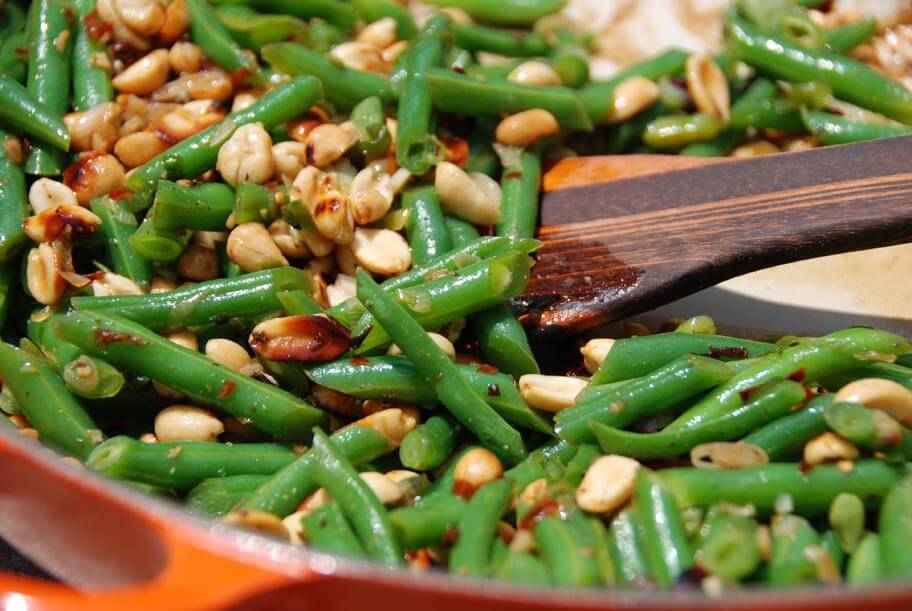
What many people don’t know is that Mexico also has its versions of Yellow rice.

From the two main kinds of Yellow rice in Mexican cooking, one has a saffron base and the other an achiote or annatto seeds base. Ironically, although saffron was brought to Mexico by the Spaniards almost five centuries ago and achiote seeds are native to Mexico, it is the saffron based rice which is considered to be the Traditional Yellow Rice in regions like Yucatán.

Yellow Rice 1
But given saffron’s high price tag, many cooks opt for achiote which is ridiculously cheap. Although it can be sometimes a bit hard to find in mainstream stores, most Latino, international or ethnic stores have it. You can always opt to click an online button to find it too…

With a similar color, and the same range of flavors, achiote seeds are a great substitute.

Yellow Rice 2
The difference aside from price, is the way in which both ingredients are used to bring out their unique flavors, aromas and colors, when making rice.

Saffron threads are soaked in water…

Yellow Rice 3
…and added to the rice after it has been sauteed in oil and the broth poured on top….

Achiote seeds, instead, are sauteed in oil for 2 to 3 minutes. Once they paint the oil and let out their flavors, they are removed with a slotted spoon before they become too bitter and right before the rice is poured in the pan. Some cooks dilute powdered achiote seeds in water, which can also be found in some stores, and do the same as with saffron. I prefer the version that uses the whole seeds much more.

Both ingredients, one from the Old World and one from the New World, have hard to describe flavors that somehow escape my words. But let me give it a shot: A bit smokey, a bit pungent, a bit bitter and strong, with a defined personality. What’s more, both ingredients help make an exotic, beautiful and tasty Yellow rice.

Here is a take on the saffron based rice that I love and that won over a great crowd. Try it, then you can tell me if it is really that good, or it may very well be that the great crowd had been waiting too long to eat during class, and that’s why they liked it so.

yellow rice
Print Recipe
3.43 from 7 votes

Yellow Rice

From the two main kinds of Yellow rice in Mexican cooking, one has a saffron base and the other an achiote or annatto seeds base. Ironically, although saffron was brought to Mexico by the Spaniards almost five centuries ago and achiote seeds are native to Mexico, it is the saffron based rice which is considered to be the Traditional Yellow Rice in regions like Yucatán.
Cook Time20 minutes
Course: Side Dish
Cuisine: Mexican
Keyword: chicken broth, garlic, onion, Recipe, rice, saffron, Tomato
Servings: 3 to 4 servings
Author: Pati Jinich

Ingredients

  • 1/2 teaspoon saffron threads crumbled, or may substitute achiote seeds
  • 2 tablespoons boiling hot water
  • 1 cup jasmine white rice
  • 2 tablespoons safflower or corn oil
  • 1/4 cup chopped white onion
  • 1/4 cup chopped tomato
  • 1 garlic clove minced or pressed
  • 2 cups chicken broth
  • 3/4 teaspoon kosher or sea salt more or less to taste

Instructions

  • Place saffron threads in a small mixing bowl along with the boiling hot water. Mix and let soak for 10 to 15 minutes.
  • Place rice in a bowl, cover with very hot water, and let soak for 5 to 10 minutes. Drain, rinse with cold water, and drain thoroughly.
  • Heat the oil in a 3 to 4 quart pan over medium-high heat. (If you are using achiote seeds instead of saffron, just let a teaspoon of them cook in the oil for 2 to 3 minutes before adding the rice.) Once the oil is hot, add the dried rice and saute for 1 to 2 minutes. Incorporate the onion, tomato, and garlic, stir, and continue to cook until the rice changes color to a milky white. It should sound and feel heavier, as if you were moving sand in the pot, about 4 to 5 more minutes.
  • Pour in the chicken broth, saffron mix, and salt and stir everything together. When the liquid starts to boil, cover the pot, lower the heat to low and continue cooking for about 20 more minutes, or until the rice is cooked through and the liquid has been mostly absorbed.
  • If the grains don't seem soft and cooked through, add a bit more chicken stock or water and let it cook for another 5 minutes or so. Turn the heat off and let it sit covered for 5 to 10 minutes. Fluff with a fork and serve.
  • Rice can be made ahead of time and reheated later the same day. Before reheating, add 1 tablespoon of water and heat, covered over the lowest heat possible. Once it has cooled down, it can be kept in a closed container in the refrigerator for up to 2 days.

Notes

Arroz Amarillo

Pollo Pibil

Last December, Daniel and I went to Yucatán. I was swept off my feet by the grandiose nature and history of the old Haciendas, but mostly by the uniqueness of the cuisine. It stands out from the rest of the country; with its aromatic, pungent, citrus flavors, charred and toasted ingredients and elements not found anywhere else.

Since at the Institute we established topics for the 2009 program in January and I left Yucatán as a December closing session, by the time class came around I was desperate to share these flavors. What a tortuous self imposed wait!

Of course Pollo Pibil had to be included, as it is one of the most loved dishes of the area. The rest of the menu was built around: Dzotobi-chay tamales, Mexican avocado soup, strained beans, a yellow rice, and old fashioned flan for dessert.

Chicken Pibil 1(One of the views inside of Hacienda San José)

Pollo Pibil is made with one of the pillars of Yucatecan cuisine, recado rojo or achiote paste,  which can now be found in many stores or online. If you walk into any market in Yucatán, you will see countless stands boasting colorful mountains of the main recados or pastes: black or chilmole, brown or de bistek, green or pepita and red or achiote.

The word Recado translates to message. In a way, each of the recados has a unique combination of ingredients, which makes a distinct bouillon of sorts, that translates a particular message of flavors into the dishes it is being used in.

They will sell you as much as you want.

Chicken Pibil 2

Or have it ready in previously measured bags.

Chicken PIbil 3

A couple of things distinguish anything cooked Pibil style:

First is the marinade. With achiote paste as a base, it has a rusty brick-like color and a pungent and sort of permanent flavor. That’s because of the achiote seeds it is made with. Then the paste is mixed with oregano, cumin, allspice, black pepper, salt and charred garlic; and diluted with bitter orange, which has a peculiar a flavor, quite different from regular oranges.

Since bitter orange can be hard to come by, many cooks have found substitutes such as a mix of orange juice and vinegar or a mix of different citrus juices. After testing for a while in my kitchen, I found the substitute I like the most to be equal parts of grapefruit, orange and lime juices and white distilled vinegar. The marinade is flavorful and aromatic and, as it has a high acidic content, it tenderizes the meat beautifully.

Chicken Pibil 4(A freshly opened bar of achiote paste, posing for my camera so you can take a look)

The second thing that distinguishes a Pibil is the cooking technique, which is what gave it its name. Traditionally, Pibil meats were marinated, wrapped in banana leaves and placed in “Pibs”- roasting pits buried underground layered with stones and pieces of wood. The “Pib” gave the dish a rustic, earthy and ashy feel while the banana leaves infused the meats with a grassy fragrant flavor and kept them moist.

Since it’s not likely that we are going to dig roasting pits on any given workday in our backyards anytime soon, many cooks have tried to find a method that can accomplish similar results.  Some wrap the chicken or meat in leaves and cook it in a steam bath in a large covered pot, while others do the same in the oven.  However, the dish becomes way too juicy and you are missing that earthy, roasted, ashy flavor.  When you cook in an earthen pit, although the chicken is wrapped, the excess moisture escapes through the pit, so the final dish is not that wet.

Here again, restless me, kept testing in the kitchen. And later then, very happy me, found a great and quick method to obtain similar results. First roast the chicken in the oven (detailed recipe below)  for that charred earthen flavor with the plus of nice browned skin and a thickening and seasoning of the marinade. Then bundle with banana leaves (if you have them) and/or aluminum foil to give it that final cooking that will make the meat come off the bones. Chicken Pibil 5

Chicken Pibil is an absolute hit paired with pickled red onions and a fiery and feisty habanero chile sauce. Yes, its spicy, but it is a welcome shock.

Print Recipe
4.29 from 7 votes

Chicken Pibil Style

Pollo Pibil is made with one of the pillars of Yucatecan cuisine, recado rojo or achiote paste,  which can now be found in many stores or online. If you walk into any market in Yucatán, you will see countless stands boasting colorful mountains of the main recados or pastes: black or chilmole, brown or de bistek, green or pepita and red or achiote.
Prep Time4 hours 10 minutes
Cook Time2 hours
Course: Main Course
Cuisine: Mexican
Keyword: achiote paste, allspice, banana leaves, bitter orange juice, chicken, chicken broth, cumin, onion, red onion, Tomatoes
Servings: 5 to 6 servings
Author: Pati Jinich

Ingredients

  • A 5 to 6 pound chicken cut in pieces
  • 2 tablespoons seasoned achiote paste or recado rojo
  • 2 cups of bitter orange juice or substitute (1/2 cup orange juice, 1/2 cup grapefruit juice, 1/2 cup lime juice and 1/2 cup white distilled vinegar)
  • 2 cups chicken broth
  • 5 garlic cloves charred, broiled or toasted and then peeled
  • 1 teaspoon oregano
  • 1/4 teaspoon ground cumin
  • 1/4 teaspoon ground allspice
  • 1/2 teaspoon kosher or sea salt or more to taste
  • 1/2 teaspoon ground black pepper
  • 1 red onion roughly chopped
  • 2 tomatoes roughly chopped
  • Banana leaves optional

Instructions

  • To make the marinade, place the achiote paste, bitter orange or its substitute, chicken broth, charred garlic cloves, oregano, cumin, allspice, salt and pepper in the blender or food processor and puree until smooth.
  • Rinse chicken pieces and pat dry. Place in a zip lock bag or container and pour the marinade on top. Make sure all the chicken pieces have been bathed in the marinade. Close or seal the bag or container and place in the refrigerator for 4 to 24 hours. Flip and move around the chicken pieces once or twice along the way.
  • Remove the chicken from the refrigerator. Preheat the oven to 450 degrees.
  • Spread the roughly chopped red onion and tomatoes on a large baking dish/pan. Place the chicken pieces on top of that layer and pour the marinade on top, making sure the pieces are not on top of each other. Place in the oven and roast for 25 to 30 minutes or until the skin has nicely browned and crisped.
  • Remove the baking dish from the oven. Flip the chicken pieces to the other side and baste with the marinade. If using banana leaves, wrap them around the chicken making a bundle. Cover the whole baking dish with aluminum foil, securing it around the edges. The less steam that is able to escape, the better.
  • Lower the oven temperature to 350 degrees. Place the baking dish back in the oven and let the chicken bake for about 1 1/2 hours. The chicken should be completely cooked through and almost coming apart from the bones. Remove the baking dish from the oven and let it rest for 10 to 15 minutes.
  • Place the chicken on a platter. You may serve whole chicken pieces or remove the meat from the bones. Ladle the remaining sauce into a bowl and either drizzle the sauce over the chicken or serve it on the side. This dish is also delicious with a side of pickled onions and habanero salsa.

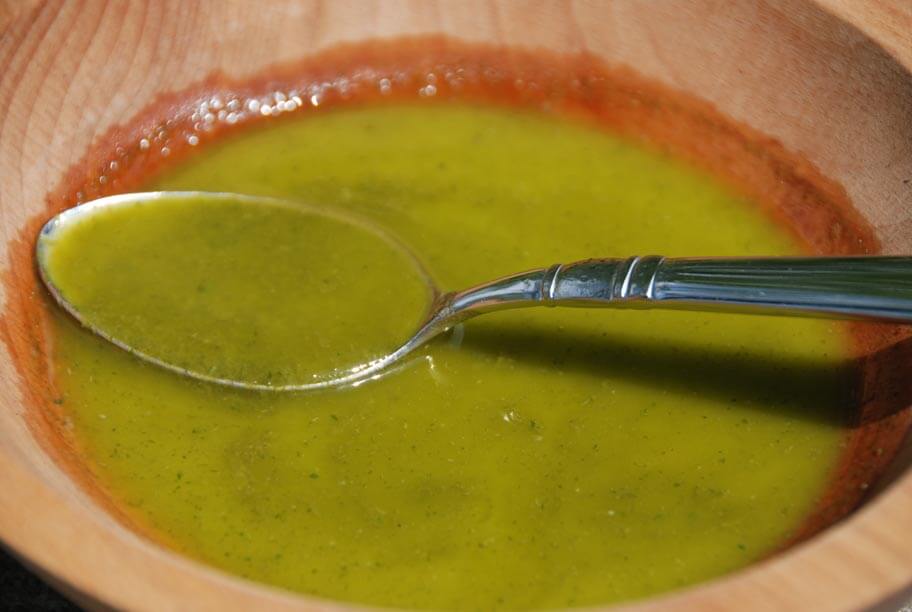
Notes

Pollo Pibil